

Venus and Mars in Marriage: Affection, Initiative and Context
Use a two-ascendant Venus–Mars comparison to separate affection, initiative, house ownership and conjunction distance in a relationship reading.
Attraction is only one part of partnership. Two people may enjoy each other's company but differ over how quickly to make decisions, how to show affection or how much independence feels comfortable. A useful Venus–Mars discussion keeps these questions separate instead of compressing them into a single label such as “chemistry.”
In the symbolic vocabulary used here, Venus introduces preferences, affection and agreement; Mars introduces initiative, assertion and action. We use those themes to organize questions. They do not measure compatibility or establish what another person feels.
Start with the same placement in two charts#
Imagine Venus and Mars together in Libra. Keep their positions fixed and change only the ascendant. These are partial fictional configurations, not two claimed client outcomes.
| Detail | Aries ascendant | Taurus ascendant |
|---|---|---|
| Libra's house | Seventh | Sixth |
| Houses Venus rules | Second and seventh | First and sixth |
| Houses Mars rules | First and eighth | Seventh and twelfth |
| Immediate structural observation | Ascendant lord joins seventh lord in the seventh | Ascendant lord joins seventh lord in the sixth |
Both configurations connect the first and seventh lords. That shared fact matters, but their meeting place changes. For Aries, the combination occupies the partnership house. For Taurus, it occupies a house associated in traditional readings with work, duties and the handling of disagreements.
The Taurus configuration is not a verdict about the quality of a marriage. It suggests a different starting question: how do two people organize the practical work of being together? A reading that predicts the same story for both configurations has skipped the house context.
Use the symbols to ask better questions#
Consider a fictional couple arranging their first shared home. One wants time to compare neighbourhoods and make the space inviting. The other wants to secure a place quickly and solve problems as they appear. It would be easy to label one indecisive and the other impatient. A more useful conversation asks which decisions need speed, which need agreement, and whether both people have a say.
That is the kind of everyday distinction the Venus–Mars vocabulary can help articulate. It is an original conversation exercise, not an outcome inferred from the illustrative placements. The people must tell us whether those descriptions fit.
Try three questions: What makes affection visible to you? How do you make a request without turning it into a demand? When you disagree about pace, what helps you reach a decision? These produce more useful information than assigning one person the role of “Venus” and the other the role of “Mars.” Both planets exist in both charts.
Same sign does not mean the same distance#
Now add degrees. Venus at 12° Libra and Mars at 14° Libra are 2° apart. Venus at 1° Libra and Mars at 28° Libra are 27° apart. Both pairs share Libra, but their angular separations are very different.
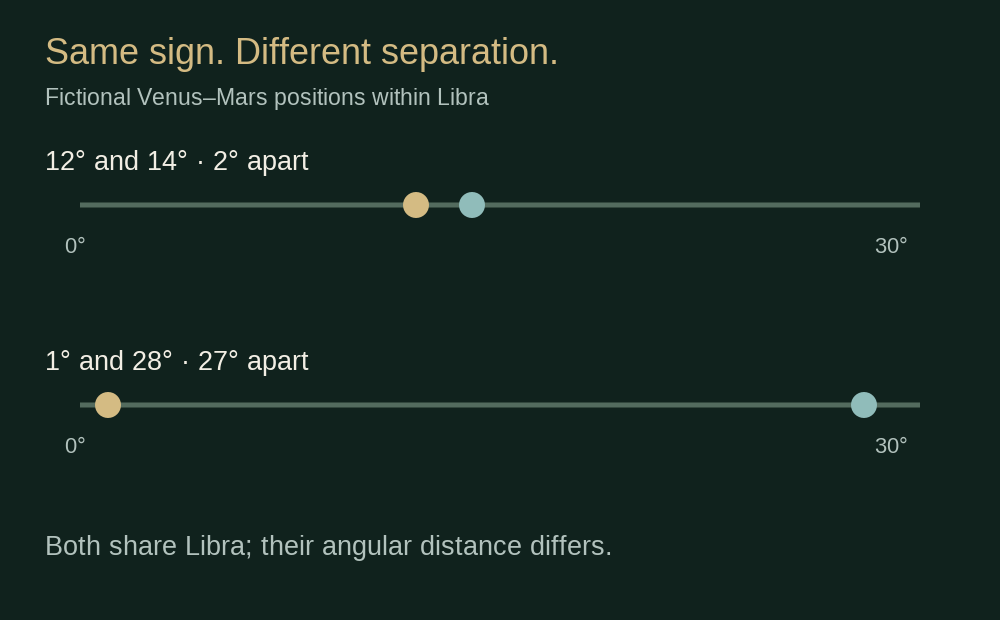
A sign-based method may record both as a same-sign association. A degree-based method needs an explicitly stated allowance for proximity. Do not switch between those definitions halfway through the reading. Also avoid interpreting a conjunction as an astronomical eclipse or treating closeness to Mars as combustion; those are different conditions.
Follow the planets through the rest of the chart#
The next step is not to add ten more adjectives. It is to record the conditions that could change the interpretation: other planets in the sign, relevant aspects, the planets' D9 placements, and which of them is involved in the running dasha.
A natal association is present throughout life. If the question is why a particular year feels different, the association alone cannot answer it. You need dated evidence. The dasha-layer guide shows how to keep that timing separate from a permanent natal configuration.
Write a balanced chart note#
A clear note might say: “In this fictional Aries configuration, Venus and Mars connect the first and seventh houses in Libra. I would explore how personal initiative and partnership agreement interact. The close-degree version adds a different geometrical detail from the wide version. Timing and lived experience have not been supplied.”
That note tells the reader what was observed, which question it raises and what remains to be examined. It leaves room for an actual person rather than inventing one from two planet names.
For more calculation context, read same-house conjunctions and degrees and natural versus functional planetary roles. The sign-ruler convention is also described in Vedic Astrology: An Integrated Approach; the scenarios here are original editorial exercises.
Related Posts
Jupiter in the Seventh House: Shared Values and Functional Lordship
Read Jupiter in the seventh without a blanket good-marriage promise, using Gemini, Virgo and Capricorn examples and explicitly counted aspects.
Mars–Mercury in Relationships: Speech, Action and Chart Context
Work through Mars–Mercury in Gemini for Gemini and Sagittarius ascendants, checking degrees, aspect directions and the difference between decisiveness and disagreement.
Mars Synastry: Initiative, Pace and Boundaries in Two Charts
Measure Mars contacts across two charts, check a cross-sign boundary example and distinguish house overlays from attraction, consent and compatibility claims.
A little more perspective.
Keep discussions respectful. No harassment, hate, sexual content or spam. Comments are reviewed before publication. Report concerns from a comment menu, or contact [email protected].
Checking your session…