
Marriage Timing Through Mahadasha, Antardasha and Pratyantar
Read the full Vimshottari hierarchy, compare planetary roles across ascendants and work through sub-period durations without inventing a wedding date.
“I am running a Venus period” can describe very different lengths of time. It might mean Venus mahadasha, a Venus antardasha inside another planet's mahadasha, or a short Venus pratyantardasha. Those are nested periods, not interchangeable labels.
For a marriage-timing question, write the complete path first. A note such as Saturn / Moon / Mars identifies three levels. It still does not explain why any of those planets would be relevant to the person's question. That requires the chart.
Separate the calendar from the interpretation#
The calendar calculation answers which period contains a date. The interpretation asks what the period lord represents in that particular chart. Calculate the first before attempting the second. A compelling interpretation assigned to the wrong antardasha is still assigned to the wrong period.
Record the start and end of each level. Use the same timezone and boundary convention throughout. If your report exposes times, do not silently reduce a handover near midnight to a date and then treat the whole date as belonging to both lords.
The Pratyantardasha calculation guide explains the subdivision in more detail. This article uses simple duration arithmetic to show why the layers should not be confused.
A duration example you can check#
Vimshottari distributes a 120-year cycle among its planetary periods. Under the standard proportional subdivision, an antardasha takes its lord's share of the parent mahadasha, and a pratyantardasha takes its lord's share of the parent antardasha.
For a full Saturn mahadasha of 19 years and a Moon allocation of 10 years:
Saturn–Moon duration = 19 × 10 ÷ 120 = 1.58333… years.
Using twelve equal months per model year, that is 19 model months. Those are not nineteen identical calendar-month lengths. If the calculation convention uses 365.25 days per year, the same antardasha lasts 578.3125 days.
Now subdivide that parent duration:
| Pratyantardasha inside Saturn–Moon | Share | Duration with the stated year convention |
|---|---|---|
| Mars | 7/120 | About 33.73 days |
| Rahu | 18/120 | About 86.75 days |
These are duration examples, not this reader's dates. To obtain calendar boundaries, the calculation also needs the actual parent start and the subdivisions that precede the selected planet. You cannot place Mars at the beginning of Moon antardasha just because Mars is the period you want to examine.
The same period names can carry different chart roles#
Consider the same Saturn / Moon / Mars path for two whole-sign ascendants:
| Planet | Virgo ascendant | Cancer ascendant |
|---|---|---|
| Saturn | Rules fifth and sixth | Rules seventh and eighth |
| Moon | Rules eleventh | Rules first |
| Mars | Rules third and eighth | Rules fifth and tenth |
For Cancer, the mahadasha lord has direct seventh-house ownership. For Virgo, it does not. This does not decide the outcome; occupants, aspects, placements and D9 still need examination. It does show why a stock interpretation of the three planet names is incomplete.
A compact worksheet should therefore give each lord its own row: houses owned, house occupied, relevant contacts, D9 position and the dates of the period. Do not replace the chart information with “benefic” or “malefic” and assume the work is finished.
What the smaller period adds#
A pratyantardasha identifies a shorter part of the antardasha. It can be examined as a timing layer, but its shorter length does not automatically make it a more accurate predictor. The same PD lord returns under different parent periods and different transits.
If an event happened during Mars once, record that observation without converting it into “Mars always brings relationships.” Compare other Mars periods, including ones in which nothing notable happened. Also examine events that occurred under other lords. Otherwise the test is designed to notice supporting examples and overlook everything else.
The same caution applies to sookshma dasha: greater calendar resolution means more boundaries to inspect, not automatically more knowledge about an event.
Partial periods at birth need their original structure#
When only part of the first mahadasha remains at birth, the nested periods must reflect where birth falls within the full cycle. Restarting every subdivision at birth or shrinking all of them to fit the remaining balance can create a plausible-looking but incorrect schedule.
For timing work, use the calculated hierarchy and investigate unexpected dates before interpreting them. This is particularly important when comparing reports from different software or different year-length conventions.
Continue to the Navamsa cross-check. The Vimshottari framework is covered in Vedic Astrology: An Integrated Approach. The duration exercise and two-ascendant comparison above are original and establish arithmetic and house roles, not the likelihood of marriage.
Related Posts
Marriage Astrology: A Study Guide to Partnership and Timing
Explore 56 marriage guides: Venus and Mars placements, seventh-house planets, combinations, Darakaraka, synastry and timing with worked examples.
Navamsa in Marriage Timing: Cross-Checking the Dasha Lords
Follow the same dasha lords from D1 into D9, calculate two Navamsa examples and see why a conjunction or uncertain ascendant needs careful interpretation.
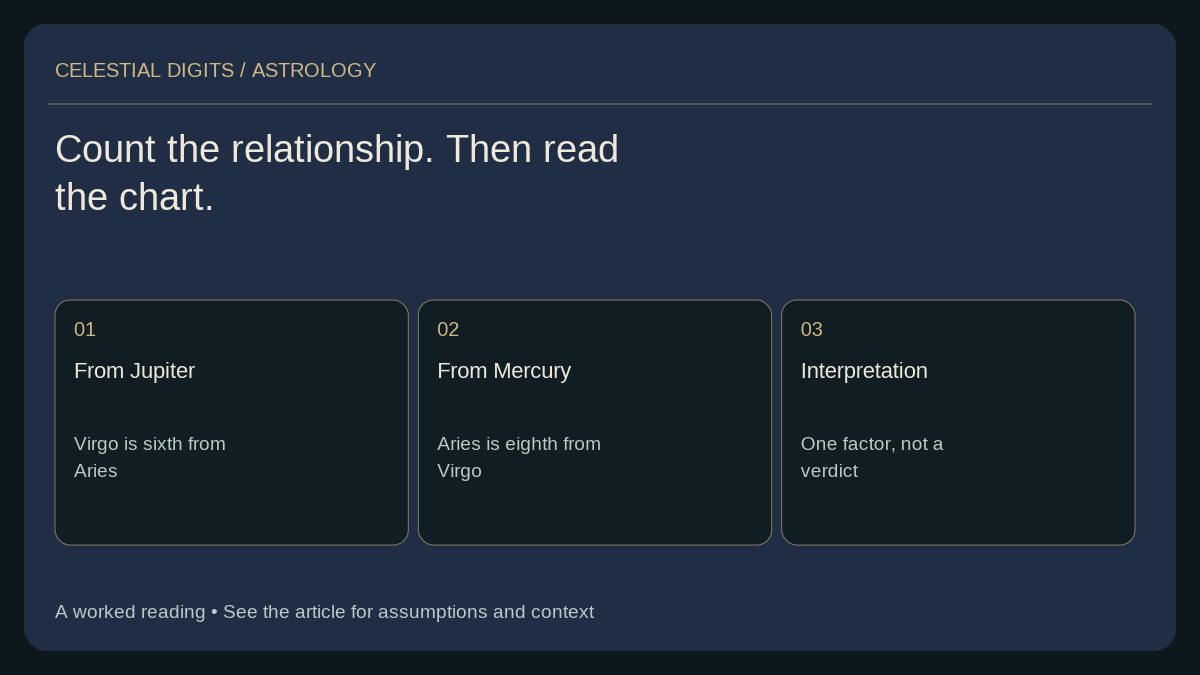
Dasha Lords in a 6/8 Relationship: What It Does—and Does Not—Tell You
Count a 6/8 relationship correctly and combine it with house ownership, dignity and actual circumstances before interpreting a dasha period.
A little more perspective.
Keep discussions respectful. No harassment, hate, sexual content or spam. Comments are reviewed before publication. Report concerns from a comment menu, or contact [email protected].
Checking your session…