
Navamsa in Marriage Timing: Cross-Checking the Dasha Lords
Follow the same dasha lords from D1 into D9, calculate two Navamsa examples and see why a conjunction or uncertain ascendant needs careful interpretation.
After identifying the running dasha lords, a reader may examine those same planets in Navamsa. The important word is same. Moving from D1 to D9 does not mean quietly replacing the original question with whichever D9 placement makes the most appealing story.
A useful cross-check records what carries over, what changes and which details depend on the reliability of the birth time. It should add information that can be named, not just a second chart labelled “confirmation.”
What is being cross-checked?#
Start with a small table for the mahadasha, antardasha and pratyantardasha lords. Record each planet's D1 sign and house, then its D9 sign and, if reliable, its D9 house. Include relevant conjunctions and the aspect convention separately.
For this article we use the standard Navamsa division of a sign into nine portions of 3°20′. The example planets and degrees are fictional. The goal is to calculate the change of chart correctly before discussing what it might mean.
Two planets can share D1 but separate in D9#
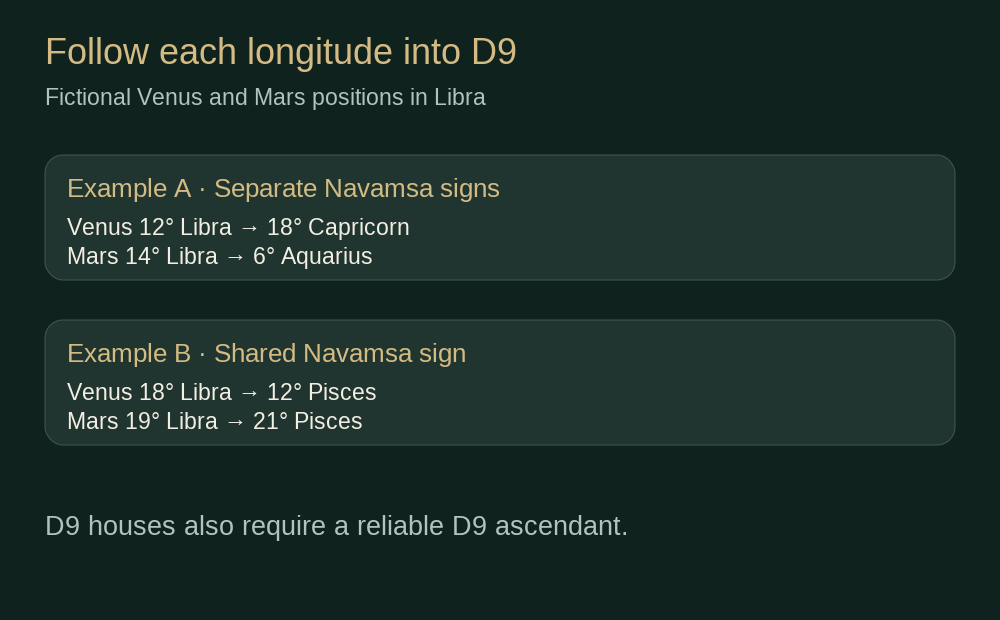
Take Venus at 12° Libra and Mars at 14° Libra. Both occupy Libra in D1. Libra is a movable sign, so its Navamsa sequence begins with Libra and continues Scorpio, Sagittarius, Capricorn, Aquarius, Pisces, Aries, Taurus and Gemini.
The fourth portion, from 10° up to 13°20′, corresponds to Capricorn. The fifth, from 13°20′ up to 16°40′, corresponds to Aquarius. Therefore:
| Planet | D1 position | D9 position |
|---|---|---|
| Venus | 12° Libra | 18° Capricorn |
| Mars | 14° Libra | 6° Aquarius |
The D9 degree is nine times the distance travelled within the relevant 3°20′ portion. Venus is 2° into its portion, giving 18°. Mars is 0°40′ into its portion, giving 6°.
Their D1 same-sign association is still a D1 fact. It has not become a same-sign D9 conjunction. A report claiming that the two planets are together “in both charts” would be making a checkable calculation error.
A second configuration gives a different result#
Now change the invented positions to Venus at 18° Libra and Mars at 19° Libra. Both fall in Libra's sixth Navamsa portion, corresponding to Pisces. Their D9 degrees become 12° Pisces and 21° Pisces respectively.
This second pair supplies a same-sign D9 association that the first pair lacks. That is an additional observation to interpret. It is not sufficient by itself to announce marriage in any period involving Venus or Mars.
House placement requires the D9 ascendant#
Suppose the D9 ascendant is Cancer. Capricorn is its seventh house, Aquarius its eighth and Pisces its ninth. Under that assumption, the first pair occupies different houses while the second pair shares the ninth.
Now suppose an uncertain birth time produces Leo as the D9 ascendant instead. The signs of those planets may remain the same over the tested time range, but Capricorn becomes the sixth, Aquarius the seventh and Pisces the eighth. The house-based interpretation has changed.
This is why a worksheet should distinguish a stable D9 sign observation from a sensitive D9 house observation. Test the plausible birth-time interval rather than choosing the ascendant that seems to explain a known event best.
Bring it back to the timeline#
If Venus and Mars are relevant dasha lords, carry their correctly calculated D9 information into the period table. Record exactly what the cross-check contributes: shared sign, changed dignity, house placement or another explicitly defined contact. Also record what it does not settle.
A D9 configuration is derived from natal positions; it is not a new ephemeris for the month in question. It does not supply a calendar date on its own. The dated dasha hierarchy and transit intervals remain separate layers.
Check one claim at a time#
Before accepting “D9 confirms marriage,” ask what was confirmed. Was the sign calculated correctly? Is the house dependable? Which planet is involved in the current period? Is the proposed interpretation a general convention or a specific author's method? A clear answer is more useful than the word “confirms.”
For the calculation method, see our Navamsa longitude workshop and the divisional-chart chapter of Vedic Astrology: An Integrated Approach. All positions, comparisons and questions in this article are original teaching examples.
Related Posts
Marriage Astrology: A Study Guide to Partnership and Timing
Explore 56 marriage guides: Venus and Mars placements, seventh-house planets, combinations, Darakaraka, synastry and timing with worked examples.
Marriage Timing Through Mahadasha, Antardasha and Pratyantar
Read the full Vimshottari hierarchy, compare planetary roles across ascendants and work through sub-period durations without inventing a wedding date.
Marriage Timing Windows: How to Read a Prediction Timeline
Build a marriage timing worksheet that separates meeting, commitment and marriage, records overlapping windows and keeps quiet periods in the comparison.
A little more perspective.
Keep discussions respectful. No harassment, hate, sexual content or spam. Comments are reviewed before publication. Report concerns from a comment menu, or contact [email protected].
Checking your session…