

Marriage Charts: The Seventh-House Occupant and Lord
Separate the seventh-house sign, its occupant and its ruler with two fictional Virgo charts, then see what changes when the ascendant changes.
Two people can both have Mars in the seventh house and still have very different charts. The shared placement is one observation. It leaves unanswered which sign Mars occupies, which houses Mars rules, where the seventh lord sits, and what else influences those planets.
The quickest way to improve a marriage reading is to stop putting all of those roles under one label. Write down the house sign, occupant and lord separately. Then connect them.
Build the chart note before the interpretation#
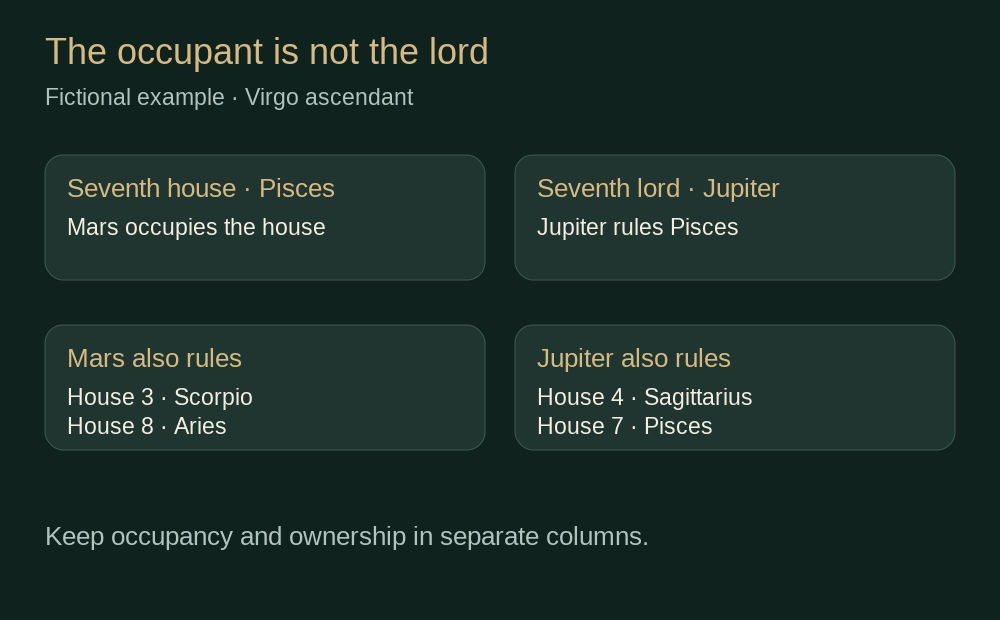
We will use whole-sign houses and the conventional seven-planet sign rulers. For Virgo rising, the signs run Virgo, Libra, Scorpio, Sagittarius, Capricorn, Aquarius, Pisces, Aries, Taurus, Gemini, Cancer and Leo. Pisces is seventh. Its ruler is Jupiter.
Now construct two fictional configurations:
| Detail | Configuration A | Configuration B |
|---|---|---|
| Ascendant | Virgo | Virgo |
| Seventh-house sign | Pisces | Pisces |
| Planet occupying the seventh | Mars | Mars |
| Seventh lord | Jupiter | Jupiter |
| Jupiter's placement | Cancer, eleventh house | Gemini, tenth house |
| Other house Jupiter owns | Fourth | Fourth |
The seventh house and its occupant are identical. The location of its lord is different. Neither row is a complete astronomical birth chart; we are deliberately changing one part of a teaching model.
What belongs to each role?#
The seventh-house sign identifies the ruler. The occupant contributes an additional planetary presence in that house. The lord's placement connects the house it rules with the house it occupies. These are different relationships within the chart, not competing answers to the same question.
In configuration A, a reader can investigate how partnership relates to friends, networks and shared aims through the eleventh house. In configuration B, the comparison shifts toward public responsibilities and work through the tenth. Those are interpretive questions prompted by the model, not predictions that one person will marry a friend and the other a colleague.
Mars adds a separate line of inquiry about initiative, pace and how disagreements are handled. Its presence does not erase Jupiter's role. Equally, Jupiter being the seventh lord does not erase the occupant. A developed reading must explain the relationship between those observations instead of selecting whichever planet supports a preferred story.
Change the ascendant and repeat#
For Taurus rising, the seventh sign is Scorpio, ruled by Mars. Put Mars there and the occupant is also the seventh lord. Mars additionally owns Aries, the twelfth house for Taurus. That is a different structure from the Virgo example, where Mars owns the third and eighth houses.
This gives a practical test for any generic “Mars in the seventh” description. Does it acknowledge the difference between a planet occupying someone else's sign and occupying its own? Does it identify the planet's house ownership? If not, the description may be a broad symbolic introduction, but it is not a full chart reading.
An empty seventh house is another variation. The sign and its ruler still exist. Removing an occupant from our Virgo diagram leaves Pisces and Jupiter in place; it does not remove the house or make the relationship question disappear.
Add detail in a useful order#
After identifying the roles, record planetary degrees, sign dignity and the aspect convention being used. Next look at the relevant D9 placements. Finally, if the question concerns a year or month, attach the actual dasha dates and transit intervals.
Do not let an impressive-looking detail outrun its purpose. A very precise longitude establishes a position. It does not by itself justify a very precise description of a future partner. Precision in the inputs and confidence in an interpretation are different things.
Try the exercise on your own chart#
Open your birth-chart report and complete one sentence: “My ascendant is ___, so the seventh sign is ___ and its lord is ___; the seventh contains ___, while its lord occupies ___.” If it is empty, write “no planets” rather than leaving the field ambiguous.
Then add one question rather than a verdict: “How might the lord's house connect partnership with this area of life?” The answer should remain a discussion until the wider chart and the person's actual circumstances have been considered.
Continue with Venus and Mars as separate interpretive roles. For the underlying chart conventions, see the houses and planetary rulership material in Vedic Astrology: An Integrated Approach. All configurations and comparisons above are our own teaching examples.
Related Posts
Jupiter in the Seventh House: Shared Values and Functional Lordship
Read Jupiter in the seventh without a blanket good-marriage promise, using Gemini, Virgo and Capricorn examples and explicitly counted aspects.
Mars–Mercury in Relationships: Speech, Action and Chart Context
Work through Mars–Mercury in Gemini for Gemini and Sagittarius ascendants, checking degrees, aspect directions and the difference between decisiveness and disagreement.
Mars Synastry: Initiative, Pace and Boundaries in Two Charts
Measure Mars contacts across two charts, check a cross-sign boundary example and distinguish house overlays from attraction, consent and compatibility claims.
A little more perspective.
Keep discussions respectful. No harassment, hate, sexual content or spam. Comments are reviewed before publication. Report concerns from a comment menu, or contact [email protected].
Checking your session…