
Jupiter and Saturn in Marriage Timing: Mapping Transit Overlaps
Trace Jupiter and Saturn to a named natal target, distinguish shared-target from separate contacts, and record the actual overlapping window.
“Jupiter and Saturn are supporting marriage” sounds specific until you ask what each planet is contacting. Are both influencing the seventh house? Is one influencing the seventh lord and the other Venus? Are the contacts even active at the same time?
A useful transit note names the moving planet, the natal target, the aspect convention and the dates. Without those details, “double transit” can become a flexible label attached to almost any period.
Fix the aspect convention first#
This workshop uses sign-based Parashari graha drishti. Jupiter has seventh, fifth and ninth aspects; Saturn has seventh, third and tenth aspects. Count the occupied sign as one when locating an aspect target. Occupying a target sign is recorded separately from aspecting it.
We are not using Jaimini sign aspects or a Western degree-based orb in this exercise. Those are different methods and should not be silently substituted. Actual degree separation can be recorded as another field, but the sign-based test described here does not use an orb.
A shared-target example#
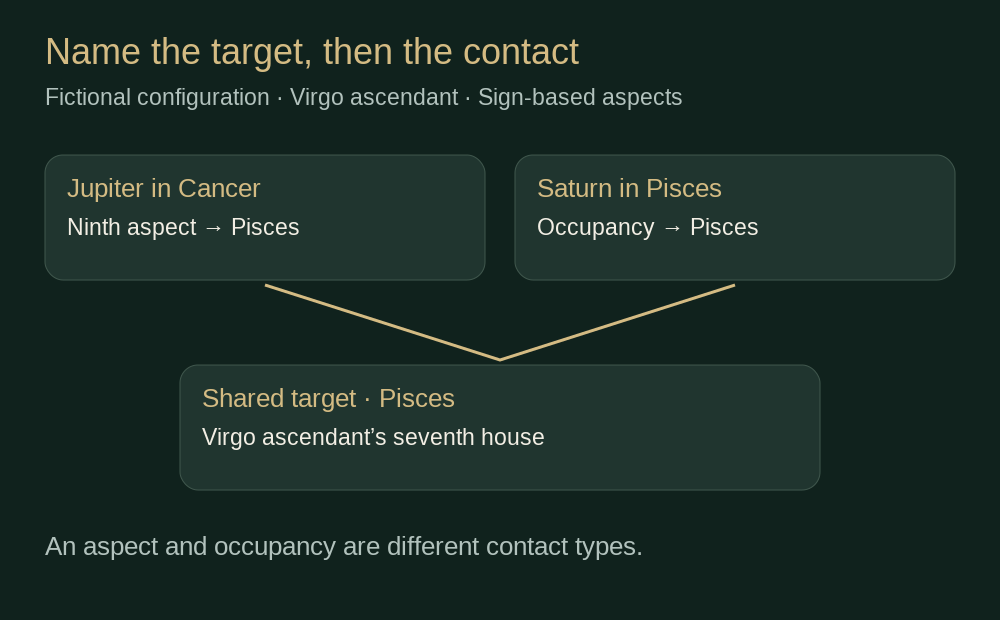
Take a fictional Virgo ascendant, whose seventh sign is Pisces. Assume, for this geometry exercise, that transiting Jupiter occupies Cancer while transiting Saturn occupies Pisces. We are not assigning these positions to a particular historical or future date.
Count from Cancer: Cancer is one, Leo two, Virgo three, Libra four, Scorpio five, Sagittarius six, Capricorn seven, Aquarius eight and Pisces nine. Jupiter therefore aspects Pisces by its ninth aspect. Saturn occupies Pisces directly.
| Moving planet | Assumed sign | Connection to natal seventh sign, Pisces |
|---|---|---|
| Jupiter | Cancer | Ninth aspect |
| Saturn | Pisces | Occupancy |
That satisfies the specific shared-target contact test used in this example: both influence Pisces under the stated convention. It establishes the geometry. Whether it supports a marriage interpretation still depends on the wider chart, the period being considered and the defined interpretive method.
Compare a different configuration#
Keep Virgo rising and Saturn in Pisces, but place Jupiter in Gemini. Jupiter's fifth, seventh and ninth aspect targets are now Libra, Sagittarius and Aquarius. Pisces is not one of them.
Suppose natal Venus is also in Gemini. Jupiter then occupies Venus's natal sign, while Saturn occupies the seventh sign. Those may both be relationship-related observations in a chosen reading, but they are different targets. They should not be described as both planets contacting the seventh house.
This distinction is valuable even when a reader's broader method accepts separate targets. The worksheet should preserve what happened rather than rewriting two different contacts into a stronger-sounding shared contact.
Turn the geometry into dated intervals#
Use a consistent sidereal setting and an ephemeris to identify when each condition begins and ends. Record retrograde exits and re-entries as separate intervals when they interrupt the condition. A sign occupied twice in one year does not necessarily create one continuous window.
For each interval, retain the exact target. “Jupiter aspects Pisces” and “Jupiter joins natal Venus's sign” should have different labels. If a moving planet changes signs, recompute its aspect targets rather than carrying the old interpretation into the new sign.
The timing-window workshop shows the overlap arithmetic using clearly fictional dates. For an actual chart, use calculated boundaries instead of those example dates.
A monthly count can hide the important difference#
Imagine two checks each register fifteen days in the same month. In one case they occur during the same fifteen days. In another, one runs in the first half and the other in the second half. The totals are equal, but the second case has no shared interval.
That is why a report should show the sequence or the intersection, not only how many days each check occurred. The duration of overlap is also not a marriage probability. It is a property of the conditions you chose to examine.
Compare the result with the dasha context#
Bring the interval alongside the running MD/AD/PD path and the D9 cross-check. Ask whether each layer contributes a distinct, relevant observation. If the same natal planet is counted under several names, avoid treating it as several independent confirmations.
Then examine similar intervals in which the defined event did not occur. Repeating contacts are normal features of planetary cycles. Their presence alone does not explain why one period coincided with a commitment and another did not.
The graha-aspect conventions are described in the aspects chapter of Vedic Astrology: An Integrated Approach. Swiss Ephemeris documents the astronomical position layer. The configurations and worksheet comparisons above are original; neither reference validates these examples as event predictions.
Related Posts
Marriage Timing Windows: How to Read a Prediction Timeline
Build a marriage timing worksheet that separates meeting, commitment and marriage, records overlapping windows and keeps quiet periods in the comparison.
What Spouse Meeting Periods Look Like in Dasha and Transit
Learn how Jyotish reads spouse-meeting periods through the 5th, 7th, 11th, Venus, dasha activation, and transit triggers without vague prediction language.
Marriage Astrology: A Study Guide to Partnership and Timing
Explore 56 marriage guides: Venus and Mars placements, seventh-house planets, combinations, Darakaraka, synastry and timing with worked examples.
A little more perspective.
Keep discussions respectful. No harassment, hate, sexual content or spam. Comments are reviewed before publication. Report concerns from a comment menu, or contact [email protected].
Checking your session…