
Moon Synastry: A Two-Chart Workshop for Relationships
Compare two Moon positions, calculate their separation and translate the comparison into questions about emotional needs without inventing a compatibility score.
Synastry compares two individual charts. It asks how their placements relate; it does not merge two people into one personality. For this workshop we will keep the scope deliberately small: two Moon positions, their actual distance, and the questions that comparison might help a couple discuss.
The Moon is often used as an emotional lens in astrology. Here that is a symbolic starting point, not a test of someone's emotional health. The useful part of the exercise is moving from a vague “our Moons match” claim to a comparison that both people can inspect.
Match the settings before matching the charts#
Use the same zodiac and ayanamsha for both charts. Record birth times and how reliable they are. If you discuss houses, identify the house system too. A sidereal Moon sign from one chart cannot be compared casually with a tropical sign label from another.
Birth-time uncertainty matters even if a house is not being used. The Moon moves during a day. A birth close to a sign or nakshatra boundary may need more care than a chart whose Moon remains well inside the same division throughout the plausible time range.
This workshop uses invented sidereal longitudes. It does not describe an actual couple and does not reproduce a full horoscope-matching system.
Three comparisons that look different on paper#
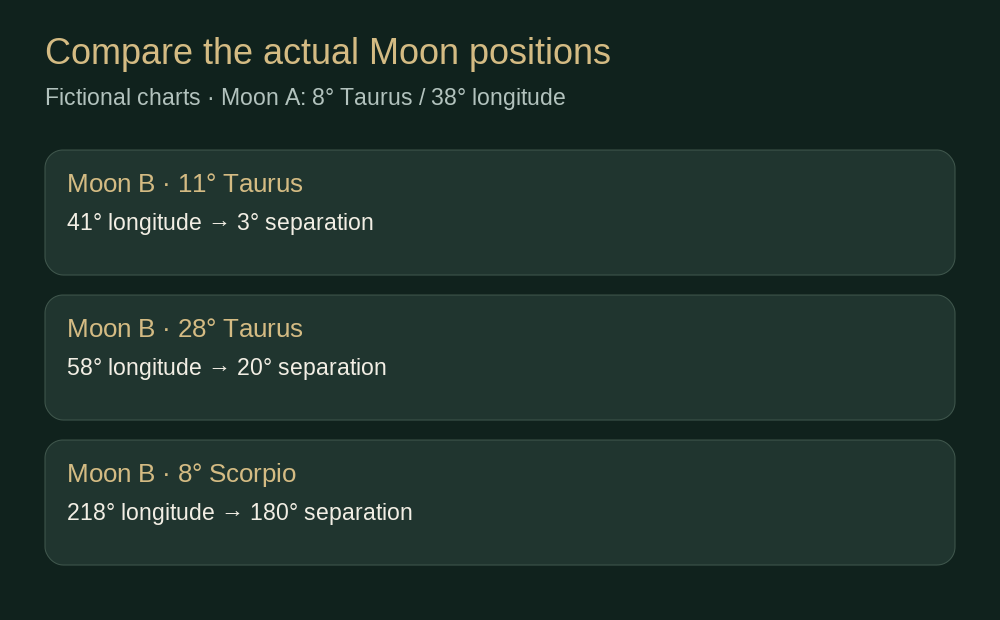
Person A's Moon is at 8° Taurus. Consider three possible Moon positions for Person B:
| Comparison | Person B | Shortest separation from A | What we can actually establish |
|---|---|---|---|
| A | 11° Taurus | 3° | Same sign and close in longitude |
| B | 28° Taurus | 20° | Same sign, considerably wider separation |
| C | 8° Scorpio | 180° | Opposite positions in the zodiac |
Taurus begins at zodiac longitude 30°, so A is at 38°. The first B is at 41°; subtracting gives 3°. The second B is at 58°, giving 20°. Scorpio begins at 210°, so the third B is at 218°: the difference is 180°.
For any pair, calculate the absolute longitude difference and use the smaller of that number and 360° minus it. This avoids accidentally calling a pair 358° apart when its shortest separation is 2°.
Turn a comparison into a conversation#
For the close pair, a reader might explore whether the two people recognize similar emotional rhythms. Ask for examples: do they both prefer to discuss a problem immediately, or does one need a pause? Do similar preferences produce comfort, or do they sometimes leave the same practical need unattended?
For the wider same-sign pair, resist copying the close pair's interpretation unchanged. A shared sign label is a broad classification. Their other placements, habits and experiences may differ substantially. “We have the same Moon sign” is the start of a question, not its answer.
For the opposite pair, explore how each person responds when the other needs reassurance. Opposite positions do not establish incompatibility. Nor do they establish a perfect balance. Either story would require information beyond the angle. A helpful exercise is for each person to name one supportive response they appreciate and one response they tend to misunderstand.
These questions are our own reflective exercises. They should not be mistaken for established psychological effects of the example coordinates.
Read the comparison in both directions#
Suppose one person enjoys daily messages while the other prefers longer conversations twice a week. Neither frequency alone measures care. Ask what each pattern means to the person using it, then agree on a rhythm both can sustain.
In chart work, the same principle encourages reading both natal contexts rather than treating Person A's chart as the standard and Person B as the modifier. If you later add house overlays, keep two separate notes: where B's Moon falls in A's houses, and where A's Moon falls in B's houses. Those placements need not be identical.
Keep synastry separate from Guna Milan#
This longitude exercise does not calculate the 36-point matching score. Guna Milan uses its own defined factors and conventions. A same-sign comparison cannot stand in for that calculation, and a Guna score cannot summarize every two-person chart interaction.
Use our Kundali matching guide for that separate framework. For personal relationship decisions, actual communication, consent and shared expectations remain information the charts cannot supply on someone's behalf.
A reusable comparison note#
Record the two positions, settings, separation and any birth-time uncertainty first. Then write one question to discuss, not a verdict to deliver. After the conversation, record what each person actually said. If the symbolic description did not fit, keep that result rather than expanding the description until it becomes impossible to disagree with.
Our chart-reading series explains the broader method. For astronomical position calculations, see Swiss Ephemeris. It supplies positions, not evidence that the reflective interpretations above predict relationship outcomes.
Related Posts
Jupiter in the Seventh House: Shared Values and Functional Lordship
Read Jupiter in the seventh without a blanket good-marriage promise, using Gemini, Virgo and Capricorn examples and explicitly counted aspects.
Mars–Mercury in Relationships: Speech, Action and Chart Context
Work through Mars–Mercury in Gemini for Gemini and Sagittarius ascendants, checking degrees, aspect directions and the difference between decisiveness and disagreement.
Mars Synastry: Initiative, Pace and Boundaries in Two Charts
Measure Mars contacts across two charts, check a cross-sign boundary example and distinguish house overlays from attraction, consent and compatibility claims.
A little more perspective.
Keep discussions respectful. No harassment, hate, sexual content or spam. Comments are reviewed before publication. Report concerns from a comment menu, or contact [email protected].
Checking your session…