

Marriage Timing Windows: How to Read a Prediction Timeline
Build a marriage timing worksheet that separates meeting, commitment and marriage, records overlapping windows and keeps quiet periods in the comparison.
A prediction such as “marriage is possible next year” leaves several practical questions unanswered. Is the reader discussing meeting someone, making a commitment or registering a marriage? Does the proposed window last twelve months, or is there a narrower overlap inside it? What would count as a miss?
A timing worksheet makes those questions explicit. Its purpose is to preserve the reasoning behind a window, including what was uncertain when it was proposed. It does not turn an interpretive method into a guarantee.
Name the event before finding the period#
Meeting a person, starting a relationship, becoming engaged and getting married can happen months or years apart. Choose the event you want to examine and keep that definition unchanged. If the question is about marriage, a new friendship should not later be counted as a successful marriage prediction.
For an existing couple, the question might concern formalizing a relationship. For someone who is single, there may be several steps between a promising meeting and a wedding. Those circumstances affect what a proposed window could mean; they cannot be supplied by a planet's name alone.
Write the event question at the top of the worksheet. Add the birth-data confidence, chart settings and period being examined. A five-minute uncertainty in birth time deserves attention before a detailed D9-house interpretation is used to narrow a date.
Keep four kinds of information separate#
| Layer | Record | Avoid substituting |
|---|---|---|
| Natal context | The identified relationship-related factors and their conditions | A general sign description |
| Dasha | The complete MD/AD/PD path and exact boundaries | A planet name without its parent period |
| D9 | The relevant planets' Navamsa placements and reliable house information | A claim that D9 starts on a particular birthday |
| Transit | Dated movement relative to a named natal target | A monthly total of loosely related contacts |
The separation matters because these observations are not independent votes. A transit to Jupiter and a transit to “the seventh lord” may be the same contact if Jupiter is that chart's seventh lord. Counting both as two confirmations inflates the evidence.
Work through an overlap exercise#
The following dates are invented intervals for a calendar exercise, not calculated transits, dasha dates or a forecast for any person. Assume that three previously defined checks are active over these intervals:
| Check | Start, included | End, excluded |
|---|---|---|
| A | 1 June | 1 September |
| B | 1 July | 1 October |
| C | 15 July | 10 August |
The common interval begins at the latest start, 15 July, and ends at the earliest end, 10 August. It includes 15 July and stops immediately before 10 August. Using a consistent end-exclusive convention prevents the boundary day being counted twice when one interval hands over to the next.
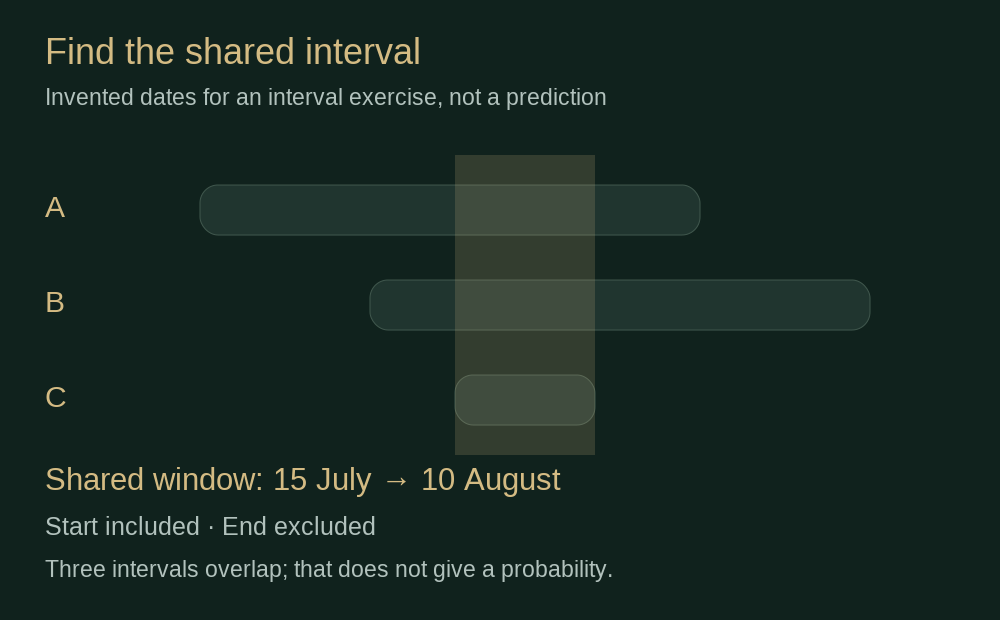
If check C does not actually connect with the chosen event, its short duration gives no reason to prefer it. Narrower is not automatically better. First justify the relevance of each check; only then intersect its dates.
Write the interpretation beside the evidence#
A useful entry might read: “The selected checks overlap in this interval. The dasha interpretation supplies the longer context, and the transit check identifies a shorter period to examine. The D9 house reading remains uncertain because the birth time is estimated.”
That wording preserves a real limitation instead of hiding it inside an overall confidence score. It also allows a second reader to disagree with a particular link in the reasoning. An unexplained “87% chance” would make the conclusion look more measured without adding evidence.
Check the rest of the year too#
If you study only the month in which an event occurred, a broad rule will often seem more specific than it is. Examine other periods where the same checks were present. Record whether those periods were confirmed quiet, contained a different event, or simply have no reliable account.
Keep “unknown” separate from “nothing happened.” A forgotten month cannot fairly prove or disprove a timing rule. Similarly, a retrospective interpretation written after knowing the outcome is not the same kind of test as a window recorded in advance.
Follow the timing sequence#
Start with mahadasha, antardasha and pratyantar, then examine the D9 cross-check, and finally map Jupiter–Saturn transit overlaps. Each guide supplies a distinct part of the worksheet.
The background vocabulary comes from established Jyotish practice; Vedic Astrology: An Integrated Approach is a public reference for studying its chart and timing systems. The worksheet, interval exercise and evaluation approach here are Celestial Digits' own educational framework, not a claim that one prescribed combination has been validated.
Related Posts

Jupiter and Saturn in Marriage Timing: Mapping Transit Overlaps
Trace Jupiter and Saturn to a named natal target, distinguish shared-target from separate contacts, and record the actual overlapping window.
What Spouse Meeting Periods Look Like in Dasha and Transit
Learn how Jyotish reads spouse-meeting periods through the 5th, 7th, 11th, Venus, dasha activation, and transit triggers without vague prediction language.
Navamsa in Marriage Timing: Cross-Checking the Dasha Lords
Follow the same dasha lords from D1 into D9, calculate two Navamsa examples and see why a conjunction or uncertain ascendant needs careful interpretation.
A little more perspective.
Keep discussions respectful. No harassment, hate, sexual content or spam. Comments are reviewed before publication. Report concerns from a comment menu, or contact [email protected].
Checking your session…