
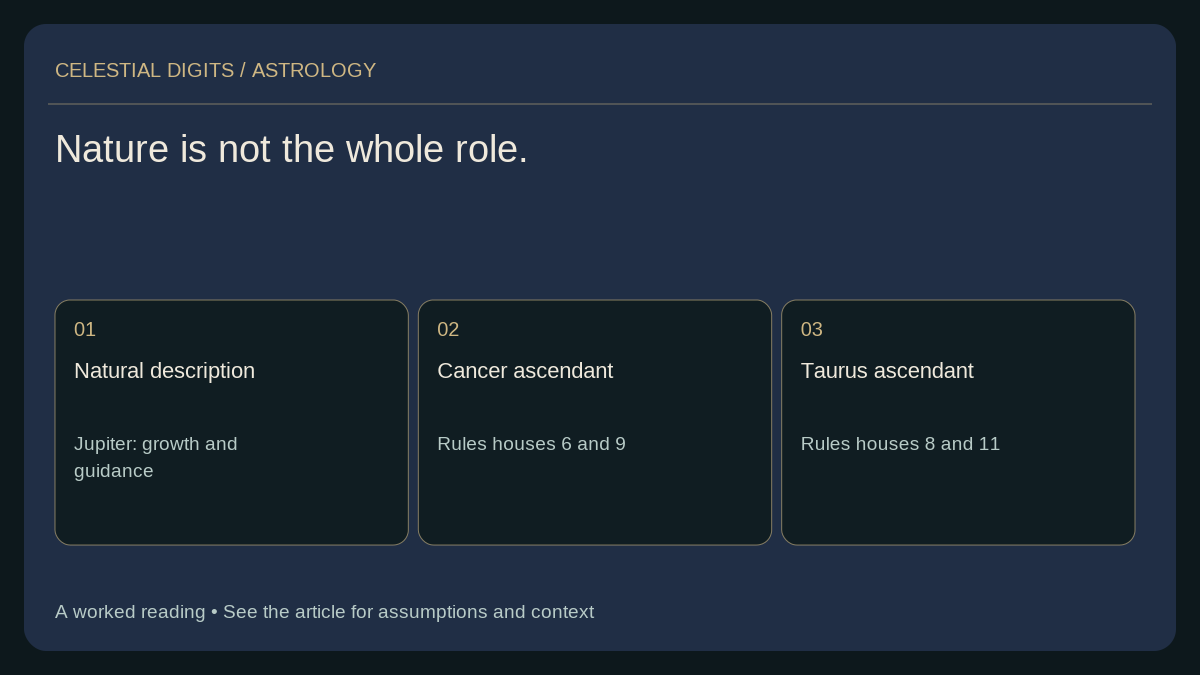
Natural vs Functional Benefic: Why a Good Planet Can Give Mixed Results
Compare a planet’s natural symbolism with its house ownership, using Jupiter for Cancer and Taurus ascendants.
“Jupiter is benefic, so its period must be easy” skips the ascendant. In Vedic interpretation, a planet's natural classification and its functional role are separate layers. One describes a broad planetary nature; the other follows the houses it owns in the particular chart.
A reading can therefore discuss a naturally benefic planet carrying difficult responsibilities without contradicting itself. The problem is usually the unexplained word “good.”
Two different questions#
Natural classification groups planets by their traditional manner of expression. Jupiter and Venus are commonly described as natural benefics. Saturn and Mars are commonly described as natural malefics. The Moon's phase and Mercury's associations require additional qualification in many classical treatments.
Functional analysis starts elsewhere: identify the ascendant, assign signs to houses and see which houses each planet rules. That information changes when the ascendant changes, even though the zodiac signs owned by a planet do not.
Follow Jupiter across two ascendants#
Jupiter owns Sagittarius and Pisces. In a whole-sign chart, count from the ascendant to locate those signs.
| Ascendant | Sagittarius | Pisces | What must remain in the reading |
|---|---|---|---|
| Cancer | Sixth house | Ninth house | Both responsibility and ninth-house themes |
| Taurus | Eighth house | Eleventh house | Change, shared resources, gains and networks |
For Cancer ascendant, Jupiter's ninth-house ownership is important, but the sixth-house ownership should not be erased. For Taurus ascendant, calling Jupiter naturally benefic does not remove its eighth- and eleventh-house roles.
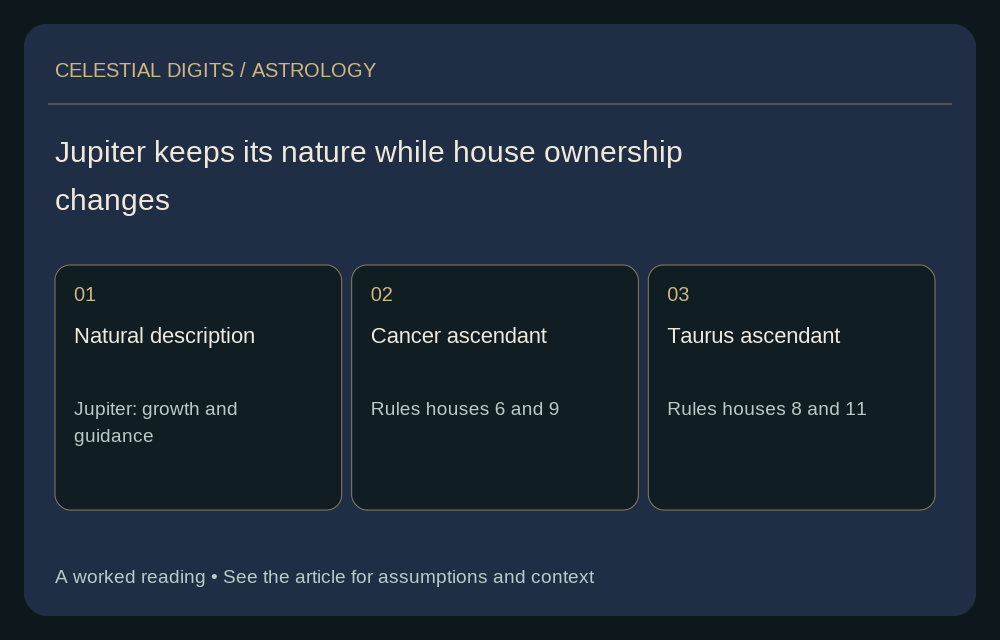
These are ownership maps, not forecasts. We have not placed Jupiter in a sign or house, checked its condition or selected a current dasha.
Turn the distinction into a better interpretation#
Imagine a hypothetical Jupiter period involving a demanding professional course. It could increase knowledge while adding debt, competition or workload. Growth and inconvenience can describe the same undertaking. A one-word benefic label would struggle to capture that combination.
For a different chart, Jupiter-related themes could appear through shared finances or an expanding professional network. The ownership map tells the reader which areas to investigate; it does not guarantee an inheritance, salary increase or relationship event.
A functional label should therefore lead into an explanation, not end one. Ask: which owned house connects with the house of placement, and what other factors support the proposed result?
Avoid the reverse mistake#
A natural malefic is not automatically useless or destructive. Saturn can own both a kendra and a trikona for certain ascendants. Mars can hold constructive functional roles too. Discipline, competition and boundaries can be relevant to desirable achievements as well as difficult experiences.
Nor does calling a planet functionally challenging mean every activity connected with it should be avoided. That would turn a chart classification into an impractical rule for daily life.
A four-line reading worksheet#
Record the planet's natural classification with any qualification. List both houses it owns. Add the house and sign where it is placed. Only then write a tentative interpretation connected to a specific question and timing context.
If any of those lines is missing, a sweeping claim about the whole mahadasha is premature. A report should also state which interpretive school it follows when classifications differ.
The distinction between natural qualities, house lordship and yoga-producing relationships appears across Brihat Parashara Hora Shastra, particularly its planetary and yoga discussions. For a complete ownership comparison, see Jupiter's roles for all twelve ascendants, then our guide to combining dasha and transit.
Related Posts
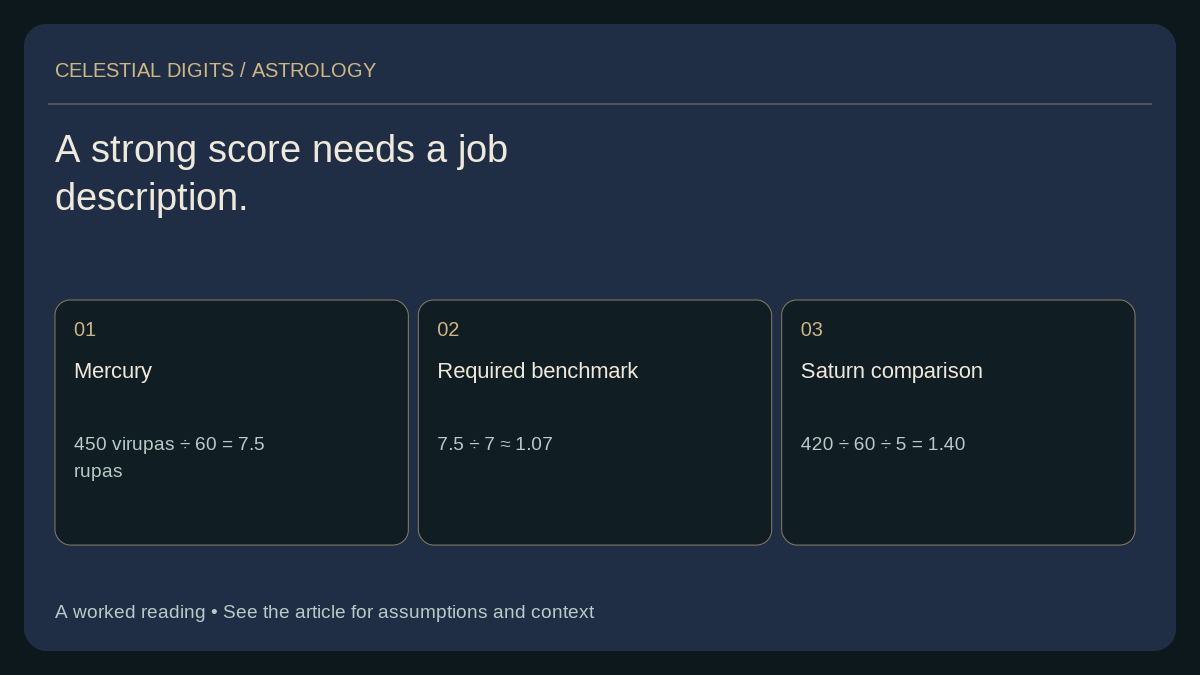
High Shadbala, Difficult Results: Strength to Do What?
Compare Shadbala totals and required ratios, then connect planetary capacity with house ownership and the actual question.
Jupiter in the Seventh House: Shared Values and Functional Lordship
Read Jupiter in the seventh without a blanket good-marriage promise, using Gemini, Virgo and Capricorn examples and explicitly counted aspects.
Mars–Mercury in Relationships: Speech, Action and Chart Context
Work through Mars–Mercury in Gemini for Gemini and Sagittarius ascendants, checking degrees, aspect directions and the difference between decisiveness and disagreement.
A little more perspective.
Keep discussions respectful. No harassment, hate, sexual content or spam. Comments are reviewed before publication. Report concerns from a comment menu, or contact [email protected].
Checking your session…