
Darakaraka’s Nakshatra and Dispositor: A Complete Worked Example
Identify Mercury as Darakaraka from an explicit seven-planet table, then trace its Taurus sign, Krittika nakshatra, pada and D9 without mixing roles.
Identifying Darakaraka is the start of a reading, not the entire reading. The planet has a sign, a house, a sign ruler and a nakshatra like every other planet. Those details should remain visible instead of being replaced by a single spouse label.
This workshop uses a seven-karaka convention: Sun, Moon, Mars, Mercury, Jupiter, Venus and Saturn. Rahu and Ketu are excluded from the ranking. Eight-karaka approaches exist, so record the convention before comparing results between apps or astrologers.
Rank degrees within signs#
Use the following fictional positions. They are a calculation exercise, not a reconstructed chart for a real person or date.
| Planet | Assigned position | Degree within sign |
|---|---|---|
| Sun | 10° Taurus | 10° |
| Moon | 18° Cancer | 18° |
| Mars | 25° Leo | 25° |
| Mercury | 4° Taurus | 4° |
| Jupiter | 12° Libra | 12° |
| Venus | 8° Gemini | 8° |
| Saturn | 21° Aquarius | 21° |
Mercury has the lowest within-sign degree and is Darakaraka in this convention. Its absolute longitude is 34°, but absolute longitude is not the value being ranked. Neither retrograde motion nor a move to D9 changes the original D1 ranking in the method used here.
If two planets appear tied after rounding, return to minutes and seconds before deciding. Do not resolve a tie by choosing the planet whose symbolism seems more suitable for the person.
Give each ruler its own label#
Mercury at 4° Taurus occupies Venus's sign. In the standard nakshatra sequence, it lies in Krittika, whose planetary lord is the Sun. Krittika runs from 26°40′ Aries to 10° Taurus; its second pada runs from 0° to 3°20′ Taurus and its third from 3°20′ to 6°40′ Taurus. Our Mercury is therefore in pada 3.
| Field | Value |
|---|---|
| Darakaraka | Mercury |
| Sign | Taurus |
| Sign dispositor | Venus |
| Nakshatra | Krittika |
| Nakshatra lord | Sun |
| Pada | 3 |
Venus and the Sun are contextual rulers. They do not replace Mercury as Darakaraka, and neither is automatically the seventh lord. That requires the ascendant, which has not yet been specified.
Follow the dispositor chain#
Mercury occupies Venus's sign, and our example places Venus in Gemini, Mercury's sign. This makes a Mercury–Venus sign exchange. The chain loops between those two planets rather than ending with the Sun.
The Sun enters through the nakshatra layer, not through sign dispositorship. Mixing those two chains would make it unclear which method produced the interpretation. Record them separately, especially when deciding which dasha connections you intend to test.
This example also shows why a Darakaraka reading cannot be reduced to “Mercury means a communicative spouse.” The surrounding chart structure needs to be examined before any such description is elaborated.
Carry the same Mercury into D9#
Mercury's absolute longitude is 34°. Multiplying by nine gives 306°, or 6° Aquarius in the standard Navamsa mapping. Mercury remains the D1-selected Darakaraka; we are now examining that planet in a different division.
Aquarius's conventional sign ruler is Saturn. Thus the D1 sign dispositor is Venus and the D9 sign dispositor is Saturn. Both statements can be correct because they refer to different charts. We still cannot specify Mercury's D9 house without a D9 ascendant.
A common error is to recalculate Darakaraka by ranking the displayed D9 degrees. That produces a different procedure from the one described here and should not be silently substituted.
What can the finished note say?#
A complete factual note reads: “Using seven karakas, Mercury is DK at 4° Taurus. Its D1 dispositor is Venus, its nakshatra lord is the Sun, and it occupies Krittika pada 3. Mercury maps to 6° Aquarius in D9, with Saturn as sign dispositor.”
That is a reproducible foundation. Partnership themes can be discussed afterward, but the arithmetic itself does not reveal a spouse's identity, thoughts or a date of marriage. A planet appearing in several linked fields also should not be counted repeatedly as independent proof.
Method and further reading#
For the broader method, start with identifying Darakaraka and Darakaraka in D9. The general terminology is covered in Vedic Astrology: An Integrated Approach; the particular ranking table and calculations here are original. Keep this worksheet beside the seventh-lord nakshatra example to see why DK and seventh lord are different starting points.
Related Posts
Seventh Lord’s Nakshatra: Sign Lord, Star Lord and Pada Explained
Locate the seventh lord’s nakshatra with a 29° Virgo Venus example, separating Mercury, Mars, Chitra pada 2 and the correct D9 placement.
Arudha Lagna, Upapada and Darapada: Worked Examples and Common Mix-ups
Learn how AL, UL and A7 use different houses, follow an inclusive-counting example, and see the exception convention used in our Jaimini calculations.
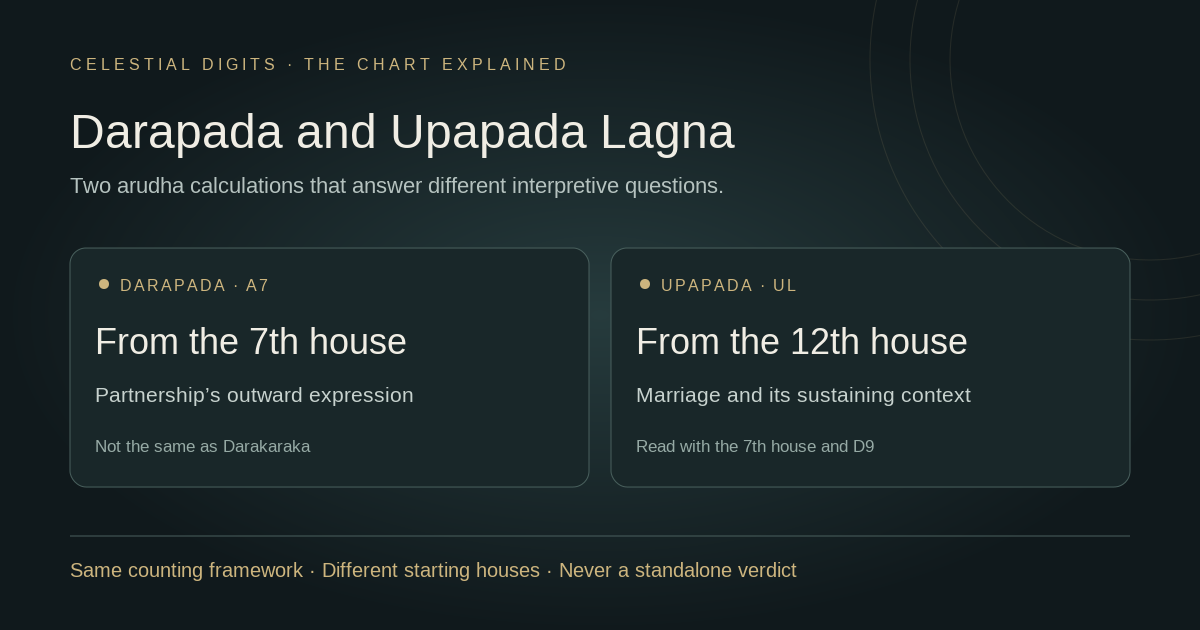
Darapada (A7) vs Upapada Lagna (UL): Relationship Indicators Explained
Understand Darapada, Upapada Lagna, the seventh house and Darakaraka with a worked arudha calculation and clear limits on relationship predictions.
A little more perspective.
Keep discussions respectful. No harassment, hate, sexual content or spam. Comments are reviewed before publication. Report concerns from a comment menu, or contact [email protected].
Checking your session…