
Same House, Different Degrees: How Close Is a Planetary Conjunction?
Compare same-sign conjunctions with actual degree gaps. Work through a three-planet cluster, cross-sign proximity and applying versus separating motion.
Two planets appear in the same diamond on a North Indian chart. Are they tightly conjunct? The drawing cannot answer that by itself. One planet could be at 2° of the sign and the other at 28°—a 26° gap inside the same sign.
In many Jyotish readings, sharing a sign is enough to describe a conjunction or association at the sign level. Degree proximity is a further distinction. Confusion starts when “together in a sign” becomes “almost at the same longitude” without checking the numbers.
First identify what the chart box represents#
In the whole-sign D1 examples below, each house corresponds to a complete sign. In a bhava chart, house boundaries need not match sign boundaries. Two planets sharing a bhava therefore do not necessarily share a sign, and two planets sharing a sign may be assigned to different bhavas under another house convention.
Keep the original sign longitudes visible while discussing house placement. Moving a planet between displayed bhava boxes does not alter its astronomical longitude. Our birth-chart reference guide explains why the reference system belongs beside every label.
Start with a pairwise distance table#
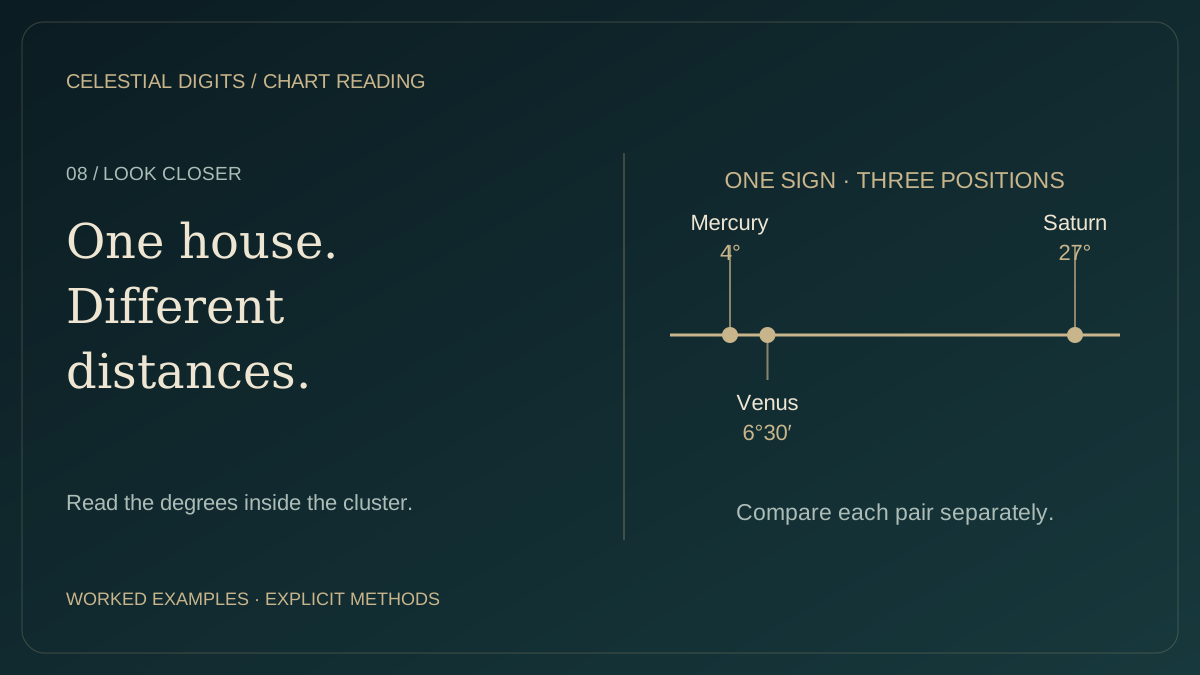
Take an invented cluster in Gemini:
| Planet | Position within Gemini | Absolute longitude |
|---|---|---|
| Mercury | 4°00′ | 64°00′ |
| Venus | 6°30′ | 66°30′ |
| Saturn | 27°00′ | 87°00′ |
All three share a sign. Their shortest longitude separations are:
| Pair | Gap |
|---|---|
| Mercury–Venus | 2°30′ |
| Venus–Saturn | 20°30′ |
| Mercury–Saturn | 23°00′ |
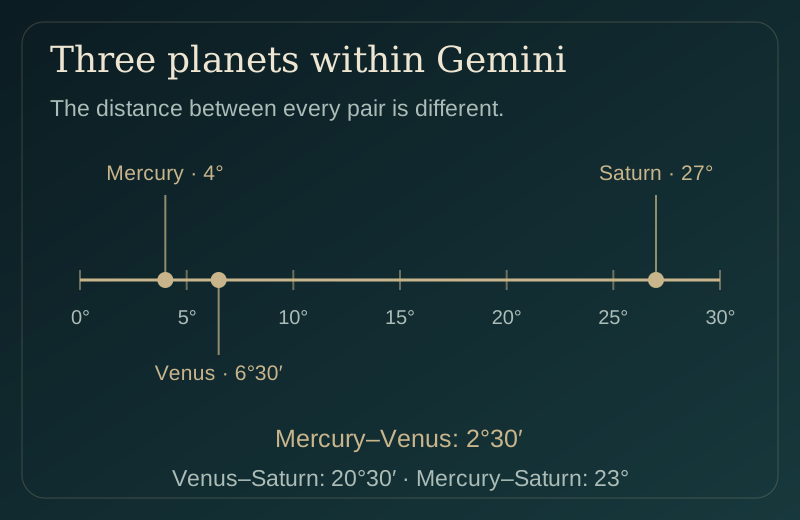
That is already more informative than “a powerful three-planet conjunction.” It identifies which pair is close without inventing a universal cutoff for the whole cluster.
Does a wide gap cancel the association?#
Not automatically. A sign-based technique may still consider all three planets associated. A degree-based technique may emphasize Mercury–Venus more strongly. State which level you are reading rather than insisting one definition invalidates the other.
There is no single orb that can be applied indiscriminately to every Jyotish conjunction, yoga, combustion rule and aspect calculation. A chosen 3° or 10° emphasis is a methodological choice unless the specific technique supplies that threshold. “Tighter” is a geometric comparison; “better” or “more damaging” is an interpretation requiring more information.
The longitude gap also is not the full angular distance between two bodies in the sky. Celestial latitude matters to that separate astronomical question. Do not present a flat zodiac ruler as a photograph of the sky.
Add house ownership: a Virgo-rising worksheet#
Now give the Gemini example a Virgo ascendant. Gemini becomes the tenth house.
- Mercury rules the first and tenth houses and occupies its own sign in the tenth.
- Venus rules the second and ninth houses and occupies the tenth.
- Saturn rules the fifth and sixth houses and occupies the tenth.
A traditional reading could explore professional work alongside resources, learning, creative responsibilities and everyday duties. The close Mercury–Venus pair gives one relationship to investigate within that larger house framework. Saturn still carries its own lordships into the shared house despite its wider gap.
We have not supplied the Sun. Therefore we cannot say whether Mercury or Venus is combust. We have not supplied the full chart or dasha dates either. The responsible next step is to obtain those inputs, not invent a career title from this fragment.
Different signs can still be close#
Consider Mars at 29°50′ Cancer and Jupiter at 0°20′ Leo. Their absolute longitudes are 119°50′ and 120°20′: only 30 arcminutes, or half a degree, apart.
They do not share a sign. In a whole-sign chart they occupy adjacent houses. A method requiring same-sign conjunction should not silently count this as one; a proximity analysis should not silently treat them as widely separated.
The accurate description is “close in longitude, across a sign boundary.” Whether a particular interpretation uses that relationship depends on its rules.
Applying or separating needs motion, not just order#
Imagine body A at 10° with a daily longitude change of +1°, and body B at 12° changing by +0.2°. Over a short interval, their two-degree gap is narrowing at approximately 0.8° per day. Reverse the speeds and the gap widens.
These are invented numbers to demonstrate relative motion. They show why the lower-degree planet is not automatically approaching the higher-degree planet. Retrograde motion and stations make actual ephemeris checks particularly useful. A date obtained by dividing the current gap by today's relative speed is only an estimate; speeds can change before exact conjunction.
Combustion and planetary war need their own checks#
Combustion concerns the Sun's relationship with another body. Its rules are not interchangeable with the gap used to emphasize an ordinary conjunction; see the Sun-distance examples.
Graha yuddha, or planetary war, is another specific technique. A very close pair among Mars, Mercury, Jupiter, Venus and Saturn can prompt that check. Traditions differ over criteria and how a winner is determined. A screenshot showing a one-degree gap does not, by itself, justify announcing a winner from longitude order alone. Record the convention and any additional inputs it requires.
A better way to describe a conjunction#
In your birth-chart report, start with: “Mercury and Venus share Gemini in D1 and are 2°30′ apart; for Virgo rising this is the tenth house.”
Then add lordships, relevant conditions and dated periods. This keeps the calculation reproducible while making the interpretation open to discussion. The pairwise table and examples here are original teaching exercises; they do not establish a causal link between planetary geometry and personal outcomes.
Related Posts
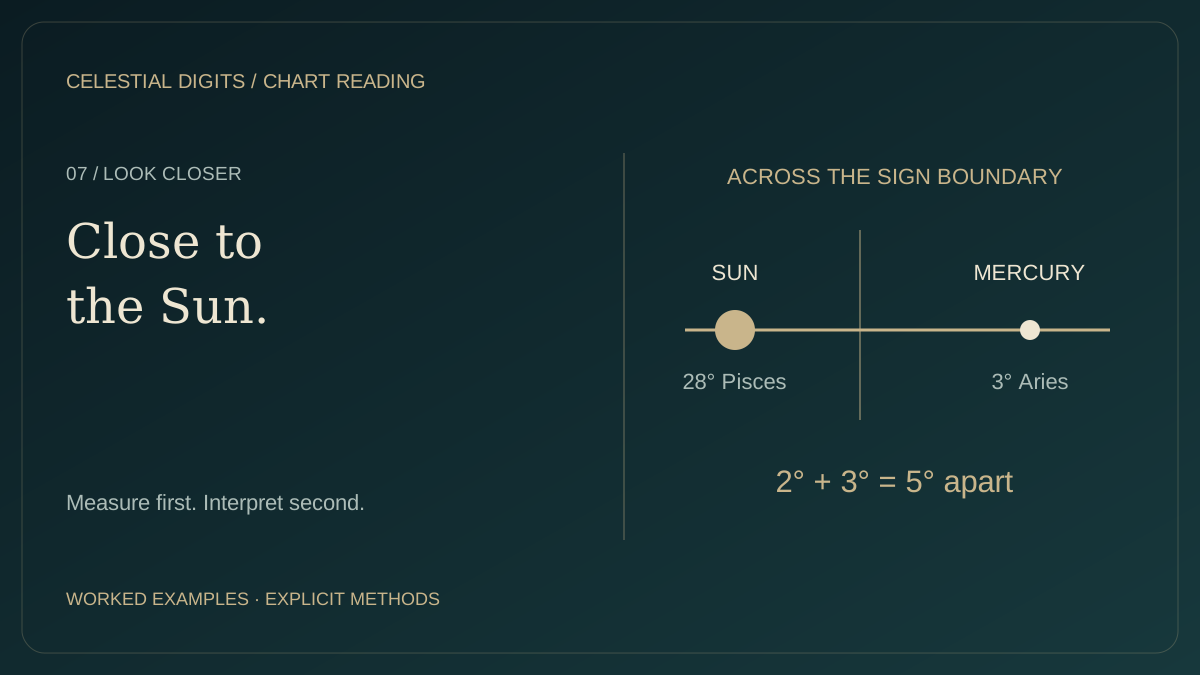
Combust Planets: Does Being Close to the Sun Always Mean Weakness?
Measure a planet's distance from the Sun with worked examples. Understand combustion, sign boundaries, retrograde motion and differing software rules.
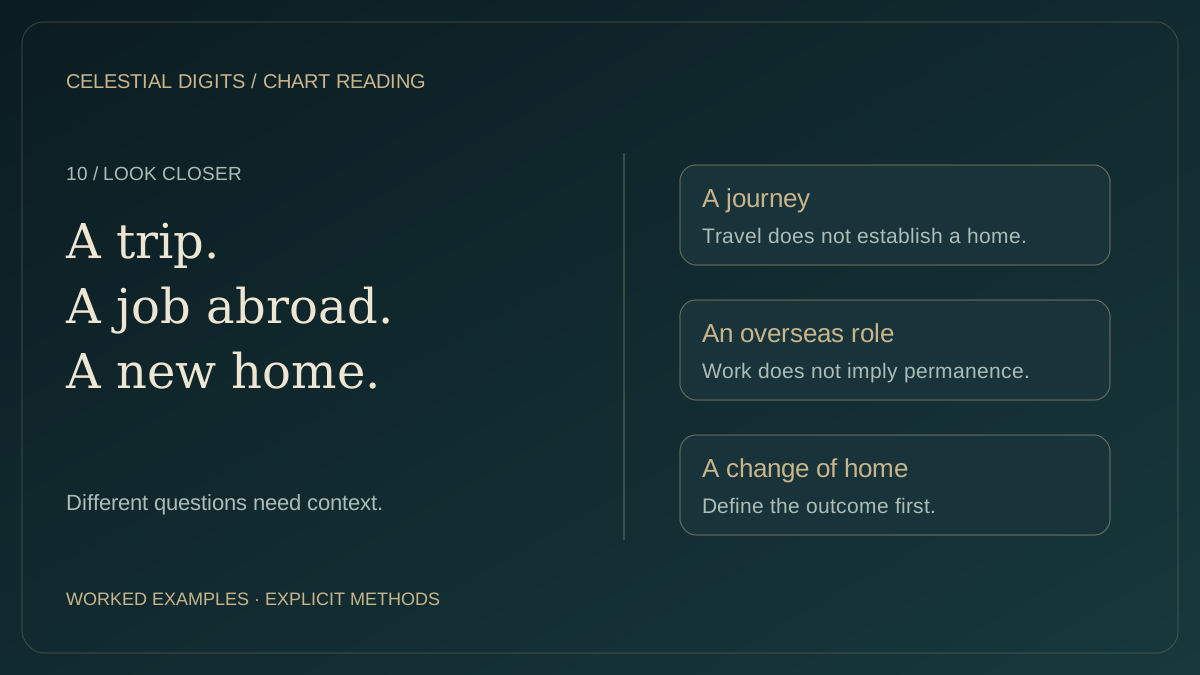
Foreign Travel, Work or Permanent Settlement? Read the Question First
Separate a foreign trip, overseas employment and a lasting change of home. Use a Virgo-ascendant worksheet to read houses, lordships and timing together.
Earning Well but Saving Little: Income, Wealth and Expenses in a Birth Chart
Separate income, accumulated wealth and expenses in a Vedic chart. Follow a Virgo-ascendant example without turning a wealth yoga into a money guarantee.
A little more perspective.
Keep discussions respectful. No harassment, hate, sexual content or spam. Comments are reviewed before publication. Report concerns from a comment menu, or contact [email protected].
Checking your session…