

Marriage Astrology: A Study Guide to Partnership and Timing
Explore 56 marriage guides: Venus and Mars placements, seventh-house planets, combinations, Darakaraka, synastry and timing with worked examples.
“What does my chart say about marriage?” can mean several different things. You might want to understand your expectations of a partner, compare two charts, or investigate a particular year. Those questions need different evidence. A description of Venus is not a date, and a period labelled “favourable” does not describe the person you will meet.
This Celestial Digits library has separate reading tracks: foundations, Venus placements, Mars placements, Darakaraka, partnership comparisons and timing. Start with the role of the planet or point you are studying, then choose the relevant guide. The library brings together 56 articles, including our existing 12-part Darakaraka series.
Three ways into the subject#
Start with your individual chart when the question concerns partnership themes. Start with two charts when you want to compare patterns. Start with a dated timeline when the question is about a period. Keep the three connected, but avoid using the answer to one as proof of another.
| Your question | Start here | What to bring |
|---|---|---|
| Which factors belong in a marriage reading? | Seventh-house occupant and lord | Ascendant, seventh-house sign and planetary placements |
| How do affection and initiative differ? | Venus and Mars | House ownership, placement and degrees |
| How can we compare emotional expectations? | Moon synastry workshop | Both charts calculated with the same settings |
| How should I read a possible marriage period? | Timing windows | An explicit event question and a dated period table |
New chart workshops: go beyond a placement label#
These 12 guides examine the details that a sign description alone cannot settle. Work through seventh-house occupants, planetary combinations, nakshatra labels and two-chart overlays. Each has an original worked example; the exercises do not claim to identify a spouse or validate a prediction.
| Workshop | What you will check |
|---|---|
| Sun in the seventh | Read Sun in the seventh house through Aquarius, Libra and Aries ascendant examples, separating dignity, lordship and partnership expectations. |
| Moon in the seventh | Compare Moon in the seventh for Capricorn, Scorpio and Taurus ascendants, then calculate lunar phase without confusing it with nakshatra or compatibility. |
| Mercury in the seventh | Explore Mercury in the seventh through Sagittarius, Pisces and Virgo ascendants, including dispositor checks and the difference between promises and practical agreements. |
| Jupiter in the seventh | Read Jupiter in the seventh without a blanket good-marriage promise, using Gemini, Virgo and Capricorn examples and explicitly counted aspects. |
| Venus and Mercury | Compare Venus and Mercury together for Virgo and Pisces ascendants, with realistic planetary geometry and a worked distinction between affection and agreement. |
| Mars and Mercury | Work through Mars–Mercury in Gemini for Gemini and Sagittarius ascendants, checking degrees, aspect directions and the difference between decisiveness and disagreement. |
| Venus and Saturn | Compare Venus–Saturn in Libra for Taurus and Aries ascendants, including Saturn’s aspect targets and why a conjunction cannot specify a spouse’s age. |
| Venus and Jupiter | Understand Venus–Jupiter through Taurus and Libra ascendant examples, separating natural symbolism, functional lordship and the geometry of their aspects. |
| Seventh lord’s nakshatra | Locate the seventh lord’s nakshatra with a 29° Virgo Venus example, separating Mercury, Mars, Chitra pada 2 and the correct D9 placement. |
| Darakaraka’s context | Identify Mercury as Darakaraka from an explicit seven-planet table, then trace its Taurus sign, Krittika nakshatra, pada and D9 without mixing roles. |
| Venus synastry | Compare two fictional Venus placements with explicit degree distances and house overlays, separating shared signs, close contacts and reciprocal relationship questions. |
| Mars synastry | Measure Mars contacts across two charts, check a cross-sign boundary example and distinguish house overlays from attraction, consent and compatibility claims. |
Open the chart workshop collection to follow the complete 12-article sequence. For a different question, return to the sign-placement or timing tracks below.
Venus and Mars: choose the actual sign placement#
Venus describes a different planetary role from Mars. Reading both through the same “relationship planet” label hides that distinction. Each guide below explores a sign placement, its ruler and two contrasting ascendant examples, followed by a table for all 12 ascendants.
These are natal sign placements, not Sun-sign forecasts or house-placement substitutes. Venus in Aries and Venus in the first house are not interchangeable. Use your sidereal birth chart to identify the planet's sign.
| Sign | Venus: affection and values | Mars: initiative and action |
|---|---|---|
| Aries | Venus in Aries | Mars in Aries |
| Taurus | Venus in Taurus | Mars in Taurus |
| Gemini | Venus in Gemini | Mars in Gemini |
| Cancer | Venus in Cancer | Mars in Cancer |
| Leo | Venus in Leo | Mars in Leo |
| Virgo | Venus in Virgo | Mars in Virgo |
| Libra | Venus in Libra | Mars in Libra |
| Scorpio | Venus in Scorpio | Mars in Scorpio |
| Sagittarius | Venus in Sagittarius | Mars in Sagittarius |
| Capricorn | Venus in Capricorn | Mars in Capricorn |
| Aquarius | Venus in Aquarius | Mars in Aquarius |
| Pisces | Venus in Pisces | Mars in Pisces |
Browse the Venus placement collection or the Mars placement collection to read them in zodiac order.
Darakaraka: identify it before interpreting it#
Darakaraka is a degree-based role in the stated Jaimini system. Venus is not automatically Darakaraka because the question concerns marriage, and Mars is not Darakaraka merely because it occupies the seventh house.
Begin with how to identify Darakaraka, then choose the planet your calculation actually identifies:
- Sun Darakaraka
- Moon Darakaraka
- Mars Darakaraka
- Mercury Darakaraka
- Jupiter Darakaraka
- Venus Darakaraka
- Saturn Darakaraka
Next add its sign placement, house placement and Navamsa context. The Darakaraka versus seventh-house comparison explains why these are different chart references rather than competing answers to one question.
These 12 existing guides are now part of this library, retaining their original URLs and reading sequence. Open the Darakaraka collection to follow that track.
Begin with an identification exercise#
Take an illustrative Virgo ascendant. Counting signs makes Pisces the seventh house, so Jupiter is its ruler. Now imagine Mars occupies Pisces while Jupiter is in Cancer. A useful chart note keeps three statements separate: Pisces is the house sign, Mars is the occupant, and Jupiter is the lord located elsewhere.
If a reading simply says “your marriage planet is Mars,” ask which role it means. Mars has not become the ruler of Pisces. Likewise, Venus being a general relationship significator does not make Venus this chart's seventh lord. Much of the confusion in longer readings begins with these small labels.
The example is a partial teaching configuration, not a complete birth chart. The occupant-versus-lord guide develops it into a comparison you can reproduce.
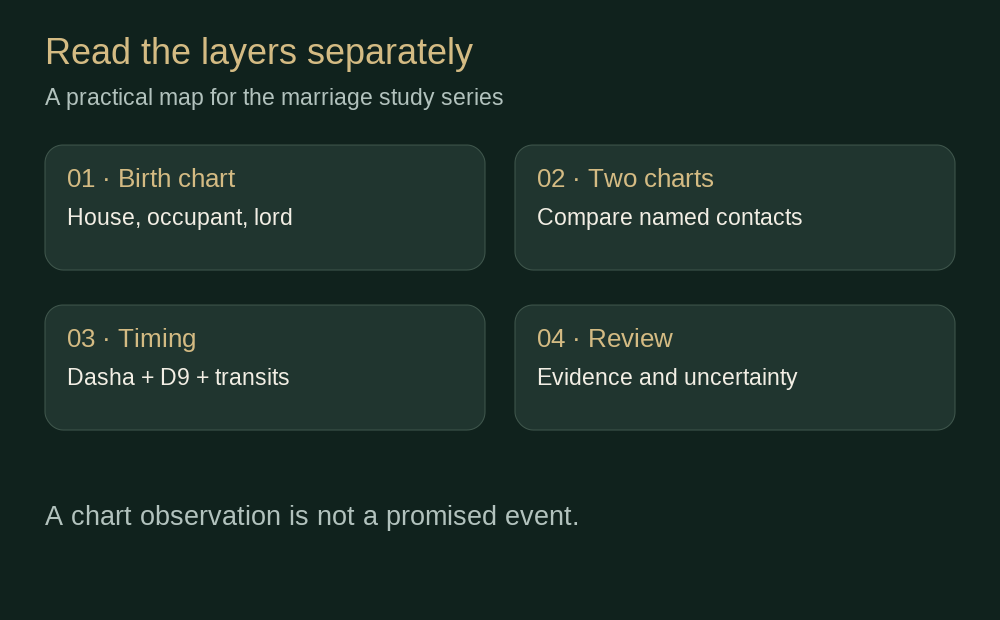
The timing reading path#
The timing section has its own sequence:
- Define the window. Decide whether you are studying meeting, commitment or marriage before looking for dates.
- Read the dasha hierarchy. Record the long period, its sub-period and the smaller period within it.
- Cross-check D9. Follow the same planets into Navamsa and identify what actually changes.
- Map transit overlaps. Trace Jupiter and Saturn to specific natal targets and distinguish their overlapping intervals.
These are reading tools, not a validated forecasting formula. The examples make assumptions visible so you can inspect the reasoning rather than accept a confident-sounding conclusion.
Keep a small evidence notebook#
A useful note has four columns: observation, interpretation, missing information and outcome. For example, “Jupiter rules the seventh” is an observation under the stated chart convention. “This period deserves a partnership review” is an interpretation. “Birth time estimated within twenty minutes” is missing precision. “An engagement occurred” is an outcome that must come from life, not from the chart.
Write the first three columns before filling in the fourth. Otherwise it is easy to change the question after an event, counting a friendly conversation, a date and a wedding as interchangeable successes. An uneventful period belongs in the notebook too.
How this series relates to our other guides#
These are standalone study articles with their own examples. The Darakaraka series, Navamsa introduction and Kundali matching guide provide additional background. They need not all be applied at once. Choose a defined method and keep its assumptions consistent.
Our diagrams use whole-sign houses unless stated otherwise. Hypothetical dates are labelled; they are not advertised as transit forecasts. The writing and examples are by Celestial Digits, while traditional astrological ideas remain attributed to their traditions and references.
References and further study#
P.V.R. Narasimha Rao's publicly available textbook provides background on chart terminology, divisional charts, dashas and graha aspects. Its author also notes that his later research revised some earlier views. The Swiss Ephemeris documentation explains the astronomical calculation layer; accurate positions alone do not establish predictive accuracy.
Related Posts

Marriage Timing Through Mahadasha, Antardasha and Pratyantar
Read the full Vimshottari hierarchy, compare planetary roles across ascendants and work through sub-period durations without inventing a wedding date.

Navamsa in Marriage Timing: Cross-Checking the Dasha Lords
Follow the same dasha lords from D1 into D9, calculate two Navamsa examples and see why a conjunction or uncertain ascendant needs careful interpretation.
Jupiter in the Seventh House: Shared Values and Functional Lordship
Read Jupiter in the seventh without a blanket good-marriage promise, using Gemini, Virgo and Capricorn examples and explicitly counted aspects.
A little more perspective.
Keep discussions respectful. No harassment, hate, sexual content or spam. Comments are reviewed before publication. Report concerns from a comment menu, or contact [email protected].
Checking your session…