
Calculate a Navamsa Placement from Its D1 Longitude
Convert movable, fixed and dual sign positions into D9 with explicit degree intervals, then check a boundary without rounding into the wrong division.
A Navamsa placement is derived from a D1 longitude. The planet does not physically travel to another location when you open D9; the chart applies a divisional mapping to the original position.
This guide shows that mapping with three fictional positions at the same degree in different signs. It complements our D9 interpretation guide, which discusses what to do after the positions are calculated.
Divide each sign into nine equal parts#
A sign spans 30°. Dividing by nine gives 3°20′ per Navamsa. The first four intervals are:
| Division | Degrees within the D1 sign |
|---|---|
| First | 0° to under 3°20′ |
| Second | 3°20′ to under 6°40′ |
| Third | 6°40′ to under 10° |
| Fourth | 10° to under 13°20′ |
A position at exactly 10° begins the fourth division. One at 9°59′ remains in the third. The later divisions continue in equal steps until 30°.
The starting sign depends on the D1 sign#
Our calculation uses the standard mapping: movable signs start from themselves, fixed signs from their ninth sign, and dual signs from their fifth. Count the starting sign as division one, then advance one zodiac sign per division.
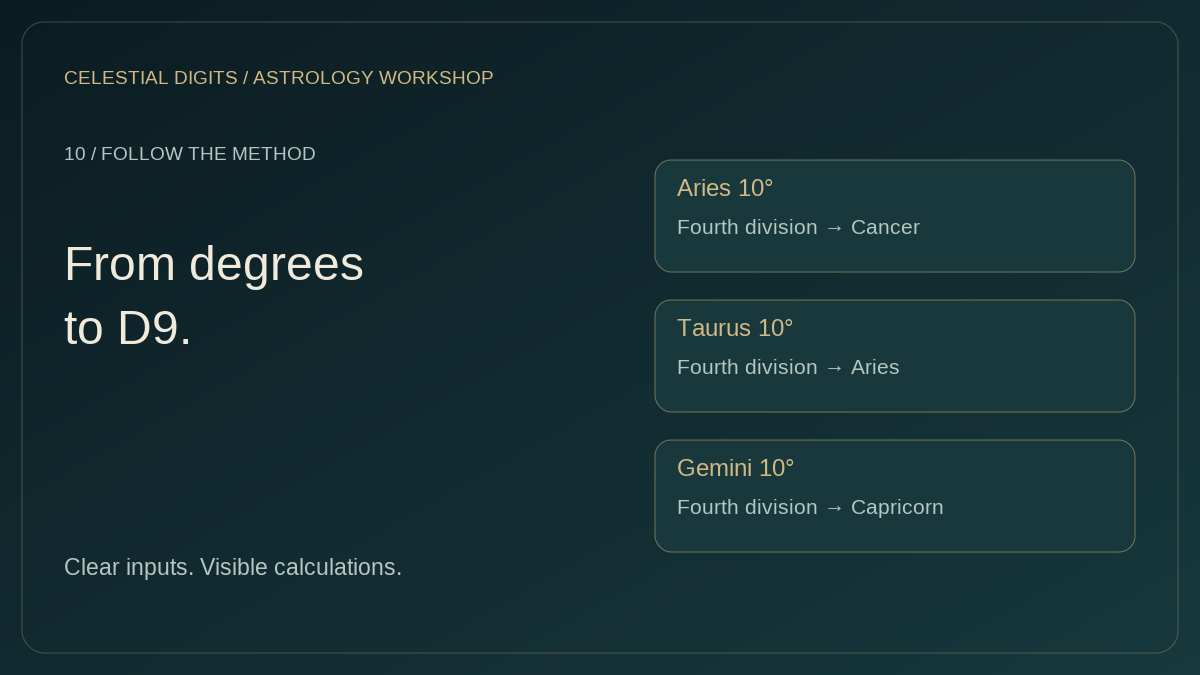
For Aries 10°, Aries is movable. The sequence begins Aries, Taurus, Gemini, Cancer. The fourth division maps to Cancer.
For Taurus 10°, Taurus is fixed. The ninth sign from Taurus is Capricorn. The sequence begins Capricorn, Aquarius, Pisces, Aries. The result is Aries.
For Gemini 10°, Gemini is dual. The fifth sign from Gemini is Libra. Libra, Scorpio, Sagittarius, Capricorn gives Capricorn.
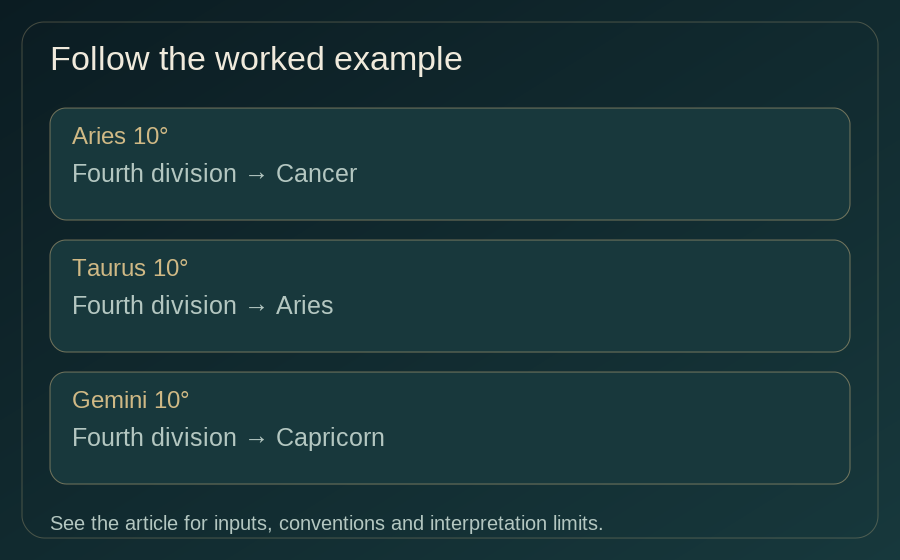
The degree within the D1 sign is the same in all three examples, but the D9 signs differ because their starting sequences differ.
Recover the degree within D9#
Consider Aries 11°. It lies one degree into the fourth Navamsa interval, which began at 10°. Multiply the within-division offset by nine: 1° × 9 = 9°. The mapped position is therefore 9° Cancer in D9.
At Aries 10° exactly, the offset is zero, giving 0° Cancer. At Aries 9°59′, the position is still in the previous division, near the end of Gemini in D9. Do not round D1 to a whole degree before deciding which interval contains it.
These are mathematical mappings, not claims about the birth chart of a person born at a stated time. A real calculation first needs the astronomical D1 longitude and the selected sidereal convention.
What a birth-time change can affect#
The ascendant changes much faster than most planetary longitudes, so its divisional placement can be sensitive to birth-time uncertainty. A small change can cross a division boundary if the original position was close to one; it need not change every planet's D9 sign.
The right question is not “does five minutes always change D9?” but “which actual longitudes cross a relevant boundary?” Our five-minute birth-time example explains that distinction.
Use the calculation as a check#
Record the D1 sign, precise degree, division number, starting sign and resulting D9 sign. If two reports disagree, compare these intermediate fields before comparing interpretations. Different ayanamshas can move a position across a boundary even when each program applies its own mapping consistently.
The rule is documented in the divisional-chart tradition; see Brihat Parashara Hora Shastra alongside the conventions returned by your calculator. A correct mapping does not independently validate a prediction about marriage, character or spiritual attainment. It establishes which D9 position the chosen inputs produce.
Related Posts
Navamsa in Marriage Timing: Cross-Checking the Dasha Lords
Follow the same dasha lords from D1 into D9, calculate two Navamsa examples and see why a conjunction or uncertain ascendant needs careful interpretation.
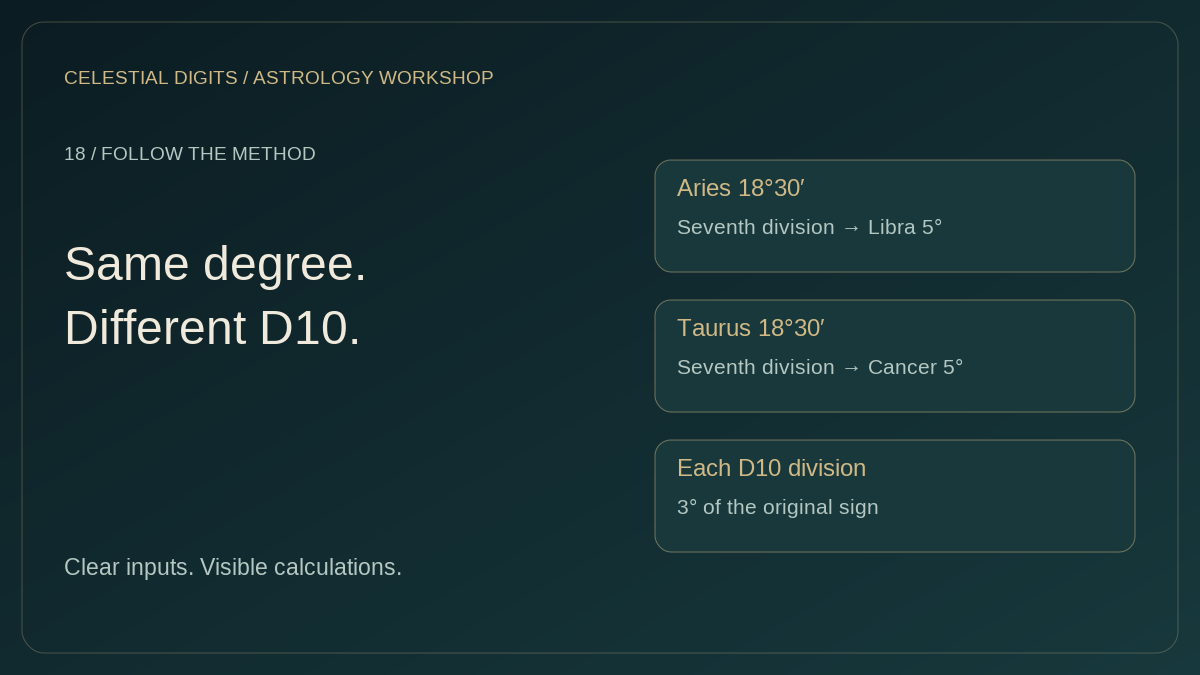
Calculate D10: The Odd–Even Sign Rule with Examples
Map Aries and Taurus 18°30′ into Dasamsa, calculate the resulting degrees, and see why D9 cannot be reused as a career chart.
Jupiter in the Seventh House: Shared Values and Functional Lordship
Read Jupiter in the seventh without a blanket good-marriage promise, using Gemini, Virgo and Capricorn examples and explicitly counted aspects.
A little more perspective.
Keep discussions respectful. No harassment, hate, sexual content or spam. Comments are reviewed before publication. Report concerns from a comment menu, or contact [email protected].
Checking your session…