
Pratyantardasha Explained: Calculation, Dates and a Worked Example
Calculate all nine Pratyantardashas inside Saturn–Mars, follow their dates, and learn why birth balances and date boundaries must stay consistent.
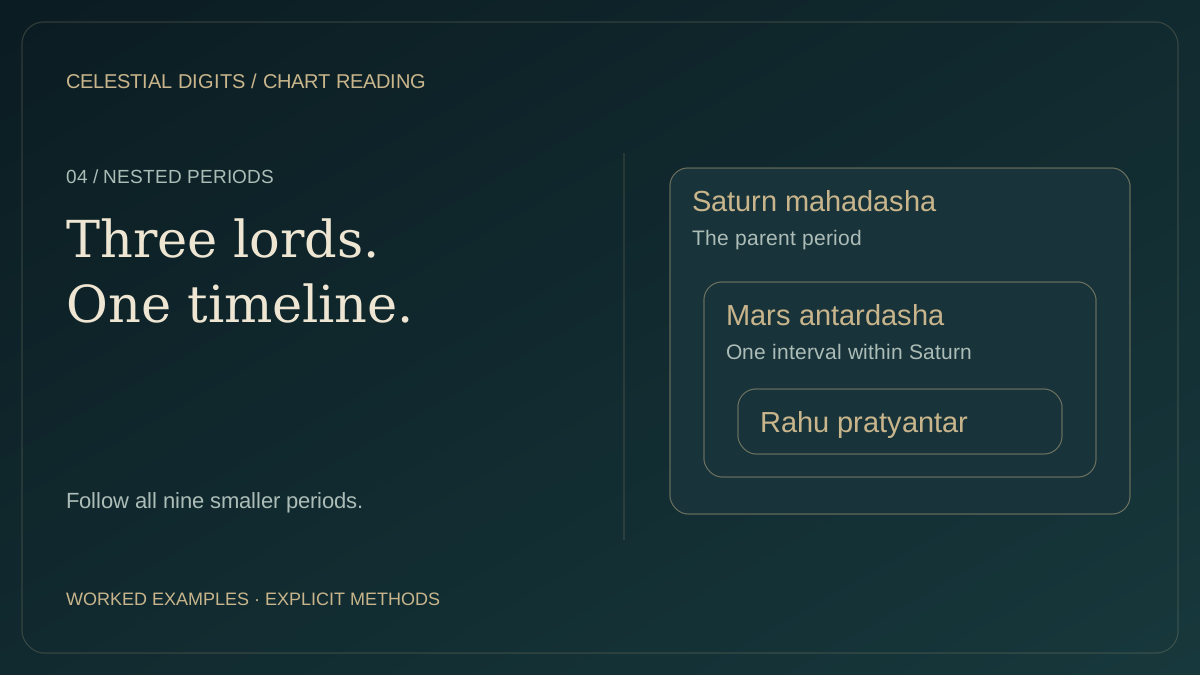
Your report says Saturn–Mars–Rahu. That is not a conjunction of three planets. It names three nested periods: Saturn mahadasha, Mars antardasha within Saturn, and Rahu pratyantardasha within that Saturn–Mars interval.
The third level is useful for examining smaller portions of a longer period. It also makes stale dates and missing birth balances much easier to notice. Before interpreting it, check that all three labels describe the same date.
This guide builds a complete fictional schedule from a stated starting instant. It is not your personal dasha and does not identify a universal Saturn–Mars period for everyone.
How the three levels fit together#
| Level | Example lord | What the label identifies |
|---|---|---|
| Mahadasha | Saturn | The major period |
| Antardasha | Mars | One subdivision of that Saturn period |
| Pratyantardasha | Rahu | One subdivision of that Saturn–Mars period |
“Pratyantar” and “pratyantardasha” commonly refer to the same third level. The hyphens describe nesting, not a new independent dasha system.
The proportional subdivision and starting-order rules appear in Brihat Parashara Hora Shastra, chapter 51, verses 1–2. Each set begins with its parent lord, then follows the Vimshottari sequence. The numerical calendar below is our own illustration of those rules.
Calculate the parent antardasha first#
The standard Vimshottari allocations are Ketu 7, Venus 20, Sun 6, Moon 10, Mars 7, Rahu 18, Jupiter 16, Saturn 19 and Mercury 17 years. They total 120.
For a full Saturn–Mars antardasha:
19 × 7 ÷ 120 = 1.108333… dasha years
To convert that interval into a calendar duration, we must select a year convention. Here we use 365.25 days per dasha year, giving 404.81875 days. A calculator using a different convention will not produce identical boundaries simply because it uses the same planetary proportions.
For each pratyantardasha, multiply the full antardasha duration by the third lord's allocation and divide by 120. Thus Saturn–Mars–Rahu lasts:
404.81875 × 18 ÷ 120 = 60.7228125 days
It does not last eighteen calendar years. Eighteen is Rahu's weighting in the 120-year cycle, reused proportionally at this smaller level.
All nine periods, with dates#
Assume this fictional Saturn–Mars antardasha begins at 1 January 2030, 00:00 UTC. It starts with Mars pratyantardasha, then Rahu, Jupiter, Saturn, Mercury, Ketu, Venus, Sun and Moon.
The calculation retains fractional days. Durations below are rounded to three decimals; timestamps omit seconds for readability and therefore are not exact boundary instants.
| Pratyantardasha | Days | Starts, UTC | Ends, UTC |
|---|---|---|---|
| Mars | 23.614 | 01 Jan 2030 00:00 | 24 Jan 2030 14:44 |
| Rahu | 60.723 | 24 Jan 2030 14:44 | 26 Mar 2030 08:05 |
| Jupiter | 53.976 | 26 Mar 2030 08:05 | 19 May 2030 07:30 |
| Saturn | 64.096 | 19 May 2030 07:30 | 22 Jul 2030 09:49 |
| Mercury | 57.349 | 22 Jul 2030 09:49 | 17 Sep 2030 18:12 |
| Ketu | 23.614 | 17 Sep 2030 18:12 | 11 Oct 2030 08:57 |
| Venus | 67.470 | 11 Oct 2030 08:57 | 17 Dec 2030 20:13 |
| Sun | 20.241 | 17 Dec 2030 20:13 | 07 Jan 2031 02:00 |
| Moon | 33.735 | 07 Jan 2031 02:00 | 09 Feb 2031 19:39 |
The unrounded durations sum to 404.81875 days, exactly filling the assumed parent interval. Adding the displayed rounded numbers instead gives a small rounding difference. Do not repeatedly round durations when constructing a schedule.
Which period is active on a given date?#
At 1 February 2030, 12:00 UTC, the assumed chart is in Saturn–Mars–Rahu. The date lies inside the Rahu row, and that entire row lies inside the Saturn–Mars antardasha.
At the exact transition, use one consistent rule: a period includes its starting instant and excludes its ending instant. In this example, Mars ends and Rahu begins at 24 January 2030, 14:44:46.5 UTC. At that instant, Rahu is active. This avoids showing two current periods at once.
A page can display only calendar dates for convenience, but it should not then interpret both ending and starting dates as complete inclusive days. Time zones also change the displayed clock or date without changing the underlying instant.
Why birth does not restart all nine subperiods#
A child can be born partway through a mahadasha, antardasha and pratyantardasha. The timeline does not restart the parent lord's first subdivision at birth.
To illustrate, imagine a birth at 1 February 2030, 12:00 UTC in the schedule above. The active third-level lord is already Rahu. A timeline showing only post-birth life would display the remaining Rahu interval, then Jupiter and the later periods. It would not squeeze a fresh set of all nine pratyantardashas into the remaining antardasha.
This is an illustration of clipping an existing interval, not a claim that a child born then necessarily has Saturn–Mars–Rahu. A real calculation derives the starting balance from the natal Moon and its nakshatra. See dasha balance at birth for that separate step.
Use the third level without promising an exact event#
In traditional interpretation, the third lord adds another factor to the mahadasha and antardasha assessment. Begin with a concrete question, then inspect the natal roles and conditions of all three planets. Our strong dasha lord guide provides a worksheet for this.
More detailed dates do not make an event prediction more certain. A precisely calculated interval is not proof that someone will marry, receive an offer or relocate inside it. Keep the mathematics separate from the interpretation and the person's actual circumstances.
Check your own timeline#
In the Dasha section, open the active mahadasha, then its active antardasha, and locate the pratyantardasha containing the date you want to discuss. Compare all three labels with the current-period summary.
For a comparison between websites, keep the birth details, Moon longitude, ayanamsha, year convention, time zone and reference date together. A screenshot of three planet names alone cannot explain a disagreement. For background on the larger hierarchy, read Mahadasha and Antardasha together.
Calculation note: This example uses an explicitly assumed parent start and a fixed 365.25-day year. It demonstrates interval arithmetic; it does not alter your saved chart or the application's time settings.
Related Posts
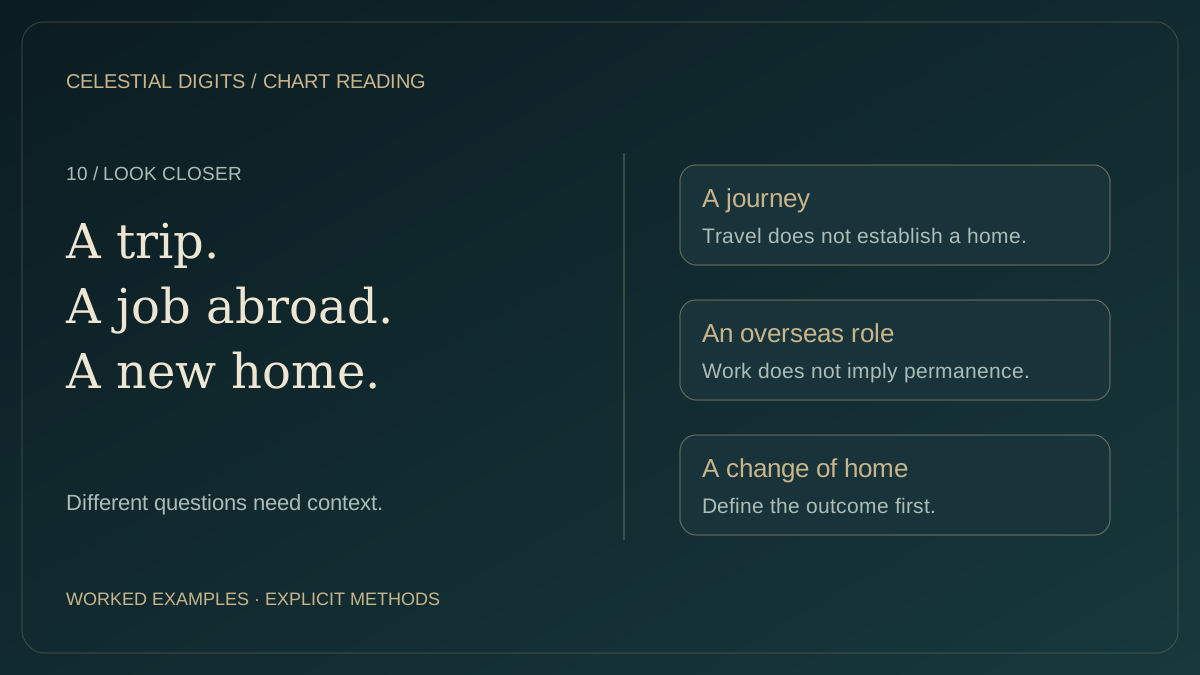
Foreign Travel, Work or Permanent Settlement? Read the Question First
Separate a foreign trip, overseas employment and a lasting change of home. Use a Virgo-ascendant worksheet to read houses, lordships and timing together.
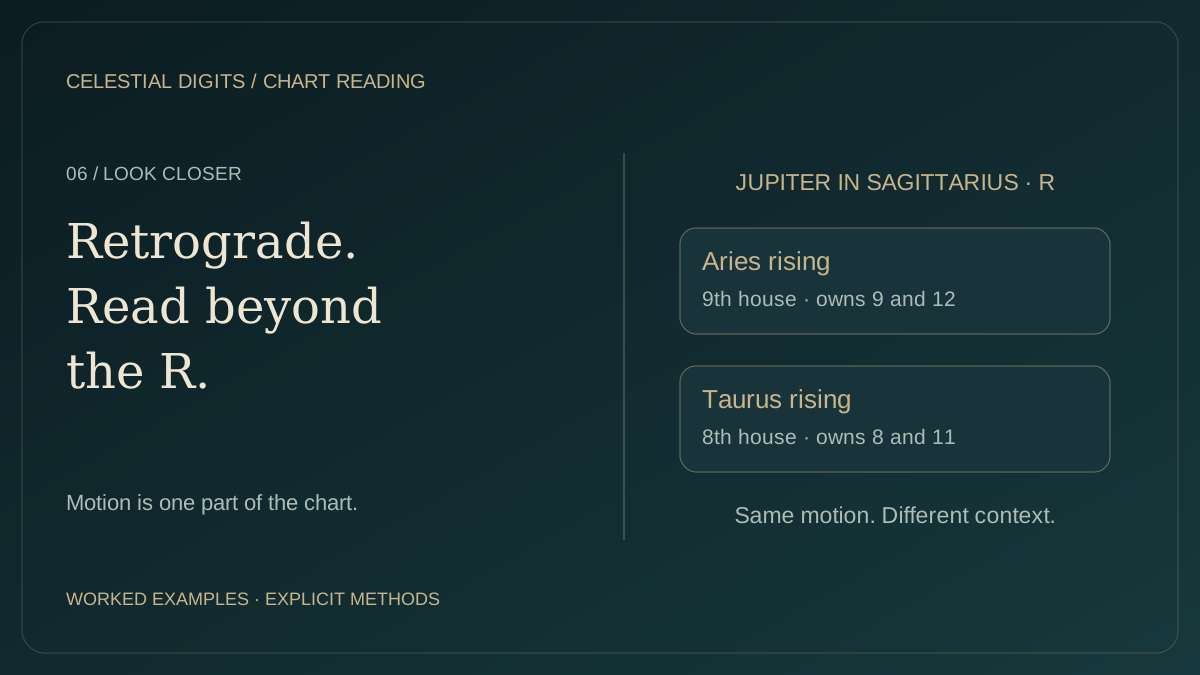
Retrograde Planets in Your Birth Chart: Stronger, Delayed or Misunderstood?
Read natal retrograde planets without blanket predictions. Separate motion, dignity, house lordship and timing with two worked chart examples.
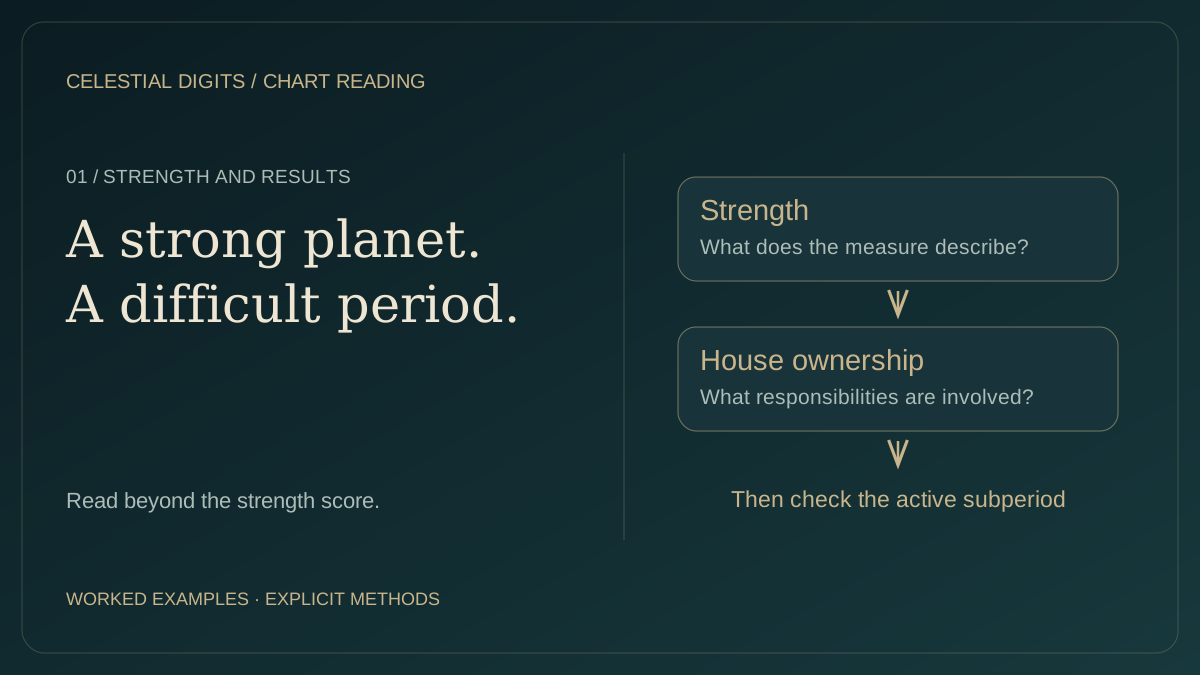
Strong Mahadasha Lord, Difficult Period: What Are You Missing?
A strong planet does not guarantee an easy dasha. Use a worked example to separate strength, house ownership, placement and the current subperiod.
A little more perspective.
Keep discussions respectful. No harassment, hate, sexual content or spam. Comments are reviewed before publication. Report concerns from a comment menu, or contact [email protected].
Checking your session…