
Navamsa for Beginners: What D9 Can and Cannot Tell You
A beginner-safe but serious guide to the Navamsa chart in Jyotish: what D9 reveals, where people misuse it, and how to combine it with the natal chart.
The Navamsa, or D9 chart, is one of the most important divisional charts in Jyotish and also one of the most misunderstood.
Some people treat it like a secret chart that overrides the birth chart. Others reduce it to "spouse chart only." Both approaches are incomplete.
If you want to use D9 well, the most important thing to learn first is not what it says. It is what it is allowed to say.
What D9 Is#
For a degree-by-degree calculation, follow Venus from Pisces in D1 to Virgo in D9. It shows how differing dignity labels can both be calculated correctly.
Navamsa is a ninth-division chart. In classical Jyotish, it is central because it refines:
- dignity
- maturity
- inner strength
- dharmic unfolding
- marriage and partnership quality
It is especially important for understanding how a planet deepens over time, not just how it appears on the surface in the birth chart.
What D9 Is Best Used For#
Navamsa is especially useful for:
- marriage and partnership analysis
- checking the deeper strength of planets
- confirming or refining natal promise
- understanding maturation of a chart over time
- reading inner dharmic quality behind outer life
It is not just about spouse. But marriage is one of the clearest areas where D9 becomes very visible.
What D9 Cannot Do by Itself#
Navamsa cannot replace the natal chart.
It cannot:
- invent an event not supported in the main chart
- overrule a completely weak natal promise by itself
- justify predictions without dasha
- be read like an isolated chart with no reference to Lagna chart
The correct order is:
- Natal chart
- D9 refinement
- Dasha activation
- Transit timing
That order solves a lot of beginner confusion.
Why D9 Matters So Much#
In practice, some placements look strong in the birth chart but behave weakly in life. Others look ordinary in the birth chart but improve with maturity and time.
Navamsa often helps explain why.
It shows whether a planet's deeper quality is:
- stable
- refined
- internally supported
- compromised
- more dharmic than it first appears
This is one reason Jyotish practitioners use D9 to judge planetary strength more carefully.
D9 and Marriage#
This is the area most people know D9 for, and for good reason.
Navamsa helps refine:
- partner quality
- marriage capacity
- deeper relational maturity
- whether the native settles well in partnership
- whether the marriage promise remains strong after initial attraction
But even here, the D9 does not replace the 7th house in the natal chart. It confirms, deepens, or complicates what the main chart already suggests.
D9 and Planetary Strength#
A practical beginner use of D9 is to ask:
- does this planet remain strong in deeper expression?
- does it improve or weaken when refined through Navamsa?
This helps especially when judging:
- 7th lord
- Venus
- Jupiter
- 10th lord
- Lagna lord
What People Mean by "Maturity" in D9#
When astrologers say D9 shows maturity, they are usually pointing to this:
Some planetary results become more visible later, after life experience, responsibility, or relational testing.
This is why certain natives:
- understand relationships better later
- become more dharmic later
- grow into their planetary strengths with age
The D9 often helps reveal that delayed ripening.
A Safe Beginner Reading Method#
Step 1: Read the Natal Chart First#
Start with:
- Lagna
- key houses
- relevant house lords
- planetary dignity
Do not open D9 before you know what question the natal chart is asking.
Step 2: Identify the Relevant Topic#
Use D9 differently depending on the question.
- For marriage: check 7th house, Venus, D9 Lagna, D9 7th factors
- For deeper planet strength: compare the natal planet with D9 dignity
- For dharmic growth: study Lagna lord, Atmakaraka-linked patterns, and internal coherence
Step 3: Check D9 Lagna and Its Lord#
This gives you a feel for the structural health of the Navamsa itself.
Step 4: Re-check Key Natal Planets in D9#
Ask:
- where does the natal 7th lord land in D9?
- where does Venus land?
- does a seemingly strong natal planet weaken?
- does a pressured natal planet recover some dignity?
Step 5: Use Dasha#
Even correct D9 reading should still be timed through dasha. A strong D9 theme may remain latent until activated.
Example 1: Strong Natal, Weak D9 Relationship Pattern#
Suppose a chart has:
- reasonable 7th house in the natal chart
- strong attraction patterns
- but a strained D9 marriage structure
This can show:
- relationships beginning easily
- difficulty settling deeply
- marriage requiring more maturity than early life relationships suggest
Example 2: Moderate Natal, Strong D9 Stability#
Suppose the natal chart is not dramatic, but D9 is stable and supportive.
This often shows:
- less flashy relationship story
- better long-term durability
- partnership improving with age
This is one reason D9 is so valuable. It helps separate surface story from deeper durability.
What D9 Is Not#
Not a "Second Destiny"#
It is a refinement layer, not a separate fate.
Not Only a Spouse Chart#
Marriage is major, but D9 also helps with planetary maturity and dharmic refinement.
Not a Shortcut#
You still need houses, lords, and timing.
Common Mistakes#
1. Reading D9 Without Natal Context#
This creates floating interpretations.
2. Treating One D9 Placement as Absolute#
D9 still needs chart-wide reading.
3. Ignoring Dasha#
D9 promise needs activation too.
4. Using D9 to Frighten People#
Marriage analysis should be structured, not fatalistic.
5. Assuming D9 Only Matters After 30#
That idea is common in modern teaching, but the deeper truth is subtler: D9 matters throughout life, though its maturity patterns often become easier to observe with age.
The Most Useful One-Line Summary#
If the birth chart shows the visible structure of life, Navamsa shows how that structure matures, deepens, and holds under dharmic pressure.
That is a better beginner rule than most viral explanations.
Related Vedic Reads#
- Navamsa (D9) for Marriage: What Actually Changes After Age 30
- Nakshatra Padas Explained: Why Pada Changes the Result
- How to Read a Vedic Chart Step-by-Step for Beginners
- Get Vedic Astrology Report
Final Take#
Navamsa is powerful because it adds refinement, not because it replaces the birth chart. Use it to judge deeper strength, relational maturity, and the quality beneath the visible story.
That is where D9 becomes genuinely useful.
For a chart-specific D9 and relationship analysis, get a detailed Vedic Astrology Report.
Related Posts
Divisional Charts Guide: How to Read D1 to D60 Without Confusion
Complete guide to Vedic divisional charts: all 16 shodashavarga with their purpose, the practical big five, D1-to-varga reading method, and birth time limits.
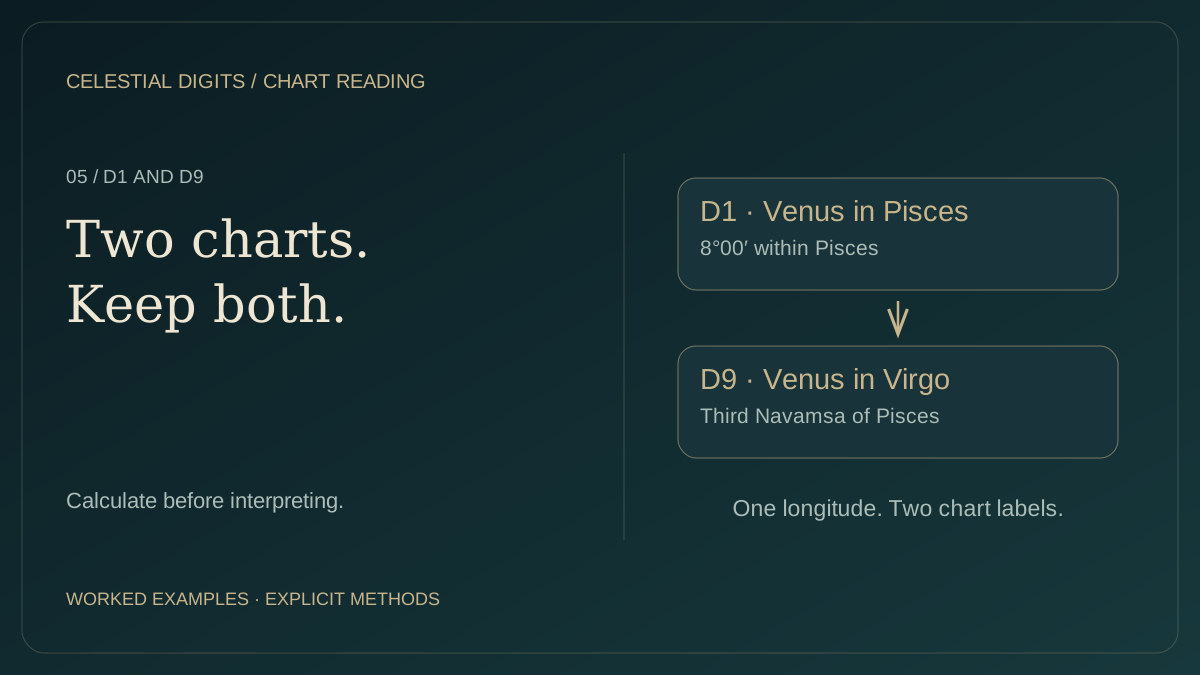
When D1 and D9 Disagree: A Worked Navamsa Example
Follow Venus from Pisces in D1 to Virgo in D9 using exact degrees. Learn how to combine differing dignities without declaring a marriage verdict.
How to Read a Vedic Birth Chart: A Beginner's Worked Example
Read a kundli step by step using a backend-generated example: identify the ascendant, separate signs from houses, find planets and lordships, then examine timing.
A little more perspective.
Keep discussions respectful. No harassment, hate, sexual content or spam. Comments are reviewed before publication. Report concerns from a comment menu, or contact [email protected].
Checking your session…