
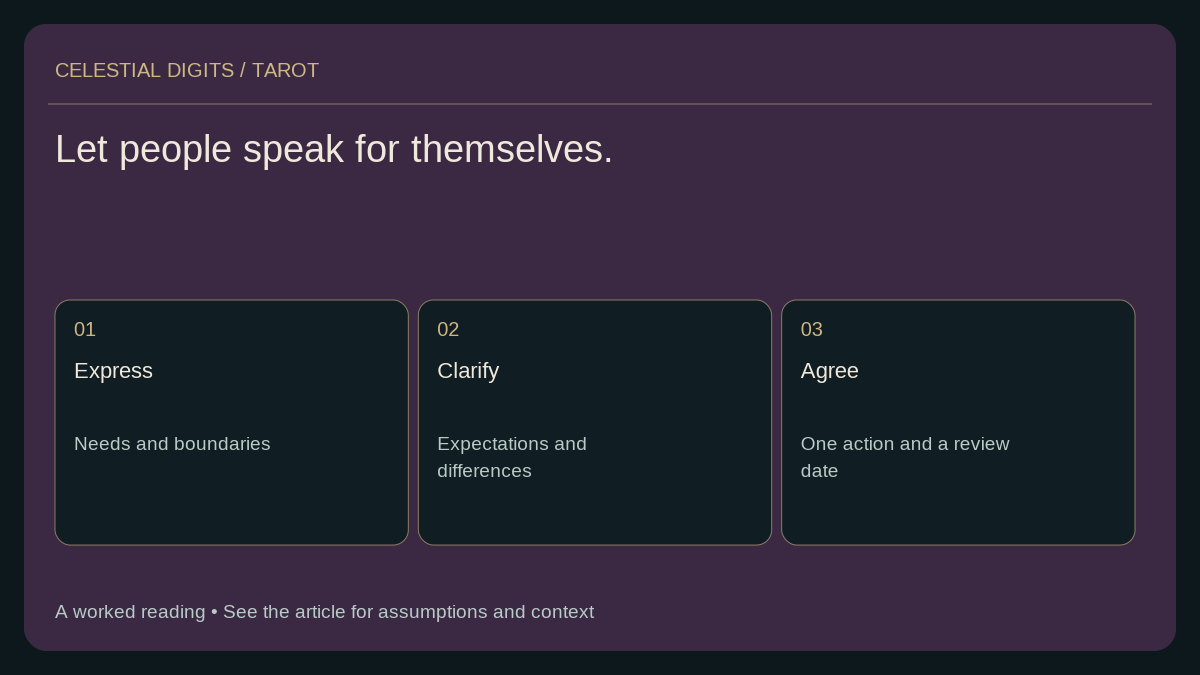
Tarot for Relationship Conversations: Needs, Boundaries and Expectations
Try a consent-based reflective spread that turns card symbolism into questions each person can answer, without claiming to read a partner’s mind.
A relationship tarot reading should not claim to reveal a partner's secret thoughts. It can, however, provide a set of prompts that people choose to answer for themselves.
The distinction is important: a card may suggest a question, but the person supplies their own answer. Consent, safety and actual communication remain more important than any symbolic interpretation.
Set the agreement before the spread#
Use this exercise only when everyone involved wants to participate. Agree that either person can skip a question, that the cards will not be used as evidence against someone and that no answer must match a remembered card meaning.
For a solo reading, keep the focus on your own needs and choices. Replace “what do they secretly want?” with “what do I need to ask directly?”
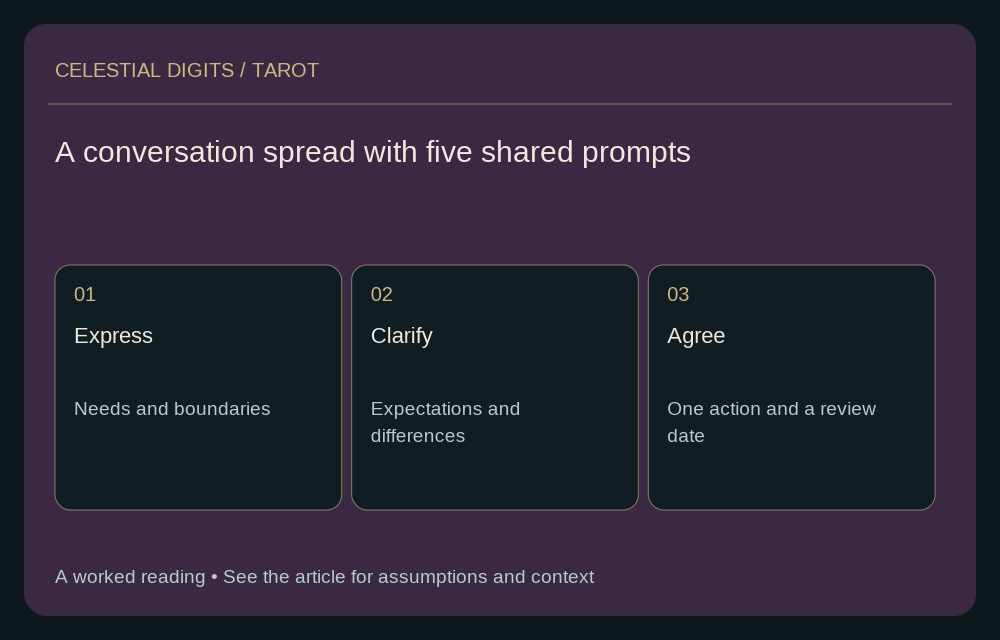
Five positions for a fictional conversation#
Imagine two partners trying to plan shared time while both have demanding schedules. These cards are intentionally chosen to demonstrate the method.
| Position | Example card | Question to answer in your own words |
|---|---|---|
| Need | Two of Cups | What helps me feel that we are meeting each other willingly? |
| Boundary | Four of Pentacles | What time, energy or privacy do I need to protect? |
| Clarity | Queen of Swords | What needs to be said plainly and respectfully? |
| Adjustment | Temperance | What arrangement could accommodate our differences? |
| Shared action | Three of Pentacles | What will each of us actually contribute? |
The cards do not identify which partner is right. The positions organise a conversation, not a verdict.
Translate symbols into specific statements#
Instead of “the Two of Cups says we are meant to be,” one person might say, “I feel connected when we have an uninterrupted meal together.” Instead of calling the Four of Pentacles selfish, ask whether protecting one evening for rest would help.
The Queen of Swords position can prompt clear wording without turning bluntness into a virtue. Temperance can prompt adjustment without requiring either person to ignore an important boundary.
Make the shared action observable#
The Three of Pentacles position might lead to a simple agreement: each person proposes one feasible time, both confirm it in advance and either can request a change with reasonable notice.
A specific arrangement is easier to review than a promise to “be more present.” It also reveals practical obstacles that no card can solve on its own, such as incompatible work schedules or unequal responsibilities.
Leave room for disagreement#
A useful conversation does not require both people to interpret a card identically. One may associate a symbol with reassurance while another notices pressure. Ask what each response means to them rather than choosing the interpretation that supports your preferred answer.
If participation becomes coercive or unsafe, stop the exercise. A tarot spread should not be used to demand reconciliation, obtain access to private information or excuse harmful behaviour.
Review the agreement, not the prediction#
After a week or two, ask whether the arrangement helped and what needs changing. The outcome is information about the agreement and circumstances; it does not prove that the relationship passed or failed a tarot test.
Continue with Lovers versus Two of Cups and Four versus Five of Pentacles.
Source and scope#
The imagery belongs to the Rider–Waite–Smith tradition documented in The Pictorial Key to the Tarot. This consent-based conversation spread is an original contemporary exercise. It cannot establish another person's feelings, fidelity or intentions.
Related Posts
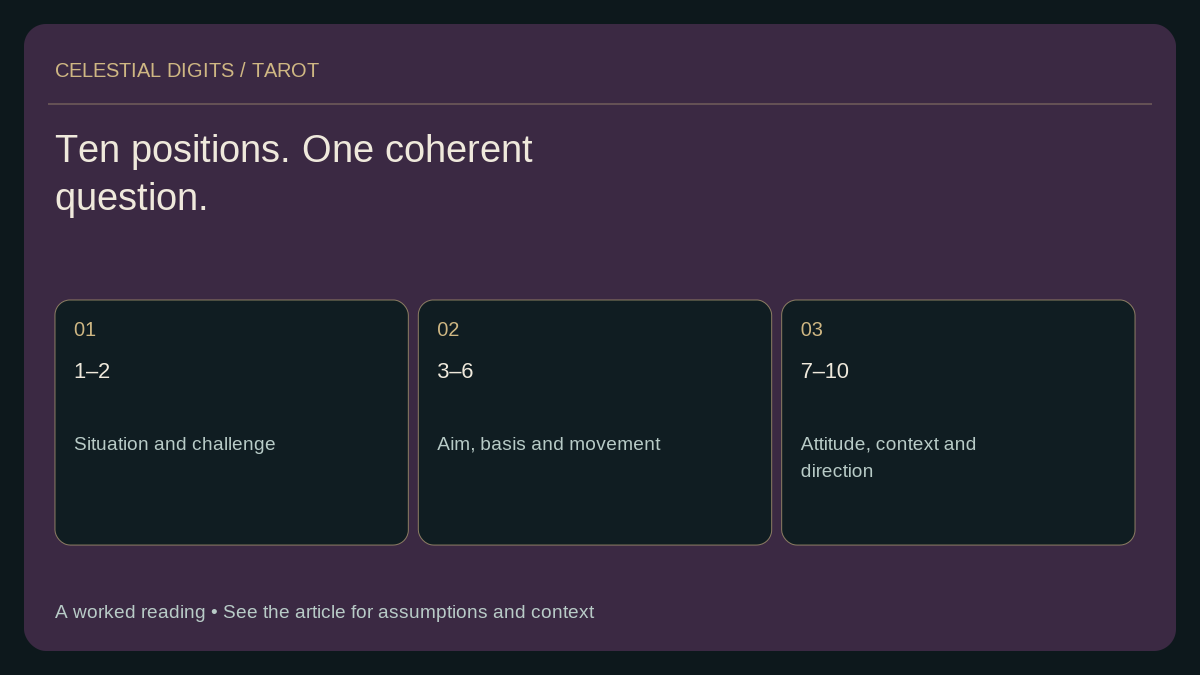
The Celtic Cross Explained Through One Complete Example
Follow all ten Celtic Cross positions in a fictional creative-project reading, then combine the cards into a practical, conditional interpretation.
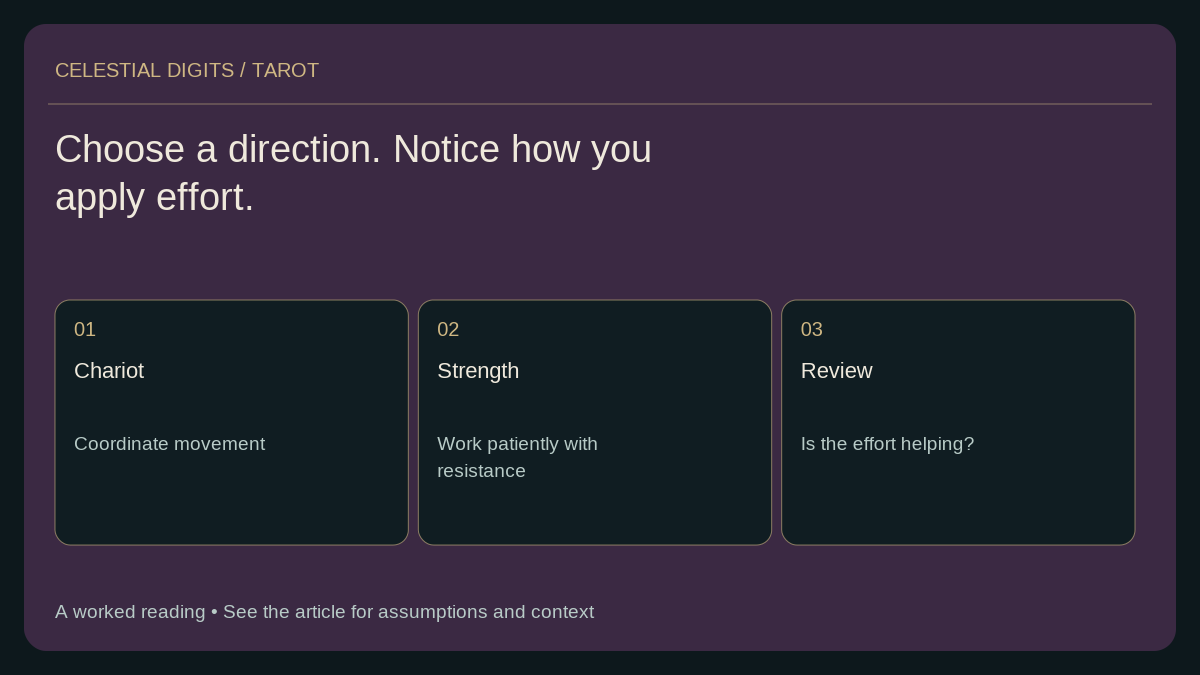
The Chariot vs Strength: Direction, Persistence and Resistance
Compare purposeful direction with patient self-regulation through a rehearsal example, without treating either card as a command to push harder.
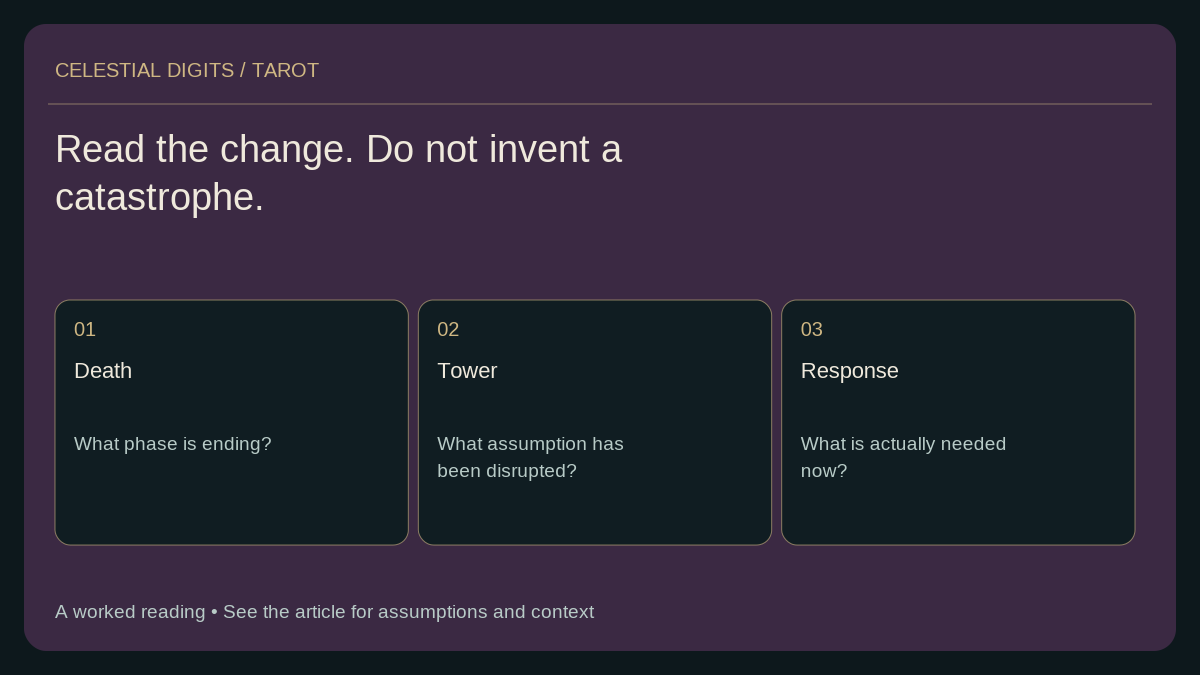
Death vs The Tower: Endings, Disruption and What Comes Next
Compare two often-feared tarot cards through project examples, separating symbolic change from literal predictions of disaster.
A little more perspective.
Keep discussions respectful. No harassment, hate, sexual content or spam. Comments are reviewed before publication. Report concerns from a comment menu, or contact [email protected].
Checking your session…