
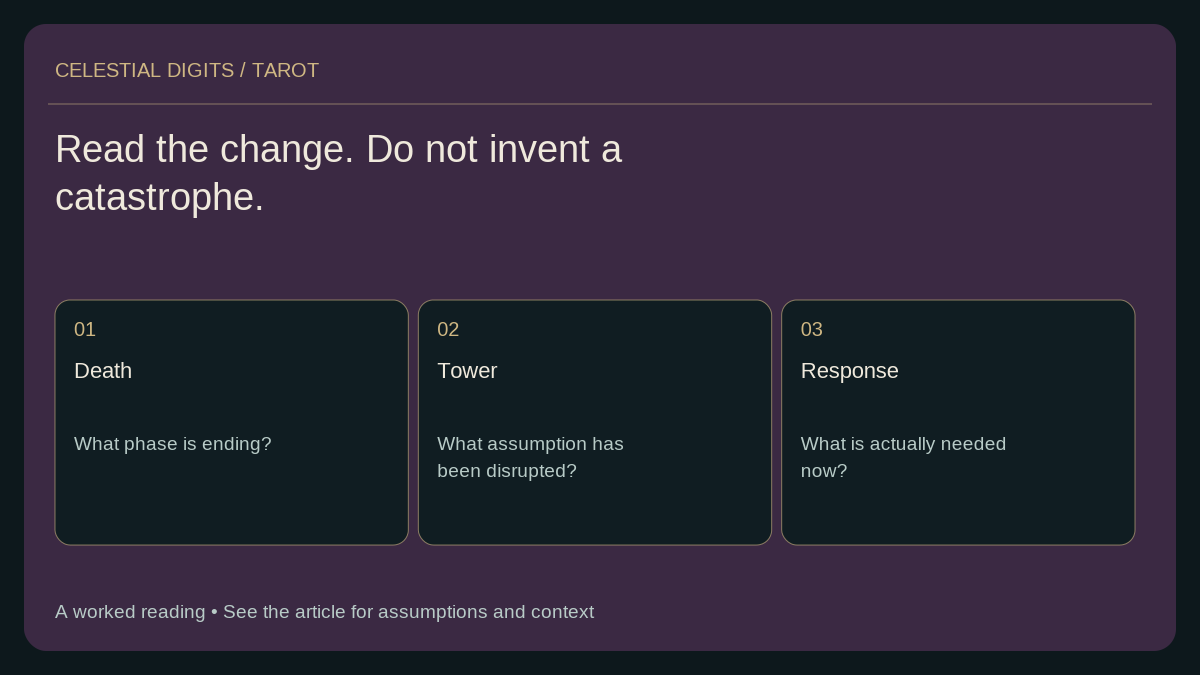
Death vs The Tower: Endings, Disruption and What Comes Next
Compare two often-feared tarot cards through project examples, separating symbolic change from literal predictions of disaster.
Death and the Tower can make a reader anxious before any interpretation begins. Their dramatic images deserve careful handling. Neither card establishes that a death, accident or disaster will occur. A responsible reading starts with the question and the person's actual circumstances.
A useful contemporary distinction is between recognising an ending and confronting a sudden disruption to an existing structure or assumption. It is not a rigid rule about how quickly every change must happen.
Compare the visual stories#
The Rider–Waite–Smith Death card shows a mounted figure moving through a scene of transition. The Tower shows a structure struck from above, with figures falling. The images can support different questions about change, but they should not be turned into literal forecasts.
Waite discusses these cards through mystical and doctrinal symbolism. The everyday project examples below are a modern reflective application, not a claim to reproduce every part of his interpretation.
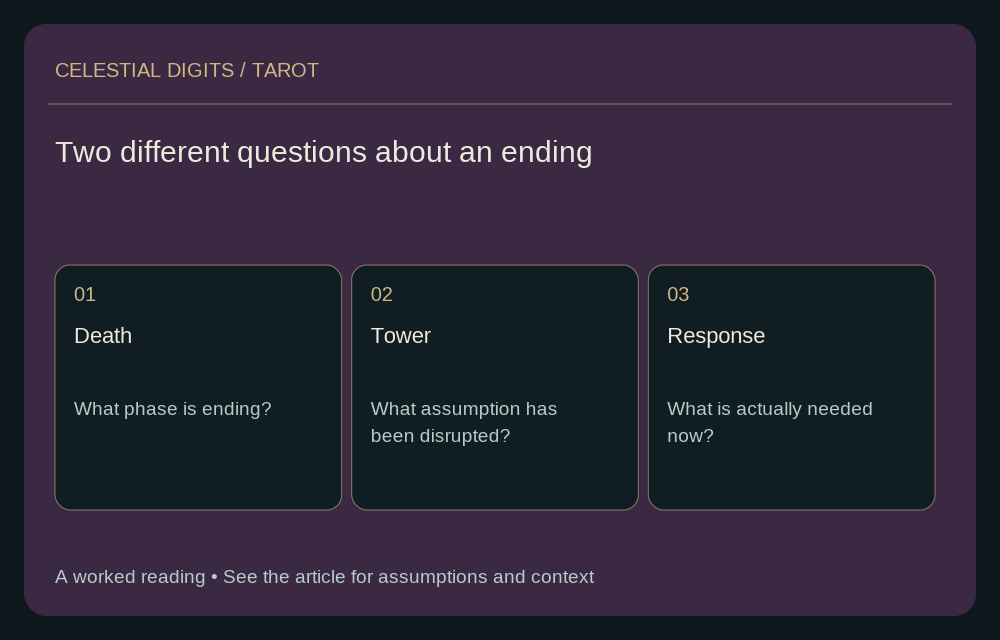
Two project examples#
Imagine a community newsletter has completed its planned year and the organisers decide to close it. Death, in a teaching position called “What needs acknowledging?”, can prompt recognition that the phase is over. The next step may be thanking contributors, archiving the work and deciding what should continue elsewhere.
Now imagine the same newsletter discovers that its central publishing arrangement is unavailable without warning. The Tower, in “What assumption has changed?”, can prompt attention to a structure that can no longer be relied on.
| Theme | Question | Practical response |
|---|---|---|
| Ending | What is complete or no longer continuing? | Close the phase clearly |
| Disruption | What no longer works as expected? | Establish the facts and immediate needs |
Do not force a positive meaning too quickly#
An ending can be sad even when it is appropriate. A disruption can be inconvenient without becoming a profound spiritual breakthrough. Let the person's experience remain more complex than a reassuring slogan.
The cards also do not establish that the person caused the change or deserved it. Avoid explaining hardship as punishment or insisting that every loss must produce a greater reward.
The position changes the reading#
Death in a challenge position may raise the question of holding on to a phase that has ended. In a resource position, it may invite a clear acknowledgement of completion. The Tower as a challenge may focus on disrupted expectations; as a reflection prompt, it may invite examination of an unstable assumption before further effort is invested.
These are possibilities to test against reality. They are not hidden facts revealed by the image.
Ask what comes next in ordinary terms#
For the newsletter, the relevant tasks might be informing readers, preserving files or finding a simpler publishing arrangement. Those actions can be identified without claiming that the cards predicted the event.
If the reading feels frightening, return to the actual question and remove unsupported claims. A symbolic exercise should clarify the situation rather than create a new fear.
Continue with the Fool and World and the Wheel and Justice.
Source and scope#
The historical imagery is documented in The Pictorial Key to the Tarot. The newsletter scenarios and distinction are our original teaching examples. Tarot is not an established method for predicting harm or literal death.
Related Posts
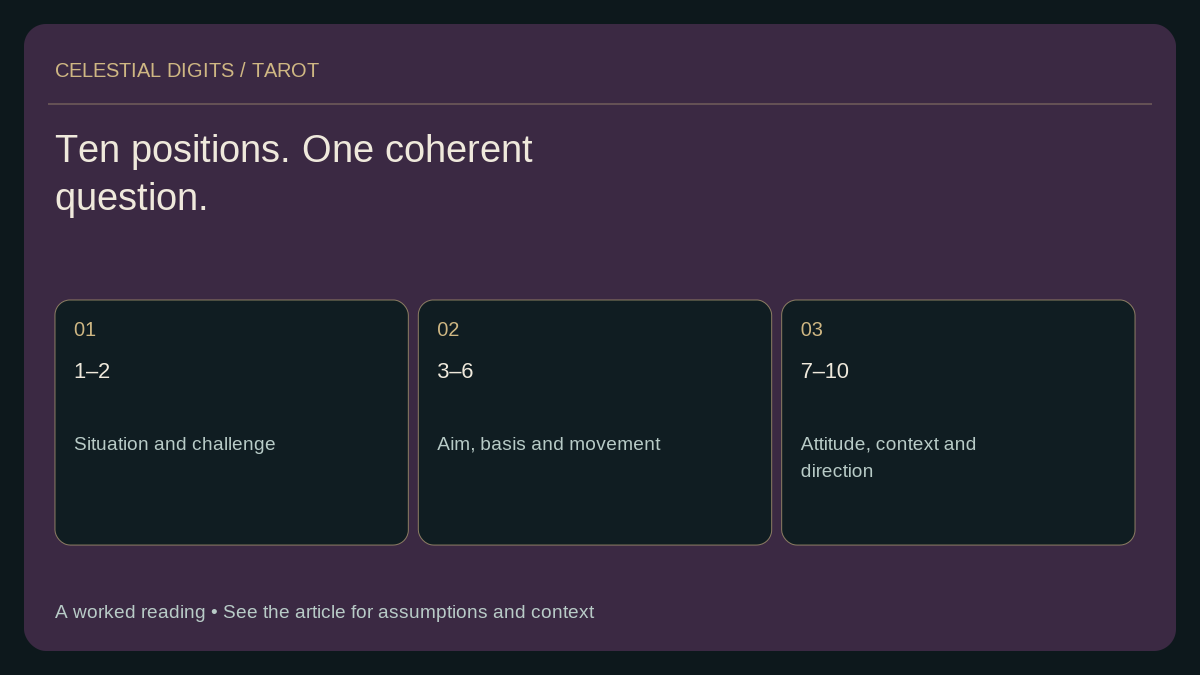
The Celtic Cross Explained Through One Complete Example
Follow all ten Celtic Cross positions in a fictional creative-project reading, then combine the cards into a practical, conditional interpretation.
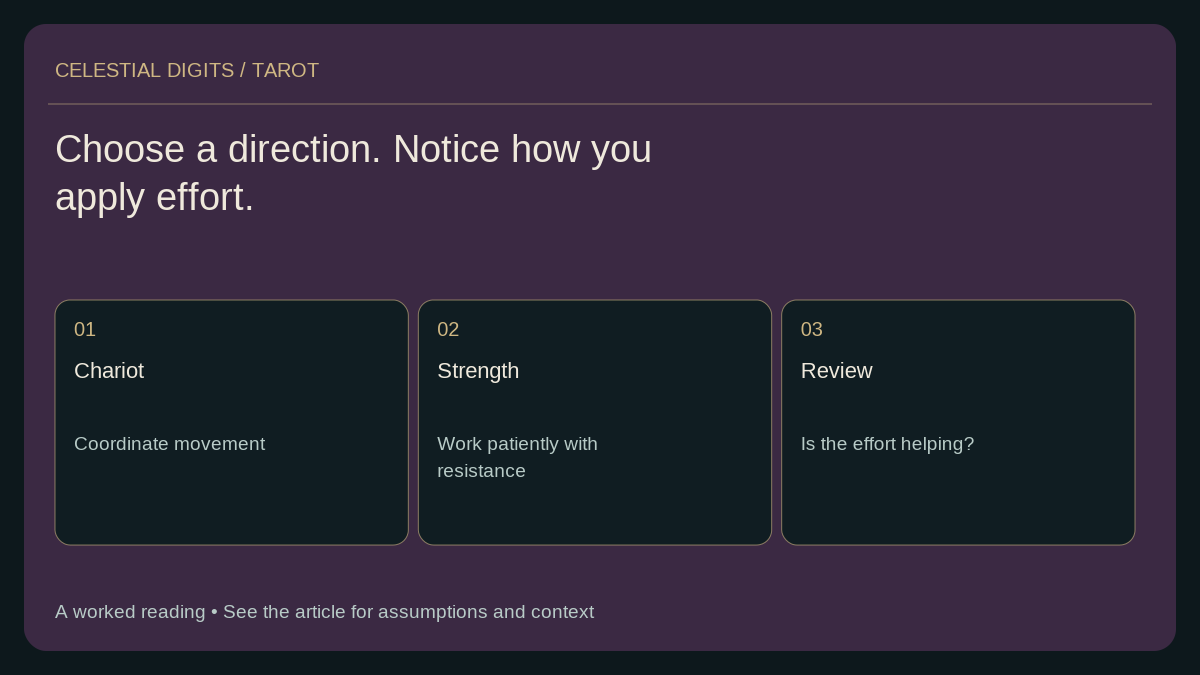
The Chariot vs Strength: Direction, Persistence and Resistance
Compare purposeful direction with patient self-regulation through a rehearsal example, without treating either card as a command to push harder.
The Devil Card: Attachment, Habit and Recovering Your Choices
Explore the Devil card through a low-stakes habit example, without treating it as proof of a curse, diagnosis or another person’s character.
A little more perspective.
Keep discussions respectful. No harassment, hate, sexual content or spam. Comments are reviewed before publication. Report concerns from a comment menu, or contact [email protected].
Checking your session…