
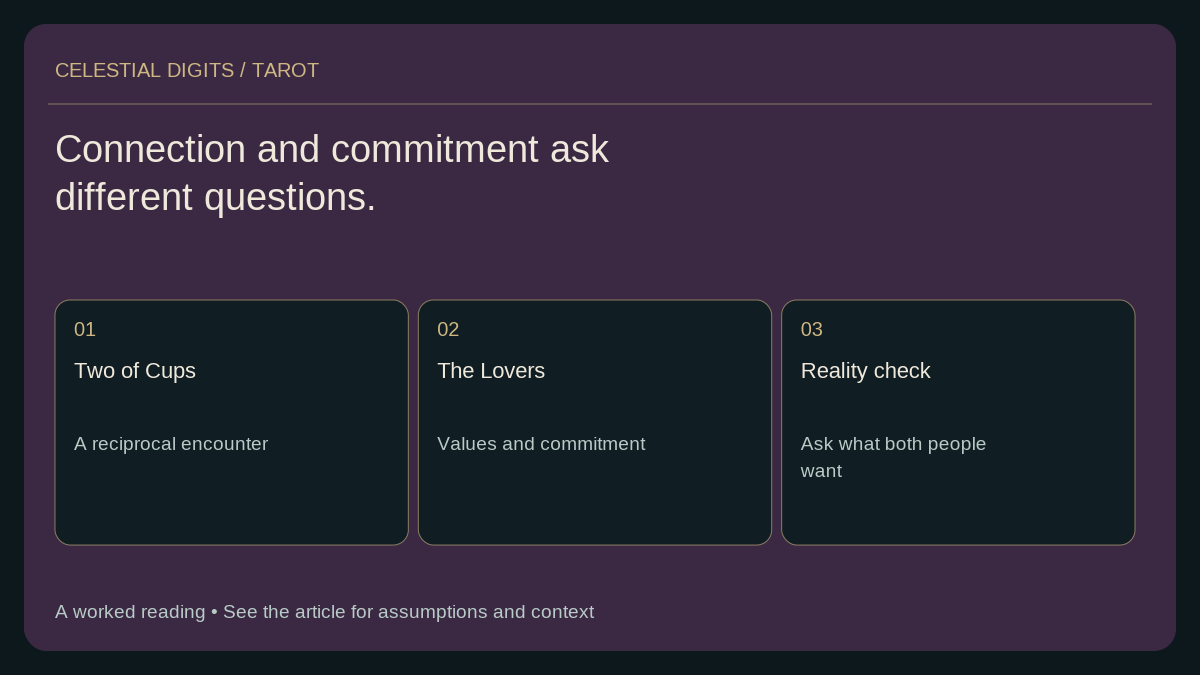
The Lovers vs Two of Cups: Choice, Alignment and Connection
Compare two relationship-related tarot cards without promising a soulmate, using a worked example about shared values and everyday exchange.
The Lovers and Two of Cups both invite relationship readings, but they need not say the same thing. Two of Cups often focuses attention on an exchange between people. The Lovers can open a broader discussion of alignment, commitment and the values involved in a choice.
Neither card proves that a particular person is a soulmate or that a relationship will last. The people involved still need to speak for themselves.
Compare the images#
The Rider–Waite–Smith Two of Cups shows two figures exchanging cups. The action is immediate and relational: meeting, offering and responding. The Lovers places two figures beneath a larger winged presence, with a more expansive symbolic setting.
Modern readings frequently use the Lovers to discuss values and significant choices. That is an interpretive development to distinguish from simply quoting Waite's own theological account of the image.
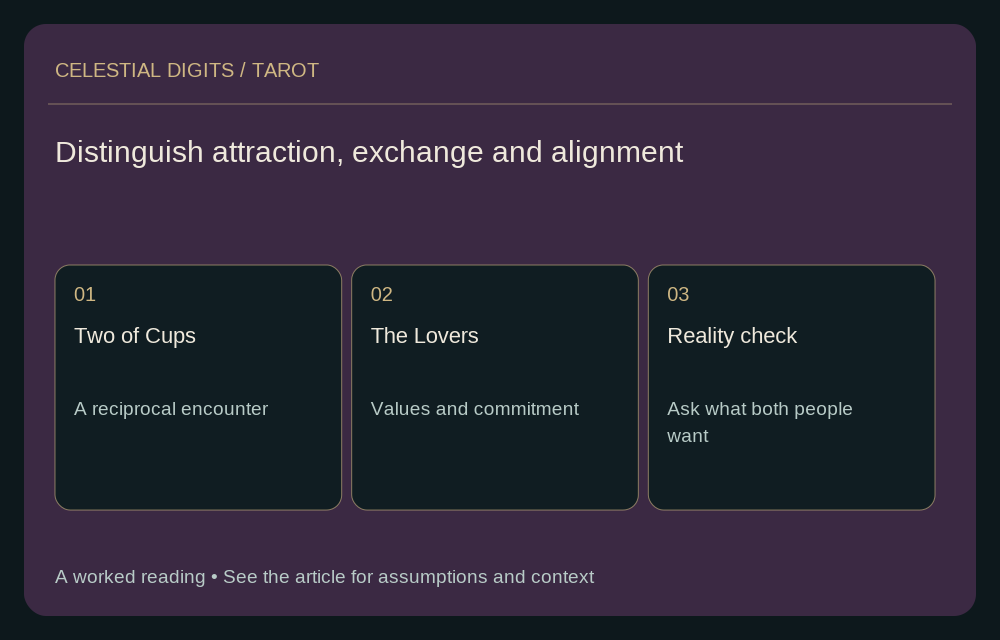
A fictional relationship example#
Imagine two people enjoy spending time together but have not discussed what they want from the relationship. In a teaching spread, Two of Cups appears in “What works between us?” and the Lovers in “What needs a conscious decision?”
The first card can prompt them to recognise mutual attention, enjoyable conversation or a willingness to listen. The second asks whether their intentions and commitments are aligned. Warm interaction does not automatically answer questions about exclusivity, future plans or the pace of the relationship.
| Card emphasis | Question to explore | What not to assume |
|---|---|---|
| Two of Cups | Is the exchange mutual and respectful? | Both people want the same future |
| The Lovers | Which values and commitments guide the choice? | A bond is destined or compulsory |
The same distinction outside romance#
Two collaborators may communicate easily while disagreeing about the purpose of a project. Two of Cups can frame the quality of their exchange; the Lovers can frame the decision about whether their values support a shared commitment.
A friendly conversation is valuable, but it does not replace agreement about responsibilities. Conversely, a shared principle does not guarantee easy day-to-day communication. Reading both layers prevents a single positive card from doing too much work.
Challenge positions change the emphasis#
Two of Cups as a challenge may prompt questions about unequal effort, an unspoken expectation or difficulty receiving support. It does not prove betrayal. The Lovers as a challenge may prompt examination of a choice that conflicts with stated values, or a reluctance to acknowledge different priorities.
These possibilities need to be checked through conversation and behaviour. A card is not evidence about another person's private feelings, and it should not be used to pressure someone into a relationship or commitment.
A practical conversation after the reading#
Try three questions: What do we each appreciate here? What are we each expecting? What needs to be agreed rather than assumed? Allow different answers without treating them as a failure of the reading.
If the answers reveal incompatibility, the purpose is clarity, not finding another spread that produces reassurance. If they reveal common ground, the next step is an ordinary agreement that both people freely understand.
Continue with useful tarot questions and reading two cards together.
Source and scope#
The imagery belongs to the Rider–Waite–Smith deck documented in The Pictorial Key to the Tarot. The distinction between exchange and conscious alignment, and the fictional conversations, are our contemporary teaching interpretation rather than a claim of predictive certainty.
Related Posts
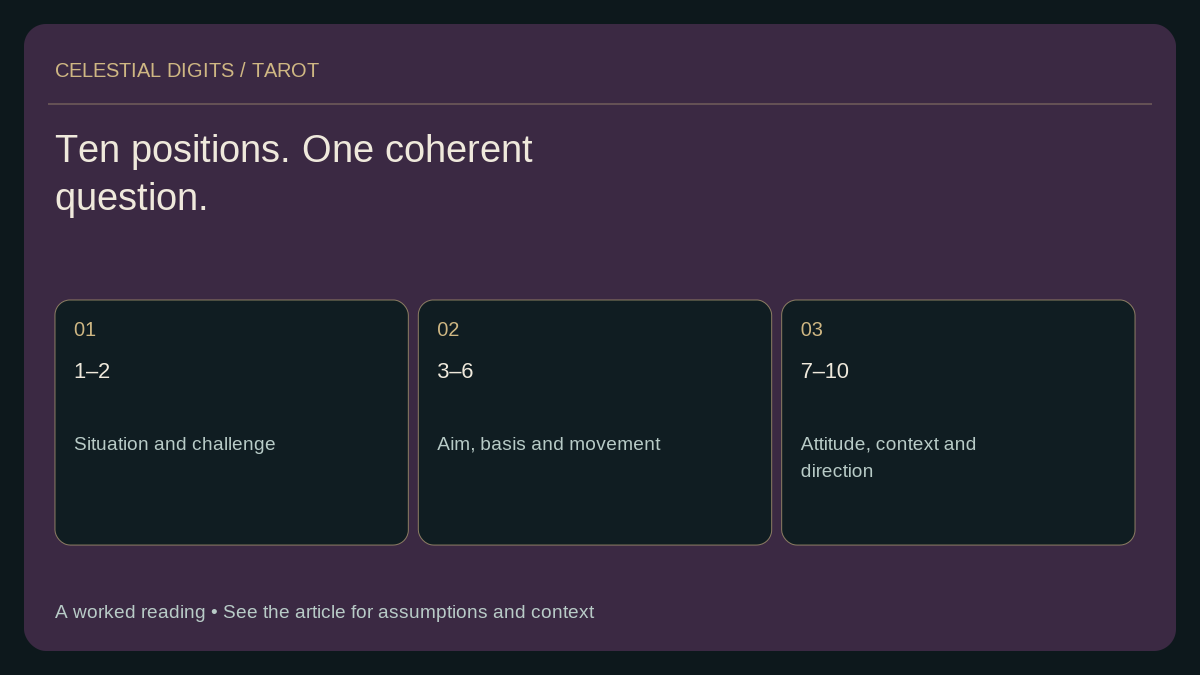
The Celtic Cross Explained Through One Complete Example
Follow all ten Celtic Cross positions in a fictional creative-project reading, then combine the cards into a practical, conditional interpretation.
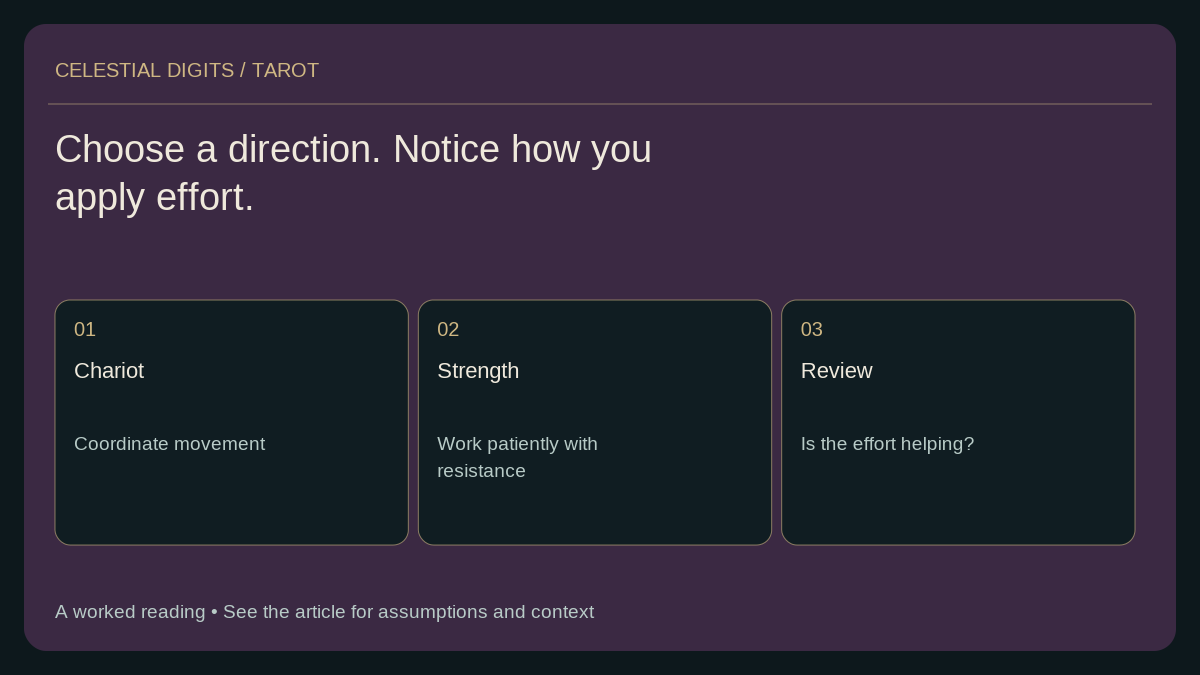
The Chariot vs Strength: Direction, Persistence and Resistance
Compare purposeful direction with patient self-regulation through a rehearsal example, without treating either card as a command to push harder.
Death vs The Tower: Endings, Disruption and What Comes Next
Compare two often-feared tarot cards through project examples, separating symbolic change from literal predictions of disaster.
A little more perspective.
Keep discussions respectful. No harassment, hate, sexual content or spam. Comments are reviewed before publication. Report concerns from a comment menu, or contact [email protected].
Checking your session…