
The Celtic Cross Explained Through One Complete Example
Follow all ten Celtic Cross positions in a fictional creative-project reading, then combine the cards into a practical, conditional interpretation.
The Celtic Cross is useful when a question has several interacting parts. Its ten positions can separate the current situation, obstacles, background, personal attitude and surrounding conditions. Without that structure, ten cards can become ten unrelated paragraphs.
This walkthrough uses a fictional question: “What should I understand before developing my weekend illustration project into a regular public practice over the next three months?” The cards are selected deliberately for teaching, not presented as a random draw or a forecast for you.
Choose the position meanings first#
There are several Celtic Cross variants. Here we keep the sequence of aims, foundation, past and approaching influence used in Waite's published method, while interpreting the final position as a conditional direction rather than an inevitable event. We omit the optional separate significator card.
Lay cards 1 and 2 together at the centre, with 2 crossing 1. Put 3 above, 4 below, 5 to the left and 6 to the right. Place 7, 8, 9 and 10 in a separate vertical column, reading from bottom to top. This left-to-right convention is fixed before reading.
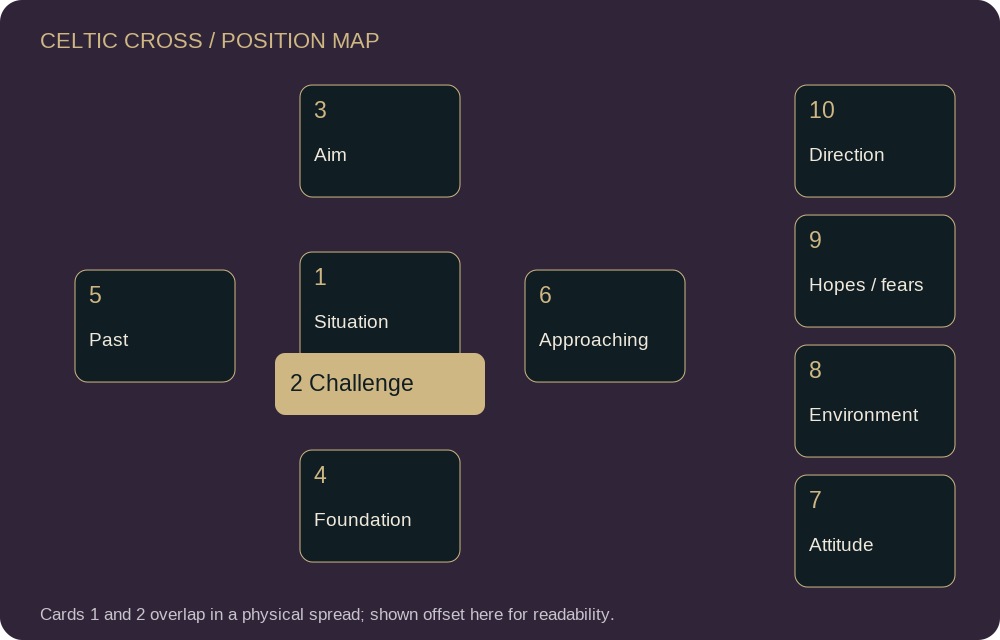
The complete teaching spread#
| Position | Question answered | Selected card |
|---|---|---|
| 1: Situation | What is happening now? | Eight of Pentacles |
| 2: Challenge | What complicates it? | Two of Pentacles |
| 3: Aim | What is the person reaching towards? | The Star |
| 4: Foundation | What already supports the situation? | Six of Cups |
| 5: Recent past | What influence is receding? | Four of Swords |
| 6: Approaching influence | What may need attention next? | Three of Pentacles |
| 7: Attitude | How is the person approaching this? | Page of Wands |
| 8: Environment | What surrounding conditions matter? | Queen of Pentacles |
| 9: Hopes and fears | What is emotionally charged? | Six of Wands |
| 10: Conditional direction | Where might this pattern lead? | Temperance |
Read the centre before the rest#
Eight of Pentacles places the emphasis on repeated craft. Two of Pentacles, as the crossing card, asks how practice fits around existing commitments. The central problem is therefore not “Do I have talent?” but “Can I give the work a sustainable place in my week?”
This is a positional interpretation. In a different spread, Two of Pentacles might describe a useful capacity to adapt rather than a challenge. Do not give the card a fixed negative role independently of its position.
Connect the aim with the foundation#
The Star as an aim suggests a desire for renewal, openness or work that feels meaningful. Six of Cups beneath it points towards familiar material, earlier interests or the pleasure that first drew the person to illustration.
Together, these cards can frame a useful question: is the project being built around an authentic interest, or around an imagined audience's approval? That is a question to investigate, not a claim that the cards reveal hidden motives.
Four of Swords in the recent past suggests a period of stepping back. Three of Pentacles in the approaching position introduces feedback, collaboration or standards shared with others. The transition is from private recovery towards constructive participation, provided the person's real circumstances support that step.
Compare attitude with environment#
Page of Wands describes an exploratory attitude. Enthusiasm can help start a project, but it does not yet supply a schedule or a reliable process. Queen of Pentacles in the environment can represent practical support, usable space or someone who helps make resources manageable.
Do not insist that the court card must be a particular woman. Ask whether the role exists: who or what makes the work easier to sustain? It might be a household agreement, an accessible studio or a supportive collaborator.
Let the last two cards qualify the conclusion#
Six of Wands in hopes and fears highlights the desire to be seen and the possibility of anxiety about reception. It does not promise popularity. Temperance as the conditional direction suggests integration and pacing: combine experimentation with a rhythm that can be maintained.
A coherent reading is: “The project already has a craft foundation. Time pressure is the main obstacle. Feedback and practical support could help, but public approval should not dictate every decision. A sustainable practice is a more useful near-term aim than a dramatic launch.”
Turn the reading into a reviewable experiment#
Choose two weekly practice sessions, finish one small series and request feedback from two appropriate people. After three months, review completed work, enjoyment and whether the schedule was realistic. Those observations are more useful than retrofitting every event to a card.
If ten cards feel unwieldy, begin with the three-card decision spread. Practise reading two cards together before adding more positions.
Historical source and adaptation#
Waite's Celtic method is the historical reference for the positional framework. The question, selected cards, reflective interpretation and conditional outcome approach are our own contemporary teaching adaptation. Tarot is not an established way to predict future events.
Related Posts
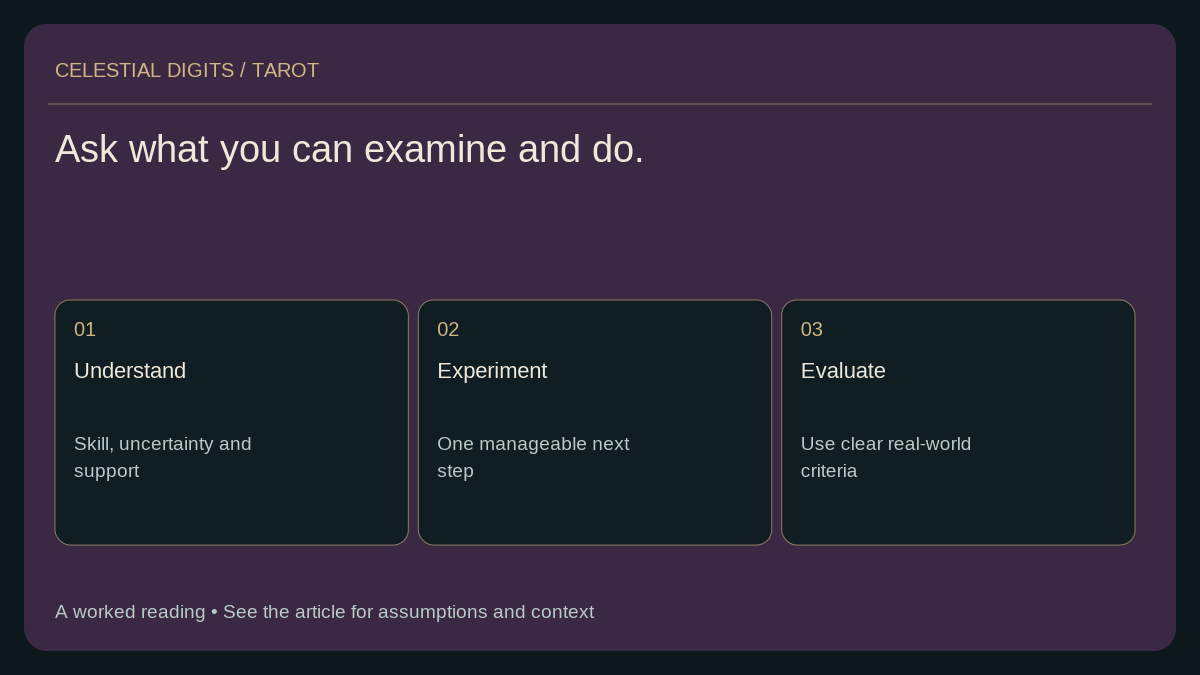
Tarot for Career Reflection: A Five-Card Worked Spread
Use five clearly defined positions to review skills, uncertainty, support, a small experiment and decision criteria without predicting a job offer.
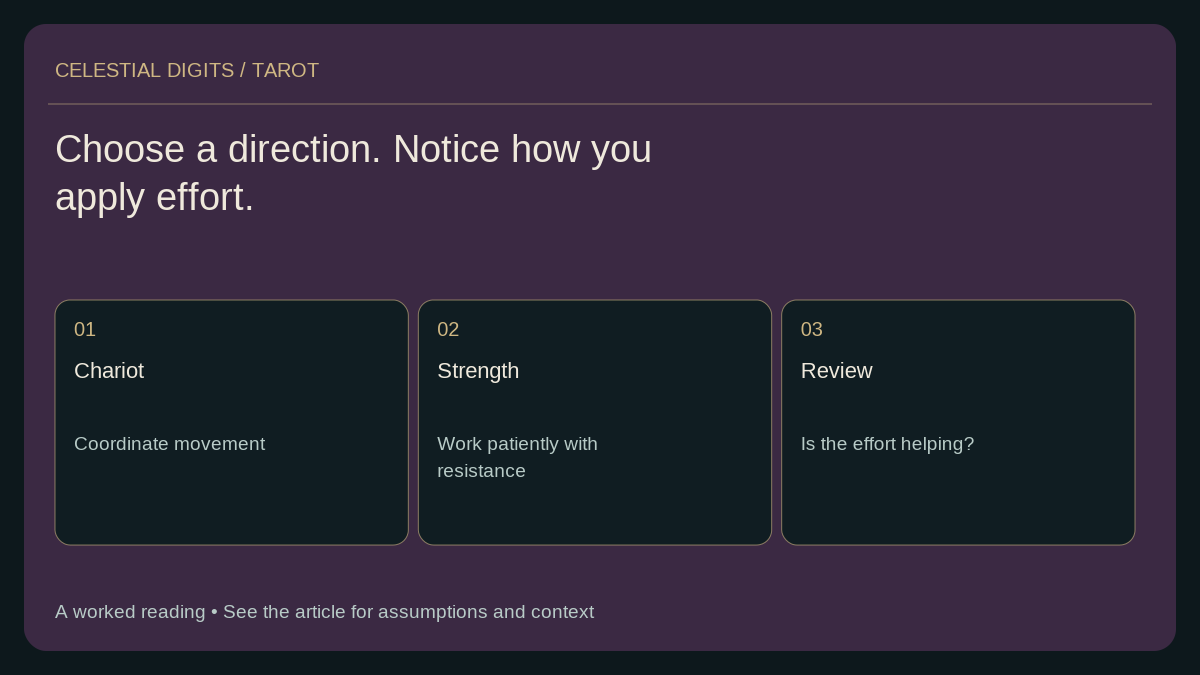
The Chariot vs Strength: Direction, Persistence and Resistance
Compare purposeful direction with patient self-regulation through a rehearsal example, without treating either card as a command to push harder.
Death vs The Tower: Endings, Disruption and What Comes Next
Compare two often-feared tarot cards through project examples, separating symbolic change from literal predictions of disaster.
A little more perspective.
Keep discussions respectful. No harassment, hate, sexual content or spam. Comments are reviewed before publication. Report concerns from a comment menu, or contact [email protected].
Checking your session…