
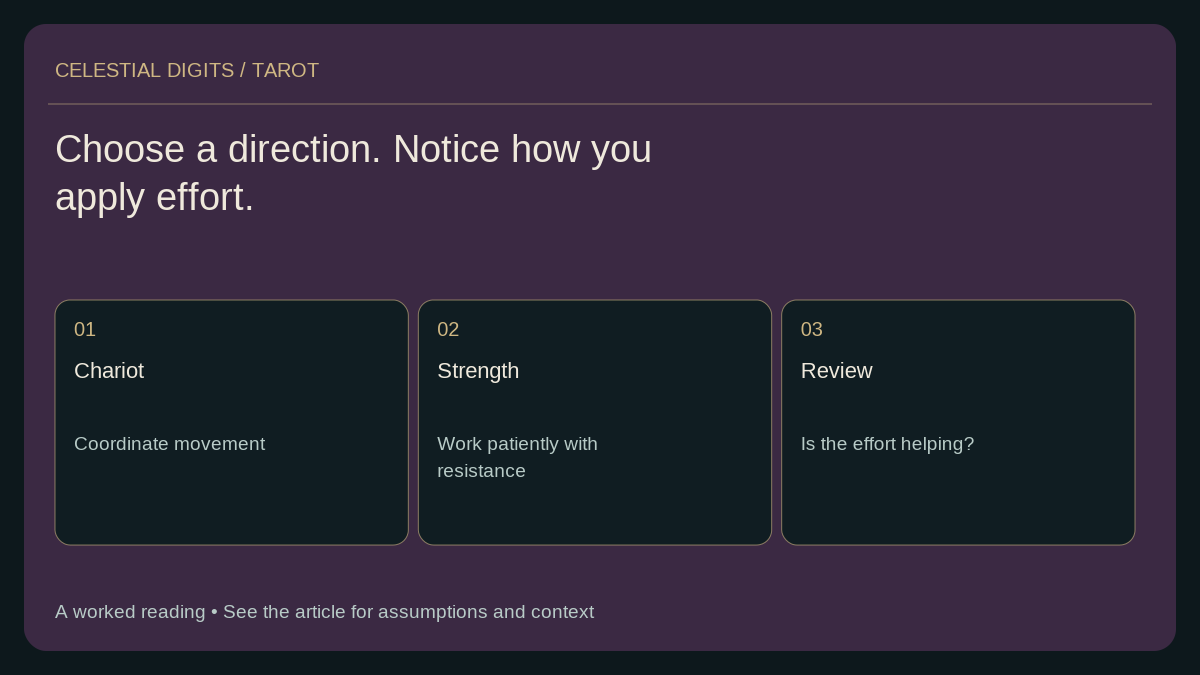
The Chariot vs Strength: Direction, Persistence and Resistance
Compare purposeful direction with patient self-regulation through a rehearsal example, without treating either card as a command to push harder.
The Chariot and Strength both suggest the capacity to meet a challenge, but they emphasise different relationships with effort. The Chariot can prompt questions about direction and coordination. Strength can prompt questions about patience and how resistance is handled.
Neither is a universal instruction to push harder. Sometimes effective persistence requires a clearer plan; sometimes it requires changing the way effort is applied.
Compare the scenes#
The Rider–Waite–Smith Chariot places a commanding figure above two contrasting sphinxes. Strength shows a person engaging with a lion without a conventional weapon. The visual contrast makes a useful starting point: organising forces towards a direction versus responding to intensity without escalating it.
Waite's own spiritual interpretations are more specific than many modern keyword lists. The practical comparison here is a contemporary teaching exercise based on the imagery.
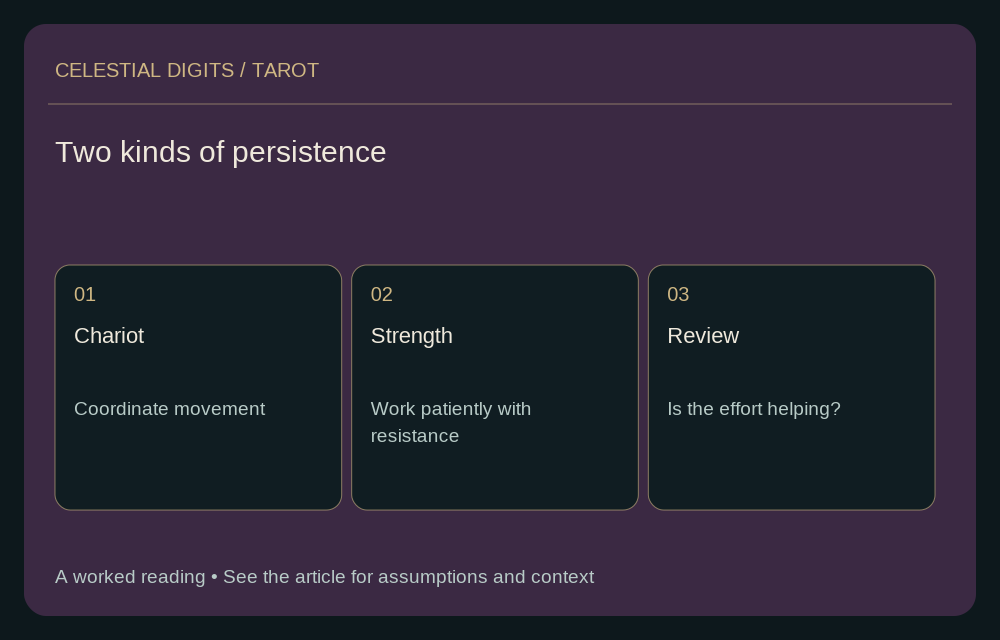
A rehearsal example#
Imagine a small theatre group is preparing a performance. In a constructed spread, the Chariot appears in “What needs direction?” and Strength in “How should we approach the difficulty?”
The Chariot can prompt a clear rehearsal order, agreed priorities and a realistic destination for the session. Strength can prompt patience when someone struggles with a scene, or a calmer response when frustration begins to spread.
| Card emphasis | Useful action | Possible excess |
|---|---|---|
| Direction | Agree which scene to complete | Treat every deviation as failure |
| Patient engagement | Break a difficult section into parts | Endure an unhelpful process indefinitely |
The two approaches work together when the group knows what it is doing and can adapt how it gets there.
What changes in a challenge position?#
The Chariot as a challenge may raise the question of competing goals or control that has become too rigid. Strength as a challenge may raise the question of suppressed frustration or patience being confused with silence.
Those are possibilities to investigate. The cards do not prove that a particular person is controlling or emotionally weak. Ask what is happening in the situation and allow the answer to shape the reading.
Persistence needs feedback#
Suppose repeating the whole scene produces the same mistake. More repetition alone may not help. A shorter exercise, clearer instruction or a different arrangement may be more effective. Continuing to force the original method is not automatically courageous.
After trying a change, review whether it reduced confusion and improved the work. That observation is more informative than insisting that a card promised victory.
A two-question exercise#
Write the destination in one sentence: what would count as useful progress today? Then describe the manner of effort: how will you respond if the task becomes frustrating? Keep both answers specific enough to review afterwards.
This exercise can support reflection about a project or conversation. It does not establish that difficult circumstances are someone's fault, or that endurance should replace needed support or boundaries.
Continue with care and structure in the Empress and Emperor and the three-card decision spread.
Historical reference#
The images and original descriptions appear in Waite's Pictorial Key to the Tarot. The rehearsal scenario and comparison are our original reflective application; they are not claims that tarot predicts success.
Related Posts
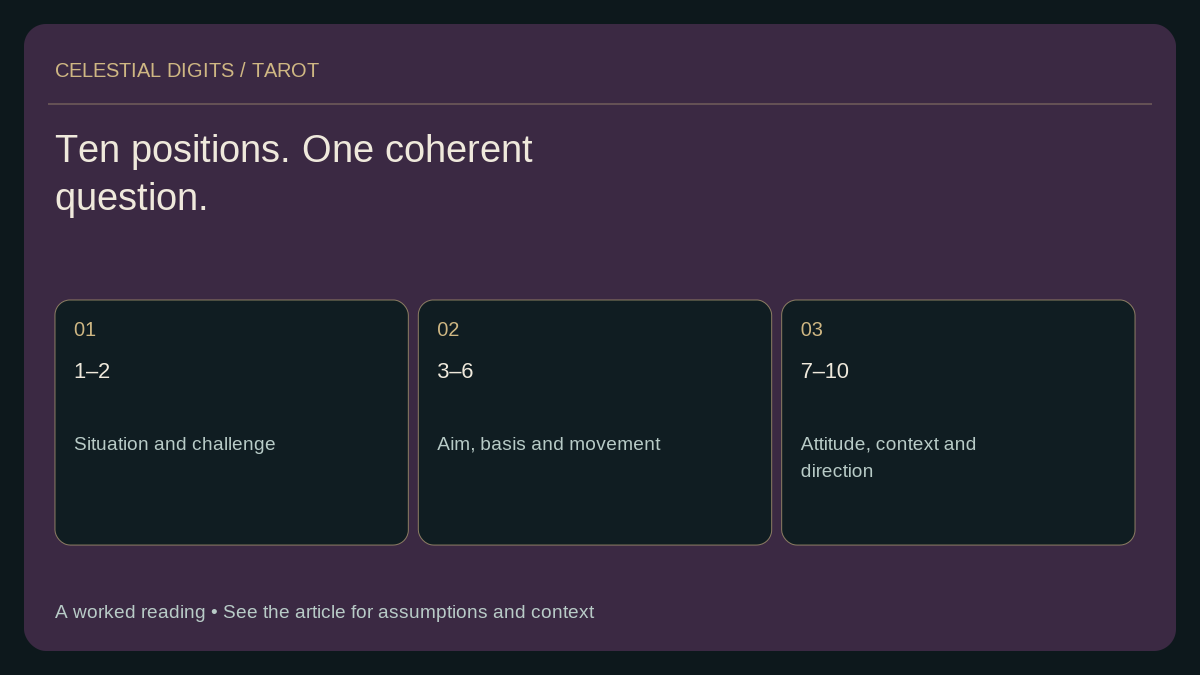
The Celtic Cross Explained Through One Complete Example
Follow all ten Celtic Cross positions in a fictional creative-project reading, then combine the cards into a practical, conditional interpretation.
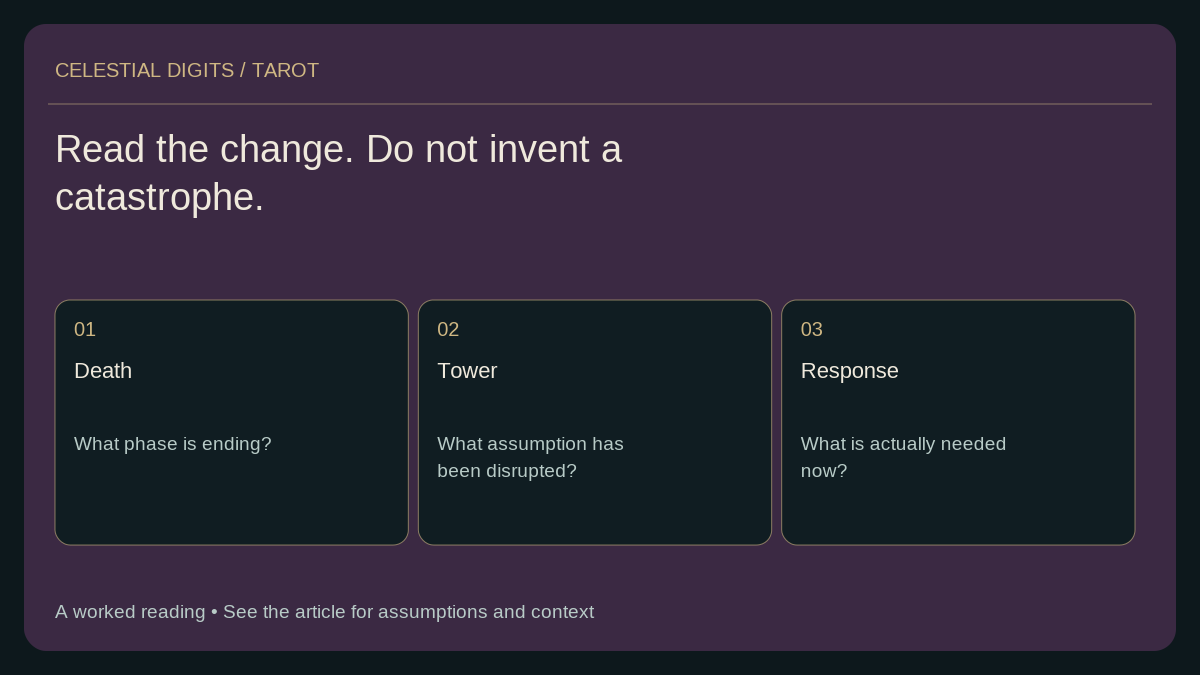
Death vs The Tower: Endings, Disruption and What Comes Next
Compare two often-feared tarot cards through project examples, separating symbolic change from literal predictions of disaster.
The Devil Card: Attachment, Habit and Recovering Your Choices
Explore the Devil card through a low-stakes habit example, without treating it as proof of a curse, diagnosis or another person’s character.
A little more perspective.
Keep discussions respectful. No harassment, hate, sexual content or spam. Comments are reviewed before publication. Report concerns from a comment menu, or contact [email protected].
Checking your session…