
Tarot Numerology: Aces Through Tens Without Mixing Systems
Use a numbered-card learning framework, then compare the four Tens to see why suit, image and spread position matter more than a number alone.
Number patterns can help a beginner organise the Minor Arcana, but a tarot number is not automatically the same thing as a birth number in numerology. A Seven of Cups does not become a Ketu reading simply because some Indian numerology systems associate seven with Ketu.
Start with the deck's own imagery and suit structure. If you add another correspondence system, name it and explain how it is being used rather than presenting the mixture as universal.
Use a learning framework, not a rigid dictionary#
The following is an original study scaffold for Rider–Waite–Smith numbered cards. It is not a claim that Waite assigned these exact meanings to every rank.
| Rank | A useful question to explore |
|---|---|
| Ace | What possibility is being introduced? |
| Two | What relationship or choice is forming? |
| Three | What is developing or being expressed? |
| Four | What structure is being held? |
| Five | What tension or disruption needs attention? |
| Six | What adjustment, exchange or movement appears? |
| Seven | What assessment or challenge is shown? |
| Eight | What sustained process is underway? |
| Nine | What has accumulated or become pronounced? |
| Ten | What culmination, burden or transition is visible? |
These questions are deliberately broad. The card image can contradict a convenient keyword, and that is a reason to look more closely rather than force the keyword to fit.
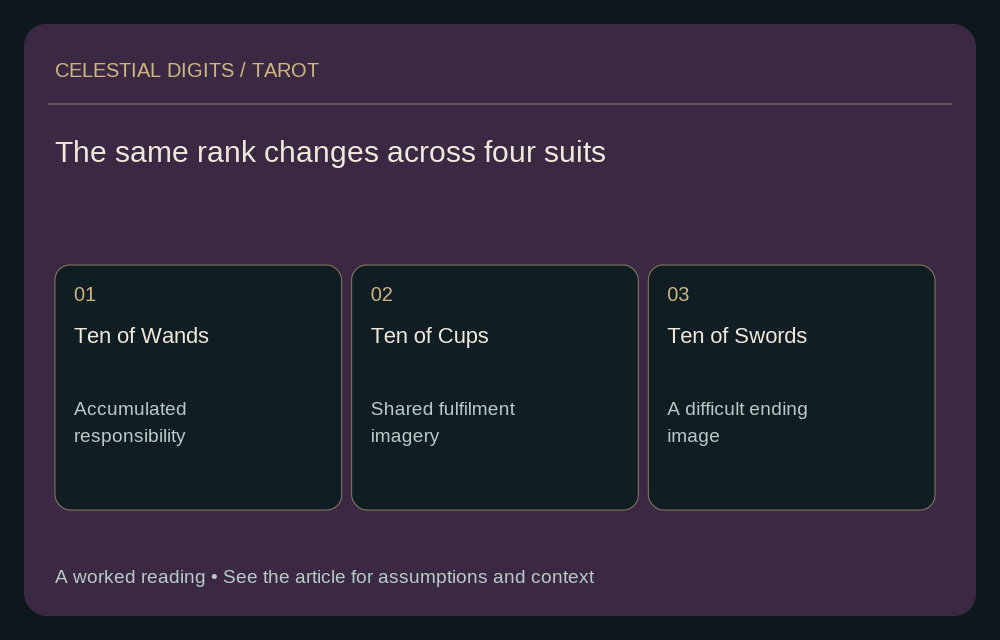
Compare the four Tens#
The Ten of Wands shows a figure carrying a heavy bundle. The Ten of Cups presents a scene of shared contentment beneath a rainbow. The Ten of Swords depicts a painful ending image. The Ten of Pentacles places people and animals within a family or estate setting.
All share the rank ten, but they do not describe identical experiences. “Completion” alone is too thin: completion can feel burdensome, satisfying, difficult or connected to continuity and inheritance, depending on the image and context.
Add the suit without erasing the scene#
Wands can direct attention toward effort and initiative, Cups toward feeling and relationship, Swords toward thought and conflict, and Pentacles toward practical or material concerns. These familiar contemporary suit associations are starting points, not exclusive boundaries.
For example, the Ten of Wands can prompt a practical question about workload. It need not mean that all Wands are about employment or that every burden is self-created. The specific question being asked still matters.
Keep rank separate from reduction#
Reducing ten to one may be meaningful in a numerological exercise, but it does not turn the Ten of Swords into the Ace of Swords. The deck contains separate images and positions for those cards.
Likewise, court cards should not be assigned arbitrary numerical values and then treated as though the deck supplied them. Different esoteric systems make different choices; identify the chosen framework when studying one.
Try a comparison exercise#
Lay out all four cards of one rank. Record one shared structural question, one distinctive visual detail per card and one situation in which their meanings would diverge. Then place one card in two different spread positions and note what changes.
This builds familiarity with the deck without requiring a universal number formula to explain every image.
Read the four suits and the effect of spread positions.
Source and scope#
The four Ten descriptions are grounded in Waite's Pictorial Key. The rank-question table is an original contemporary learning aid. Tarot and Indian numerology have distinct histories and conventions; combining them is a chosen interpretive method, not a demonstrated universal rule.
Related Posts
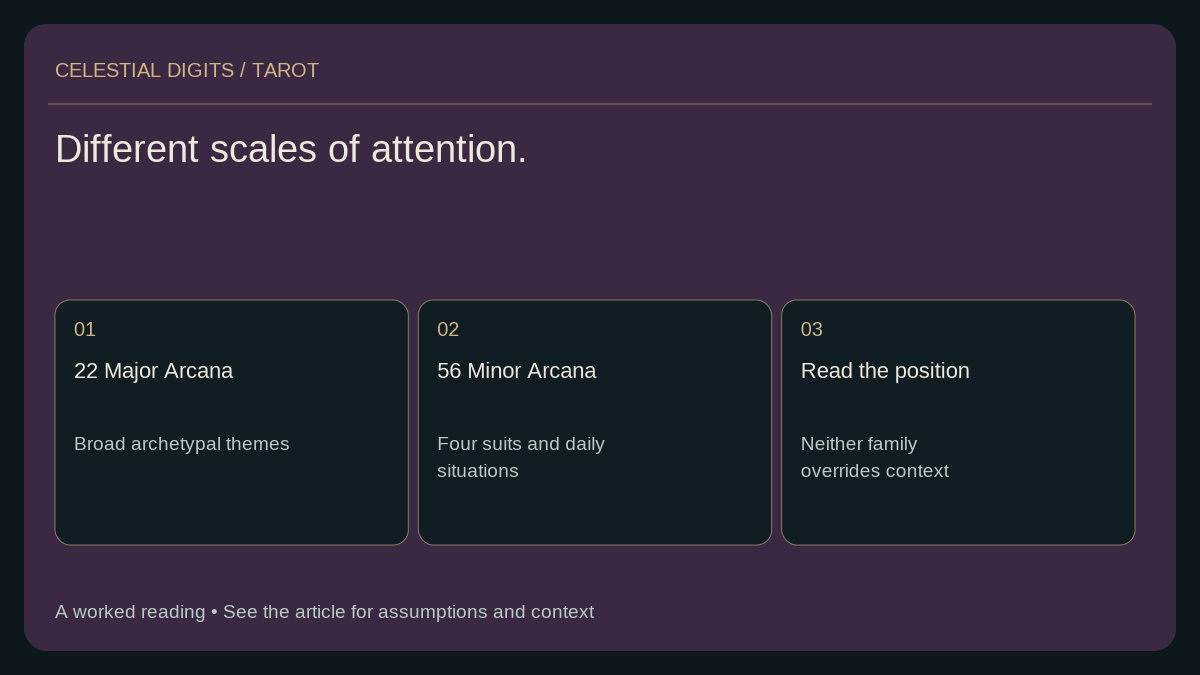
Major vs Minor Arcana: Big Themes and Everyday Situations
Understand the 22 Major and 56 Minor Arcana through two sample readings, without treating a Major card as an inevitable event.
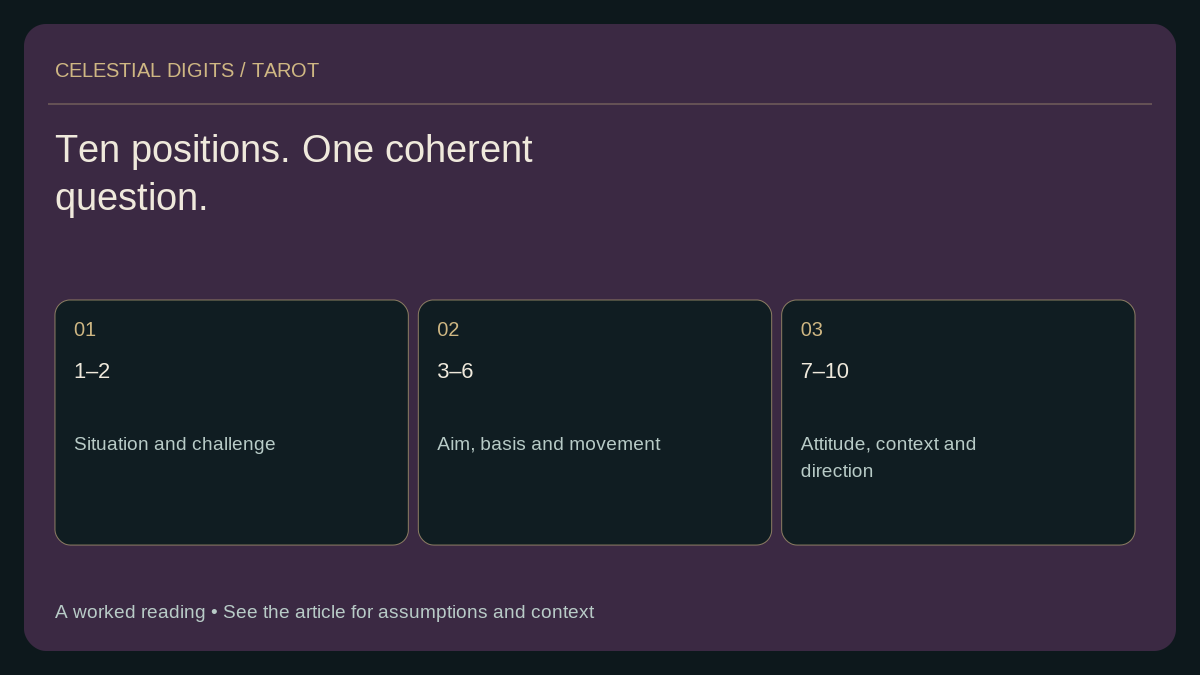
The Celtic Cross Explained Through One Complete Example
Follow all ten Celtic Cross positions in a fictional creative-project reading, then combine the cards into a practical, conditional interpretation.
The Chariot vs Strength: Direction, Persistence and Resistance
Compare purposeful direction with patient self-regulation through a rehearsal example, without treating either card as a command to push harder.
A little more perspective.
Keep discussions respectful. No harassment, hate, sexual content or spam. Comments are reviewed before publication. Report concerns from a comment menu, or contact [email protected].
Checking your session…