
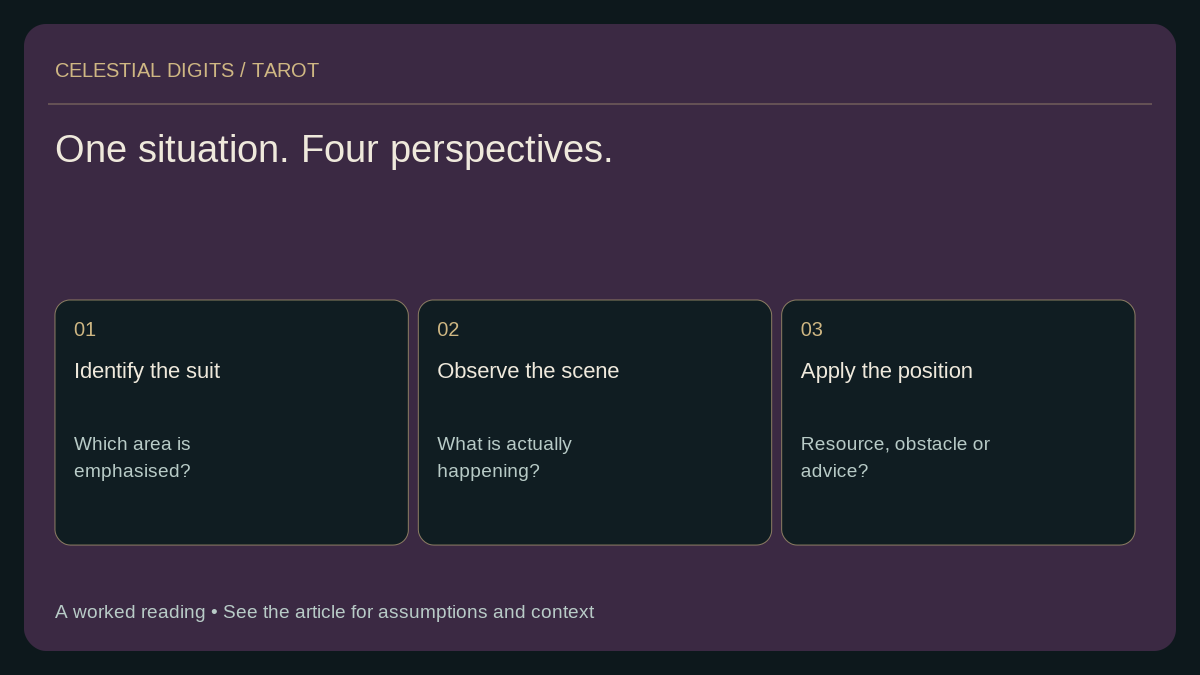
The Four Tarot Suits: Cups, Wands, Swords and Pentacles
Explore all four tarot suits through one community-project example, distinguishing emotion, initiative, reasoning and resources.
The four tarot suits are easier to learn when they describe different aspects of the same situation. A relationship has practical responsibilities as well as feelings. A career decision has uncertainty and motivation as well as money. No suit owns an entire area of life.
In this guide, we use common contemporary Rider–Waite–Smith associations and a fictional community-project example. Elemental correspondences are interpretive conventions; they are not instructions to replace a Vedic planetary or numerology system with tarot.
A working map of the four suits#
| Suit | Common elemental association | Useful area of attention |
|---|---|---|
| Wands | Fire | Initiative, motivation and the use of energy |
| Cups | Water | Feeling, connection and emotional response |
| Swords | Air | Thought, language, conflict and decisions |
| Pentacles | Earth | Resources, skill, material conditions and upkeep |
This map is a starting point. It does not mean Cups are always romantic, Swords always harmful or Pentacles always about a bank balance. The individual image and its spread position make the reading more specific.
One project seen through four cards#
Imagine neighbours organising a small reading room. They have enthusiasm but have not yet agreed how it will operate. We deliberately select four cards to practise the suit distinctions; this is not a random prediction about a real organisation.
Ace of Wands can frame the initial impulse: what idea gives the group energy? Perhaps someone wants a welcoming place for children to read after school. The discussion is about starting power, not proof that the project will last.
Two of Cups can frame mutual understanding: what does each partner believe they are agreeing to? A handshake matters only if the participants share expectations. The card need not imply a romance between organisers.
Ace of Swords can frame clarity: which rule or decision needs to be stated plainly? Who can use the room, who holds keys and what happens when expectations conflict? Clear words can support cooperation rather than threaten it.
Three of Pentacles can frame practical collaboration: who has the skills to fit shelves, organise books and maintain the space? Material competence is part of caring for the project, not a distraction from its meaning.
Why one suit cannot answer everything#
If a real spread emphasised Wands, it could invite attention to enthusiasm, impatience or competing plans. It would not prove that rent and staffing are irrelevant. An absent suit does not establish that the corresponding area is missing from someone's life.
Similarly, several Cups cards might focus a reading on relationships among organisers while the actual decision still depends on a lease. The spread can suggest a perspective; it does not supply the lease terms.
Read the rank and scene as well#
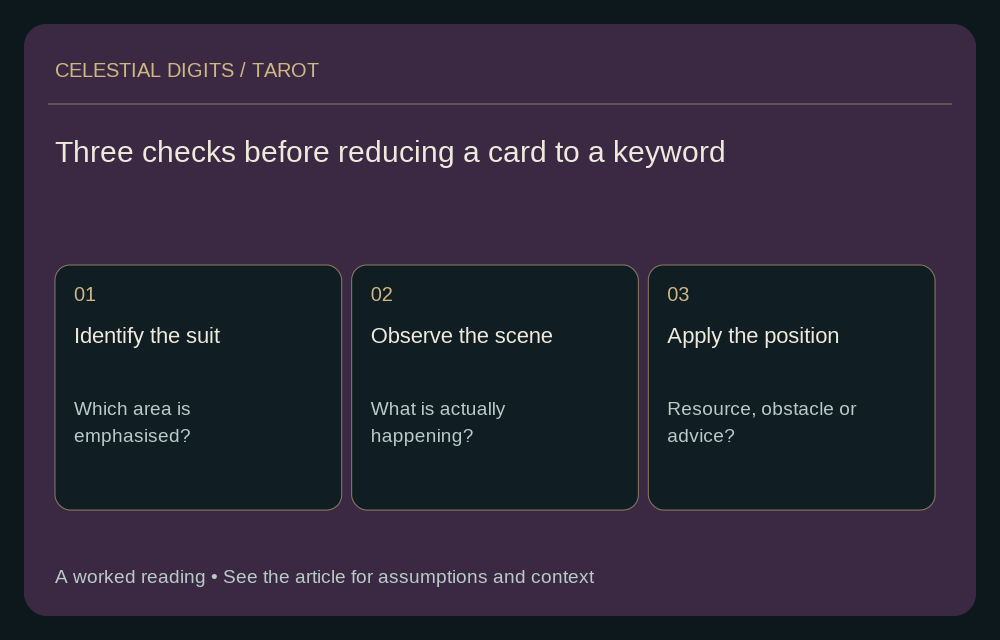
An Ace, Five and Ten in the same suit are not interchangeable. In the Rider–Waite–Smith tradition, scenic numbered cards give you more than a suit emblem. Observe what the figures are doing, what resources are present and what appears unresolved.
Then connect that observation to the position. “Pentacles means money” is too broad to distinguish the practice of the Eight from the collaboration of the Three or the guarded holding of the Four.
A short practice exercise#
Take one current project and write four headings: motivation, relationships, decisions and resources. Record one real fact and one unanswered question under each. Only then compare the notes with a chosen card from each suit. This keeps the reading connected to the situation rather than forcing the situation into a keyword list.
Waite's discussion of the four suits provides historical context. The reading-room exercise is our modern teaching example. Continue with Major and Minor Arcana and a complete beginner spread.
Related Posts
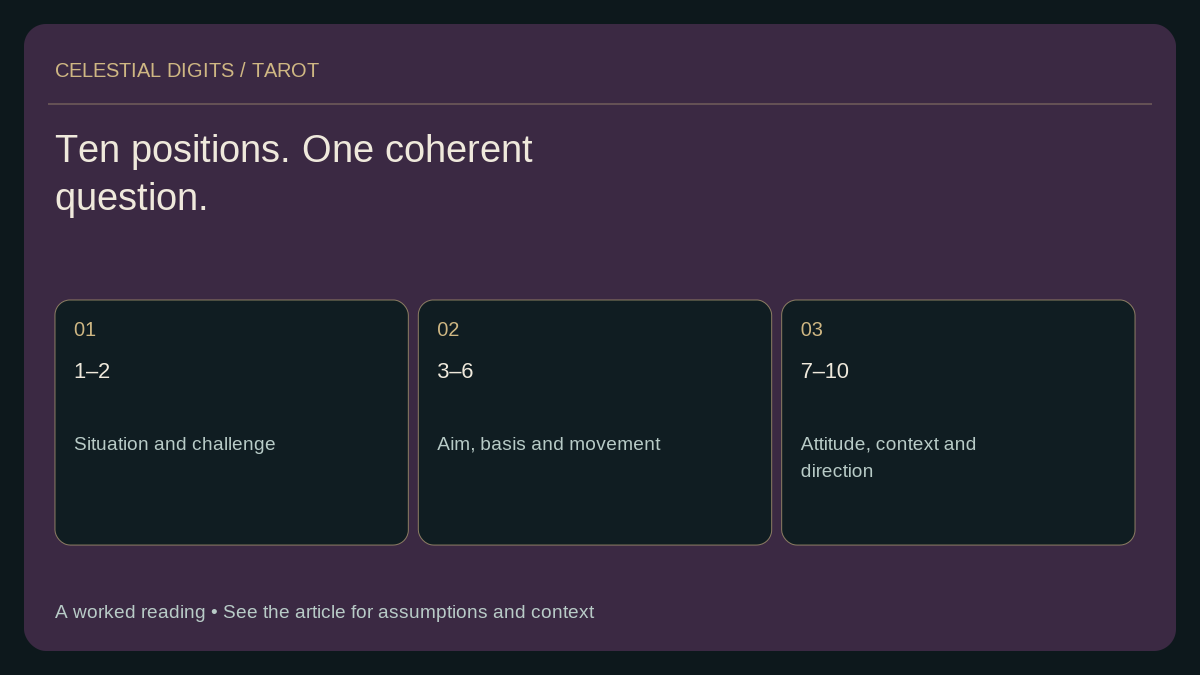
The Celtic Cross Explained Through One Complete Example
Follow all ten Celtic Cross positions in a fictional creative-project reading, then combine the cards into a practical, conditional interpretation.
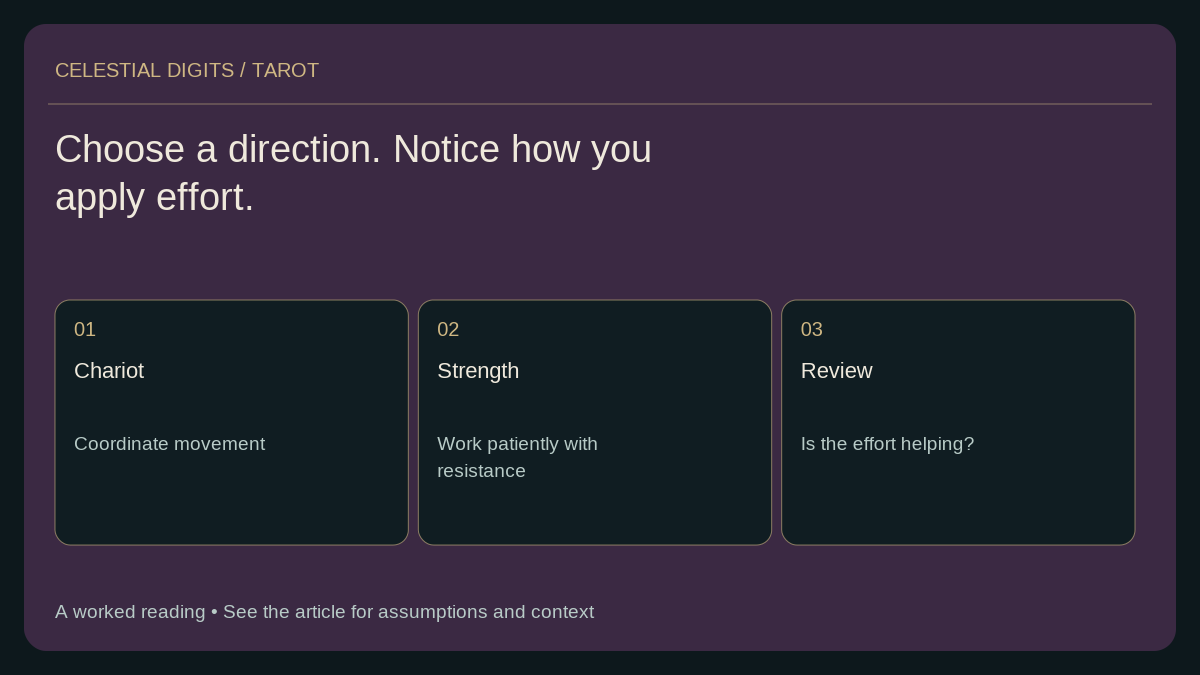
The Chariot vs Strength: Direction, Persistence and Resistance
Compare purposeful direction with patient self-regulation through a rehearsal example, without treating either card as a command to push harder.
Death vs The Tower: Endings, Disruption and What Comes Next
Compare two often-feared tarot cards through project examples, separating symbolic change from literal predictions of disaster.
A little more perspective.
Keep discussions respectful. No harassment, hate, sexual content or spam. Comments are reviewed before publication. Report concerns from a comment menu, or contact [email protected].
Checking your session…