
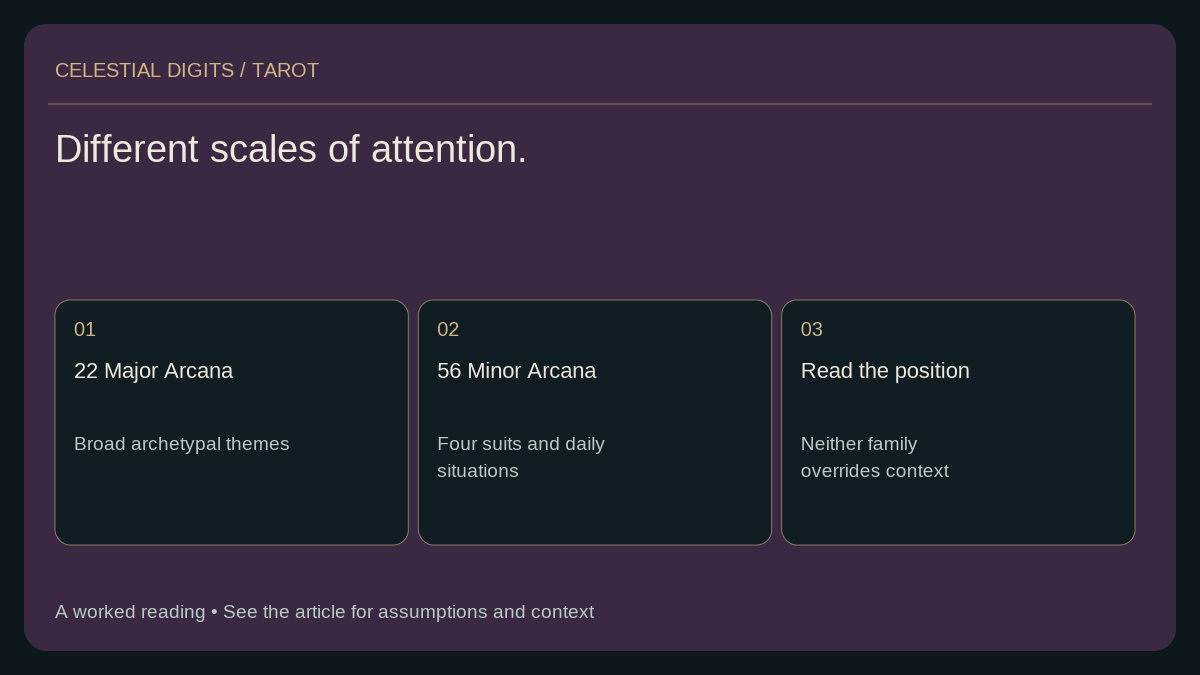
Major vs Minor Arcana: Big Themes and Everyday Situations
Understand the 22 Major and 56 Minor Arcana through two sample readings, without treating a Major card as an inevitable event.
A Major Arcana card can make a beginner feel that something enormous is about to happen. A spread without any Major cards can seem less meaningful. Neither conclusion follows from the deck structure alone.
The Major and Minor Arcana offer different ways to focus a reading. Their importance comes from the question, position and surrounding cards, not simply from belonging to one family.
Understand the structure first#
A standard Rider–Waite–Smith tarot deck contains 78 cards: 22 Major Arcana and 56 Minor Arcana. The Minor cards are divided into Wands, Cups, Swords and Pentacles. Each suit has an Ace through Ten plus Page, Knight, Queen and King.
That gives fourteen cards in each of four suits. Court cards belong to the Minor Arcana; they are not a third numerical category outside the 78.
| Family | Structure | A useful beginner lens |
|---|---|---|
| Major Arcana | Twenty-two named trumps | Larger patterns or archetypal questions |
| Numbered Minor cards | Ace through Ten in four suits | Situations, developments and responses |
| Court cards | Four ranks in each suit | Roles, approaches or people in context |
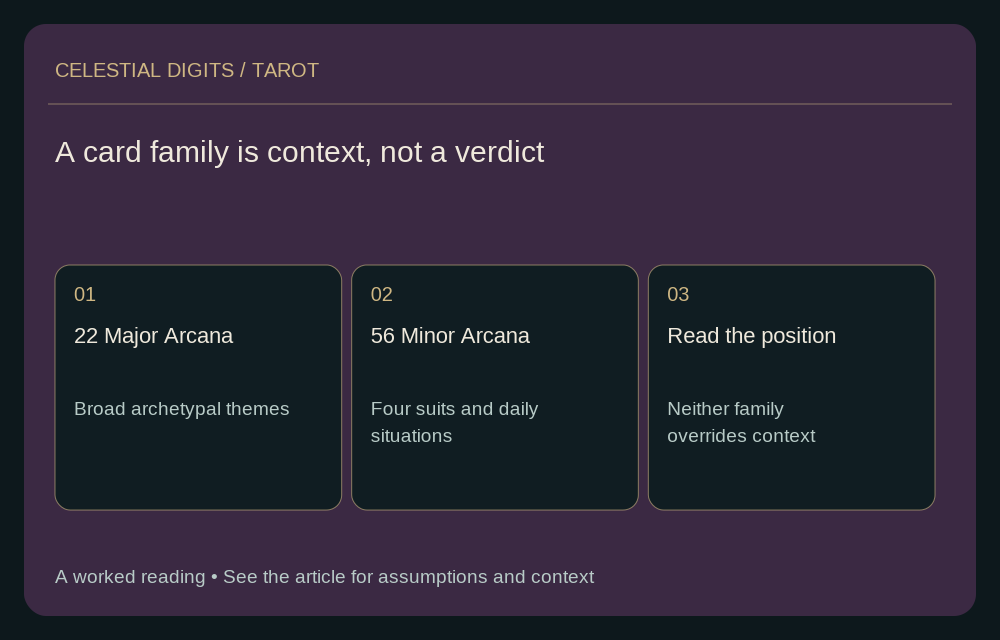
The “larger pattern” lens is a modern reading aid. It is not a rule that a Major card predicts a larger external event than every Minor card.
Compare two readings about studying#
Imagine a student asks what is affecting their preparation. In one illustrative spread, The Hermit occupies the advice position. Its solitary figure and lantern can invite a discussion about focused inquiry, choosing a reliable teacher or stepping back from distracting opinions.
In another spread, Eight of Pentacles occupies that position. Its repeated craftwork can invite a discussion about practice, revision and learning through doing. Both can lead to substantial changes in study habits, but they direct attention differently.
The Hermit does not automatically demand isolation, and the Eight does not promise that hard work will guarantee a particular grade. The student's timetable, understanding and available support remain relevant.
Read position before intensity#
A card in an obstacle position is not read in the same way as that card in a resource position. The Hermit as a resource might suggest considered reflection. As an obstacle, the reader might explore whether independent study has become avoidance of useful feedback.
That change comes from the spread's structure. It does not require pretending the card has changed its identity or that its meaning can be anything at all. The image and established symbolism still constrain the discussion.
What if a spread contains several Major cards?#
You can explore whether the question has been framed at the level of identity, values or a significant transition. But there is no universal numerical threshold at which a spread becomes “destined.” A small sample also varies naturally when cards are shuffled.
Do not keep drawing until enough Major cards appear to make a reading feel legitimate. A clear answer about a practical obstacle can be more helpful than a dramatic story about an unavoidable transformation.
Practise with a consistent question#
Choose one ordinary concern and compare a Major card with a numbered Minor card in the same position. Write what each image adds, what remains unknown and what action could be checked in real life. Label this a deliberate study exercise rather than a random reading.
For the historical deck structure and card descriptions, consult Waite's The Pictorial Key to the Tarot. For application, work through our complete three-card example and four-suit comparison. The purpose is a more precise reading, not a hierarchy of frightening and harmless cards.
Related Posts
The Empress and The Emperor: Care, Structure and Their Imbalances
Compare nurture and structure through a community-garden example, with questions for reading both cards beyond gender stereotypes.
The Fool and The World: Beginning a Journey vs Completing One
Compare two Major Arcana cards through a practical project example, and learn why openness and completion ask different questions.
Judgement: Reviewing the Past Before a New Commitment
Read the Judgement card through a practical review exercise: evidence, responsibility and a chosen next commitment rather than doom or a verdict.
A little more perspective.
Keep discussions respectful. No harassment, hate, sexual content or spam. Comments are reviewed before publication. Report concerns from a comment menu, or contact [email protected].
Checking your session…