
Strong Mahadasha Lord, Difficult Period: What Are You Missing?
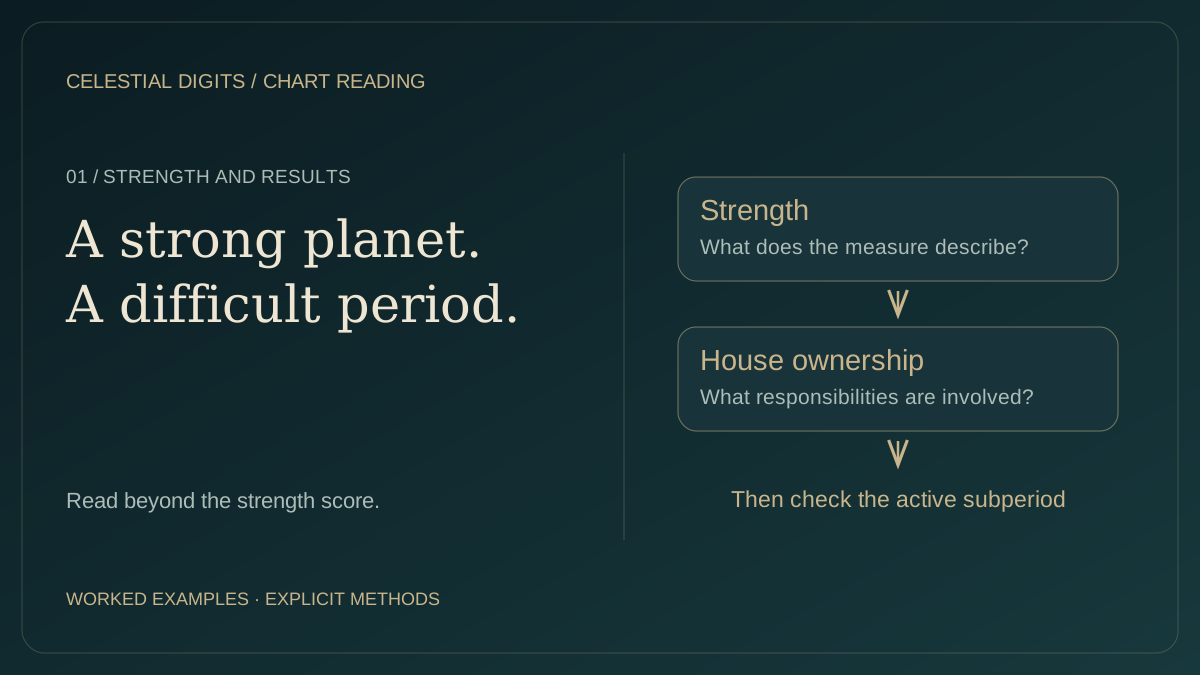
A strong planet does not guarantee an easy dasha. Use a worked example to separate strength, house ownership, placement and the current subperiod.
Your report says the mahadasha lord is strong. Perhaps it is in its own sign, perhaps its Shadbala ratio is above one, or perhaps an astrologer described it as your best planet. Yet the period feels demanding. Has the calculation failed?
First ask what the word “strong” measured. A dignity label, a Shadbala total and a statement about favourable house ownership answer different questions. None is a numerical happiness score.
This guide uses an invented chart fragment to explain the distinction. It is a lesson in traditional interpretation, not a record of someone's life or a guarantee of dasha outcomes.
Four questions hidden inside one word#
| Question | What to inspect | What it cannot establish alone |
|---|---|---|
| What responsibilities does this planet carry? | Houses it rules for the ascendant | Whether those areas will go well |
| Where are those responsibilities expressed? | Its occupied house and sign | An exact event |
| What kind of support does it have? | Dignity, strength measures, aspects and relevant divisions | Whether the person feels happy |
| Which part of the period are we discussing? | Mahadasha, antardasha and pratyantardasha dates | A result without natal context |
The dasha discussion in Brihat Parashara Hora Shastra, chapter 47 distinguishes general planetary indications from results conditioned by placement and strength. That is the traditional basis for examining several factors together. Our worksheet and example below are editorial teaching aids, not translated verses.
Worked example: Saturn in Capricorn for Gemini rising#
Assume a Gemini ascendant, whole-sign houses, and Saturn in Capricorn. We have deliberately specified only the placements needed for the exercise.
Count the signs from Gemini. Capricorn is the eighth house; Aquarius is the ninth. Saturn therefore owns both the eighth and ninth houses and occupies its own Capricorn sign in the eighth.
Three statements can now be true together:
- Saturn has own-sign dignity in this example.
- Saturn carries two different house responsibilities.
- We have not calculated Shadbala, because that requires more birth information.
Calling this simply “a strong ninth lord, so everything must be fortunate” leaves out half its ownership and its occupied house. Calling it “an eighth-house planet, so everything must go wrong” makes the opposite mistake.
A practitioner might investigate how ninth-house subjects such as study and teachers interact with eighth-house subjects such as shared resources or demanding research. For a hypothetical person undertaking a funded research degree, both the opportunity and the administrative burden could be relevant discussion points. The placement does not prove that the person will undertake that degree. This is one possible illustration, not an event prediction.
What changes inside the antardasha?#
Now suppose the hypothetical timeline is in Saturn mahadasha and Mercury antardasha. For Gemini rising, Mercury owns the first and fourth houses. That tells us which additional houses to examine; it does not tell us Mercury's actual condition.
Before offering a reading, we still need Mercury's position, its relationship with Saturn, the topic being asked about and the complete period boundaries. A paragraph about “Saturn energy” cannot supply those missing facts.
This is why a nineteen-year Saturn period should not receive one unchanging verdict. Use the Vimshottari overview for the hierarchy and the Pratyantardasha worked schedule to see how its smaller intervals fit together.
Why a Shadbala number does not settle the question#
Suppose a separate, fully calculated report gives its dasha lord a required-strength ratio of 1.20. The arithmetic means the reported total is 20% above that report's stated requirement. It does not mean 20% more luck, an 80% chance of promotion, or that every subperiod will be comfortable.
Check the components and calculation convention in the Shadbala section. If the report is using a simplified measure, compare like with like before drawing conclusions from small numerical differences.
Nor does a low score mean that a planet's difficulties disappear. A weak planet may be relevant to resources or support the person needs. “Weak malefic equals harmless” is too broad to use as a reading rule.
A useful way to investigate your own period#
Write one sentence for each of these fields:
- Question: What specific part of life am I trying to understand?
- Timeline: What are the three active lords on the date being discussed?
- Ownership: Which natal houses does each lord rule?
- Placement: Where are those planets actually placed?
- Evidence: What does the reported strength measure, and what remains unknown?
- Reality check: What observable circumstances support or contradict the interpretation?
For example, “I received more responsibility at work, but I dislike the hours” describes two different outcomes. Reducing them to “good dasha” or “bad dasha” discards useful information before the reading begins.
Questions readers often ask#
Does exaltation guarantee a favourable mahadasha?#
No. Exaltation is a dignity condition. It does not remove the planet's house ownership, describe all its associations or replace the active subperiod. The Jupiter lordship guide shows why even a naturally benefic planet needs ascendant-specific context.
Should I strengthen a planet because the period is difficult?#
Difficulty alone is not a diagnosis of planetary weakness. It does not establish that a gemstone or other strengthening practice is appropriate. First check whether the interpretation itself is based on complete, correctly labelled data.
Can a strong period still feel exhausting?#
Yes, achievement and comfort are different descriptions of lived experience. Astrology cannot determine either from a strength score alone. Use the chart as a framework for reflection while judging work, relationships and practical choices on their actual circumstances.
Method note: Whole-sign house counts in the example are reproducible. The suggested themes are traditional interpretations, with no claim of scientifically established predictive accuracy. See our editorial standards.
Separate the condition behind the strength label#
If the strength discussion begins with an R beside a planet, work through natal retrograde motion and house ownership. For a money question, use the income and savings worksheet to define what a favourable result would actually mean.
Related Posts
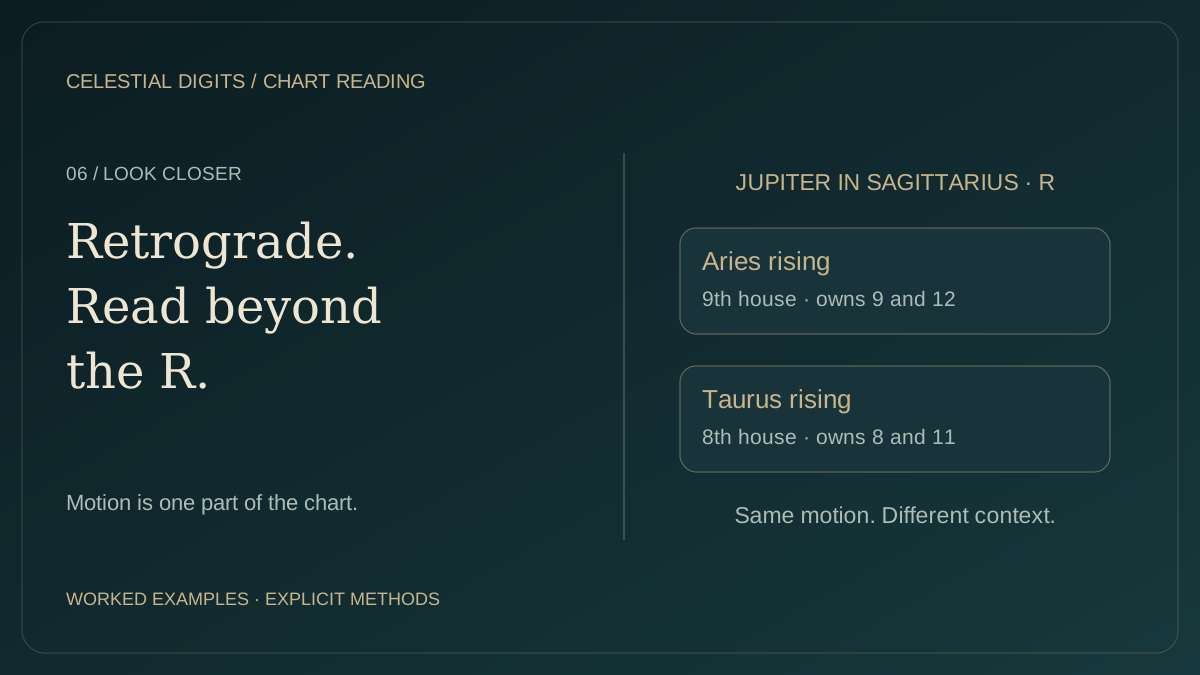
Retrograde Planets in Your Birth Chart: Stronger, Delayed or Misunderstood?
Read natal retrograde planets without blanket predictions. Separate motion, dignity, house lordship and timing with two worked chart examples.
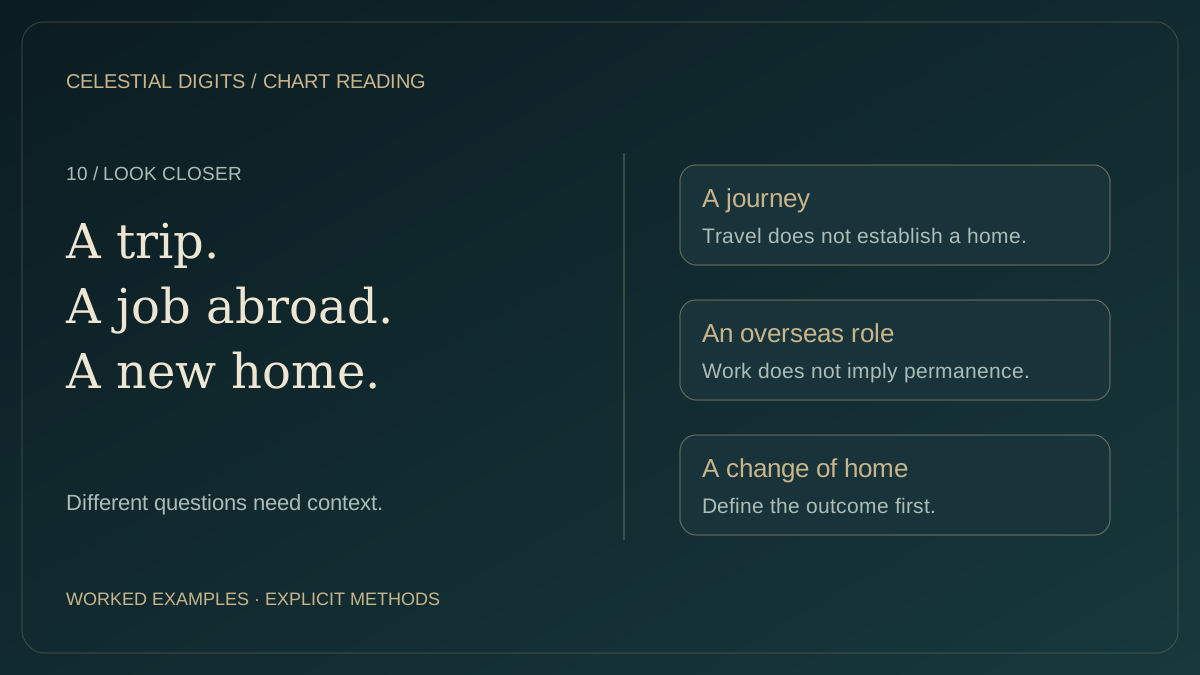
Foreign Travel, Work or Permanent Settlement? Read the Question First
Separate a foreign trip, overseas employment and a lasting change of home. Use a Virgo-ascendant worksheet to read houses, lordships and timing together.
Shadbala: The Six-Fold Planet Strength System Explained Simply
Plain-English guide to shadbala in Vedic astrology: the six balas, rupa thresholds per planet, strong vs weak planet results, and how strength shapes dashas.
A little more perspective.
Keep discussions respectful. No harassment, hate, sexual content or spam. Comments are reviewed before publication. Report concerns from a comment menu, or contact [email protected].
Checking your session…