
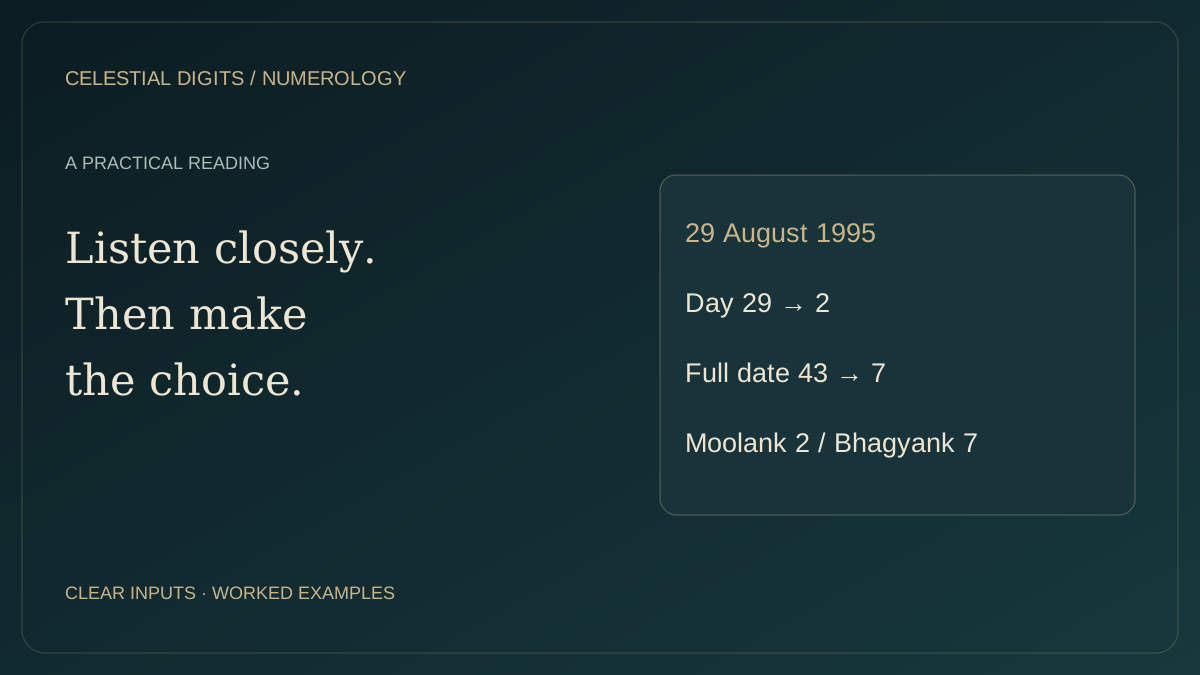
Moolank 2 (Moon): Cooperation with a clear decision
Calculate Moolank 2, separate it from Bhagyank and explore Moon symbolism through a worked situation and practical reflection.
Moolank 2 is the reduced birth-day number for people born on 2, 11, 20, 29. In the modern Indian numerology convention used here, it is associated with Moon. This guide explores cooperation with a clear decision, using a fictional situation rather than treating a birthday as a personality test.
Reproduce the day and full-date calculations#
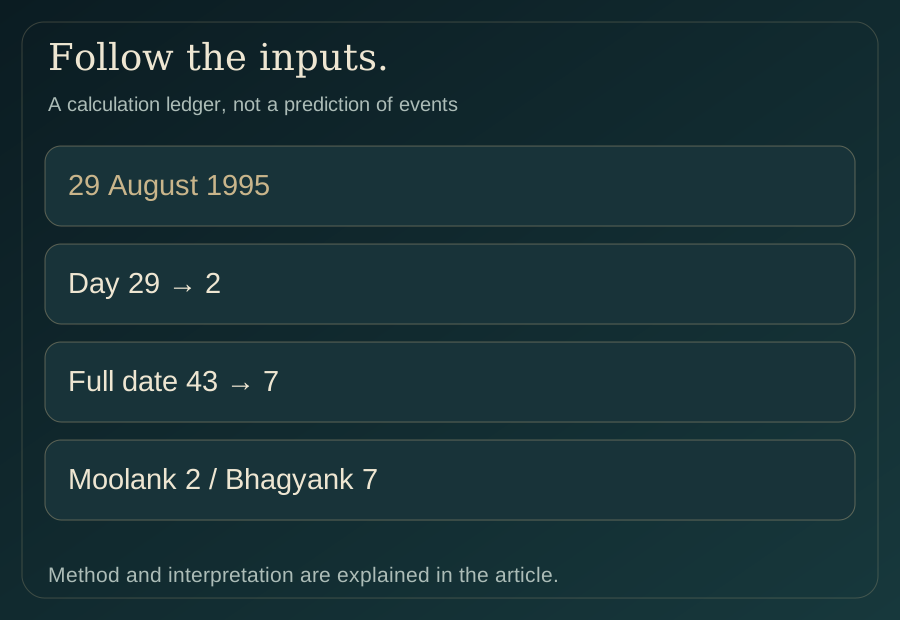
Take the fictional date 29 August 1995. The day 29 reduces to 2. The full-date calculation is 2 + 9 + 0 + 8 + 1 + 9 + 9 + 5 = 43, which reduces to 7. Its profile therefore has Moolank 2 / Bhagyank 7; those labels describe different inputs.
Sensitivity can mean noticing, not agreeing#
The Moon association brings attention to responsiveness, changing needs and the quality of an exchange. In this reading, sensitivity is a prompt to notice information that a rushed decision might miss. It is not a claim that people born on these dates are emotionally unstable or unable to lead.
A person can understand another viewpoint and still disagree. A number description becomes limiting if it praises cooperation while quietly requiring the reader to keep everyone comfortable. Useful cooperation includes stating your own preferences early enough for others to consider them.
Worked situation: friends are choosing a trip#
A fictional group is choosing between a weekend trek and a quiet stay. One member keeps saying either option is fine, then feels overlooked when the trek is booked. The Moon theme can help frame the missing information: was a preference actually expressed?
The next conversation might separate listening from consent. “I understand why you want the trek; my preference is the quieter option, and I cannot join the longer route” is both responsive and clear. No number calculation is needed to authorise that boundary.
| Stage | Question to ask | A concrete response |
|---|---|---|
| Listen | What does each person want? | Let everyone name a preference |
| Clarify | Which constraints are fixed? | State time, energy and availability |
| Decide | Who is choosing, and by when? | Agree a deadline rather than reopening indefinitely |
| Review | Did the choice represent what was said? | Check the conversation, not a personality label |
The exercise makes a symbolic theme observable. It does not show that every Moolank 2 person avoids conflict, or that a different number would handle the trip better.
The special calculation for a 29th birthday#
Twenty-nine passes through 11 before it becomes 2. Our method continues the reduction: 2 + 9 = 11, then 1 + 1 = 2. A report that displays 29/11/2 preserves the path; a system that stops at 11 is using a different rule.
Do not switch conventions only because one description feels more flattering. Record the unreduced day and the final digit together, then compare the actual methods. The calculation guide explains how Moolank differs from a full-date or name total.
Mood language needs restraint#
The Moon is a traditional symbol, not a mental-health assessment. A date cannot establish anxiety, depression, dependency or the cause of a difficult week. Sleep, workload, relationships and current events may all be relevant to how someone feels; a number description does not assess those circumstances.
If you use a reflection journal, record the situation before assigning a theme. What changed? What information did you receive? What did you need to communicate? This avoids turning every ordinary change of feeling into confirmation of a reading.
Cooperation and privacy can coexist#
Sometimes you need time alone to decide what you think before responding. That does not contradict a cooperation theme. It may make your eventual answer more honest. The 2–7 combination worksheet explores this tension through the separate labels of Moolank and Bhagyank.
For the next decision, try stating one preference and one boundary without apologising for having them. Afterwards, assess whether communication became clearer. You are evaluating a practice, not proving that your birth date controls the conversation.
Continue with your own inputs#
Check the exact date in the numerology report, then compare the day, full-date and name methods. The situations and worksheets on this page are original teaching examples. Number–planet labels follow the site's stated convention; they are not astronomical placements or scientifically established predictions.
Related Posts
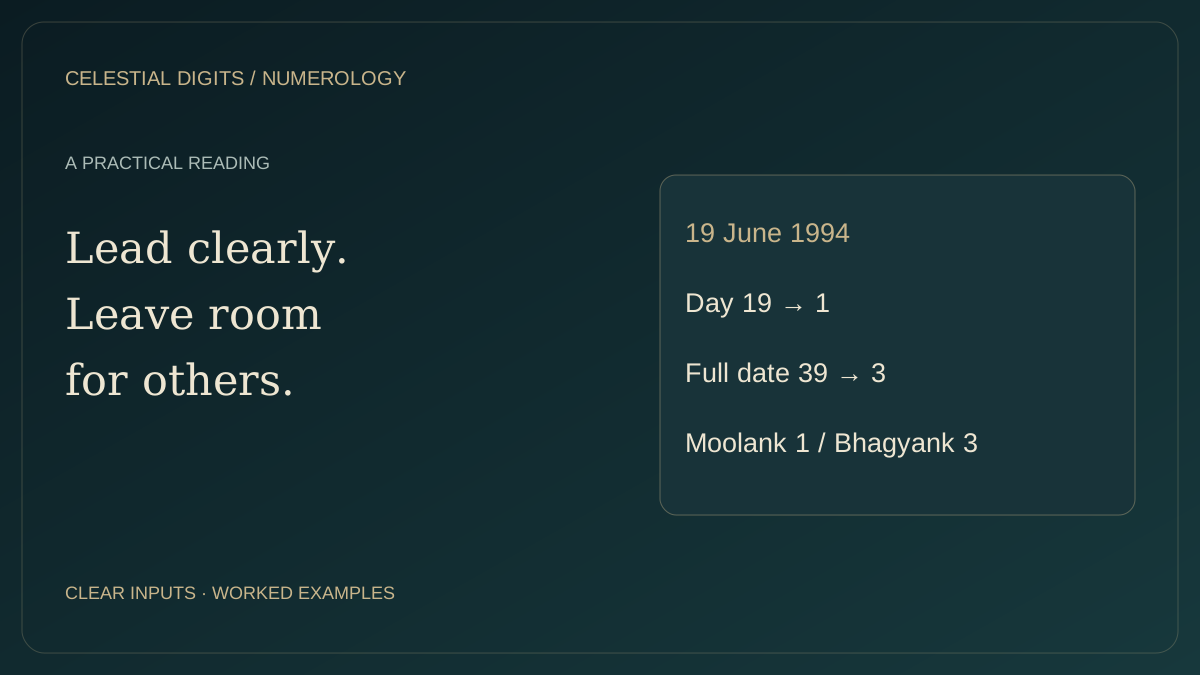
Moolank 1 (Sun): Initiative without taking over
Calculate Moolank 1, separate it from Bhagyank and explore Sun symbolism through a worked situation and practical reflection.
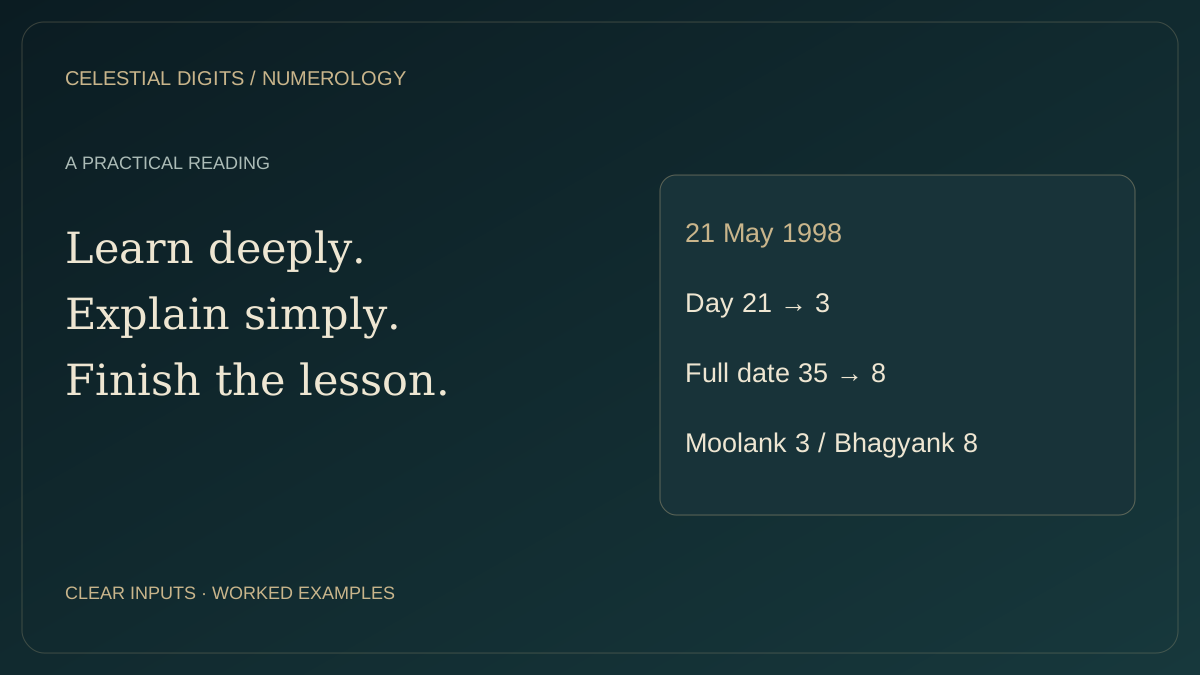
Moolank 3 (Jupiter): Learning that becomes useful teaching
Calculate Moolank 3, separate it from Bhagyank and explore Jupiter symbolism through a worked situation and practical reflection.
Moolank 4 (Rahu): Experimentation without chasing every novelty
Calculate Moolank 4, separate it from Bhagyank and explore Rahu symbolism through a worked situation and practical reflection.
A little more perspective.
Keep discussions respectful. No harassment, hate, sexual content or spam. Comments are reviewed before publication. Report concerns from a comment menu, or contact [email protected].
Checking your session…