
Born on 29 February: Numerology in Leap and Non-Leap Years
Calculate a leap-day Moolank, Bhagyank and personal year without inventing a 29 February date in a non-leap year.
A 29 February birthday does not disappear from a numerology calculation in a non-leap year. In the calendar-year method used here, the birth day and month remain 29 and 2. The target year changes; your chosen celebration date is a separate matter.
Start with a valid birth date#
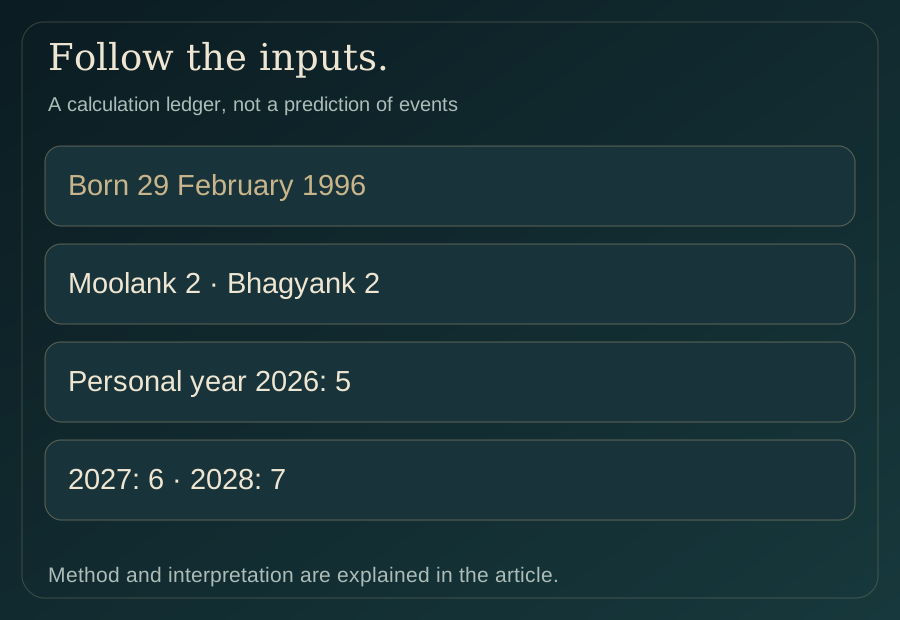
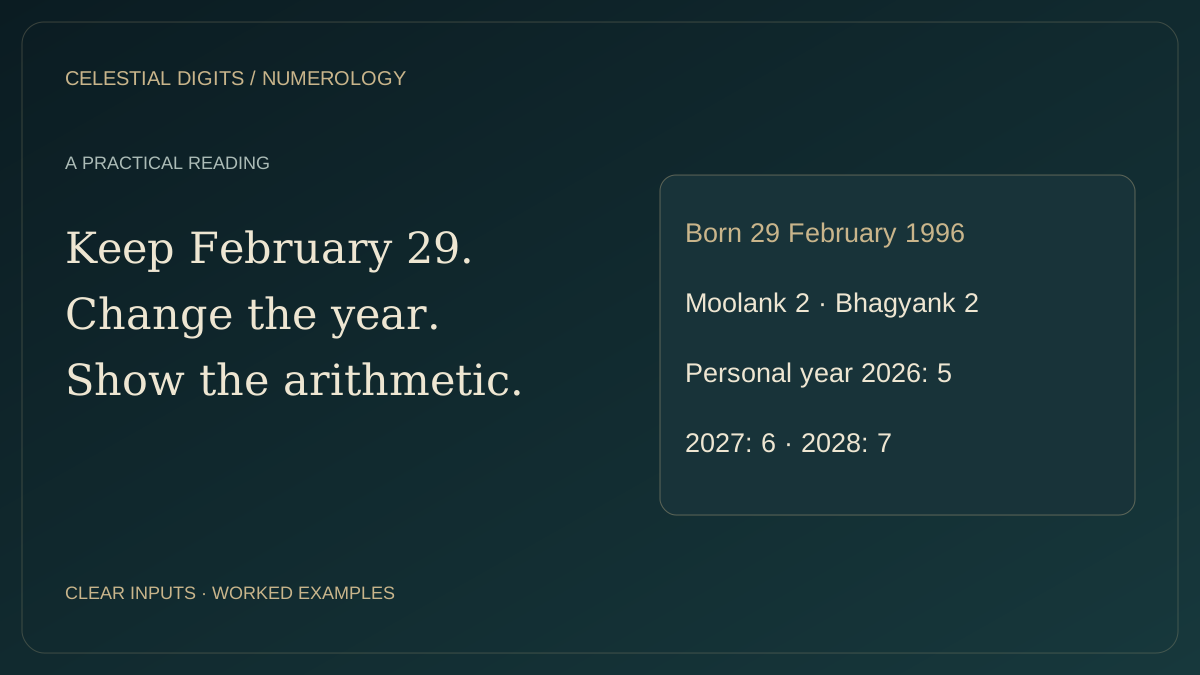
Use the fictional birthday 29 February 1996, a valid leap-day date. Moolank is 2 + 9 = 11 → 2. Bhagyank uses the complete original date: 2 + 9 + 0 + 2 + 1 + 9 + 9 + 6 = 38 → 11 → 2.
The two reduced results happen to match. That does not make the date incomplete or grant an extra predictive power to the number 2. It simply follows the stated reduction rule.
Calculate the personal year without creating an invalid date#
For 2026, reduce the birth day to 2, the month to 2 and the target year's digits to 1. Add 2 + 2 + 1 = 5. For 2027, the target year reduces to 2, giving 2 + 2 + 2 = 6.
| Target year | Birth day | Birth month | Year digit reduction | Personal year |
|---|---|---|---|---|
| 2026 | 29 → 2 | February → 2 | 10 → 1 | 5 |
| 2027 | 29 → 2 | February → 2 | 11 → 2 | 6 |
| 2028 | 29 → 2 | February → 2 | 12 → 3 | 7 |
This is arithmetic on the recorded day and month. It does not require constructing “29 February 2026” as a valid calendar date. A program that insists on creating that date before adding the digits can introduce an unnecessary error.
What if you celebrate on 28 February or 1 March?#
A celebration choice does not automatically replace the recorded birthday in this method. Substituting 28 February would change the day number to 1; substituting 1 March changes both day and month. Those are different inputs and should not be slipped into the calculation without saying so.
People make celebration choices for family, practical or cultural reasons. Numerology does not need to dictate that choice. This guide also does not determine how a jurisdiction defines age or legal anniversaries.
Calendar-year and birthday-year conventions differ#
This article uses a personal year running from January through December. A practitioner who changes the cycle on the birthday needs to explain how their method handles a leap-day anniversary in other years. Do not assume that their boundary rule is the same as the arithmetic shown here.
When comparing a reading, ask two questions: which numbers were added, and when is the resulting cycle considered active? The sum may agree while the date interval differs.
Keep the original record stable#
Write the original date once, then list target years separately. Check that exports or forms have not changed February to March during date validation. A valid original 1996 birthday should remain valid even when you are discussing 2026.
The midnight-date example shows a different way dates can change unintentionally. Both cases favour checking the input before adding interpretation. The personal-year and mahadasha comparison explains why this calendar number should not replace an astronomical timing calculation.
Related Posts
Why Two Name Calculators Disagree: Chaldean and Pythagorean Tables
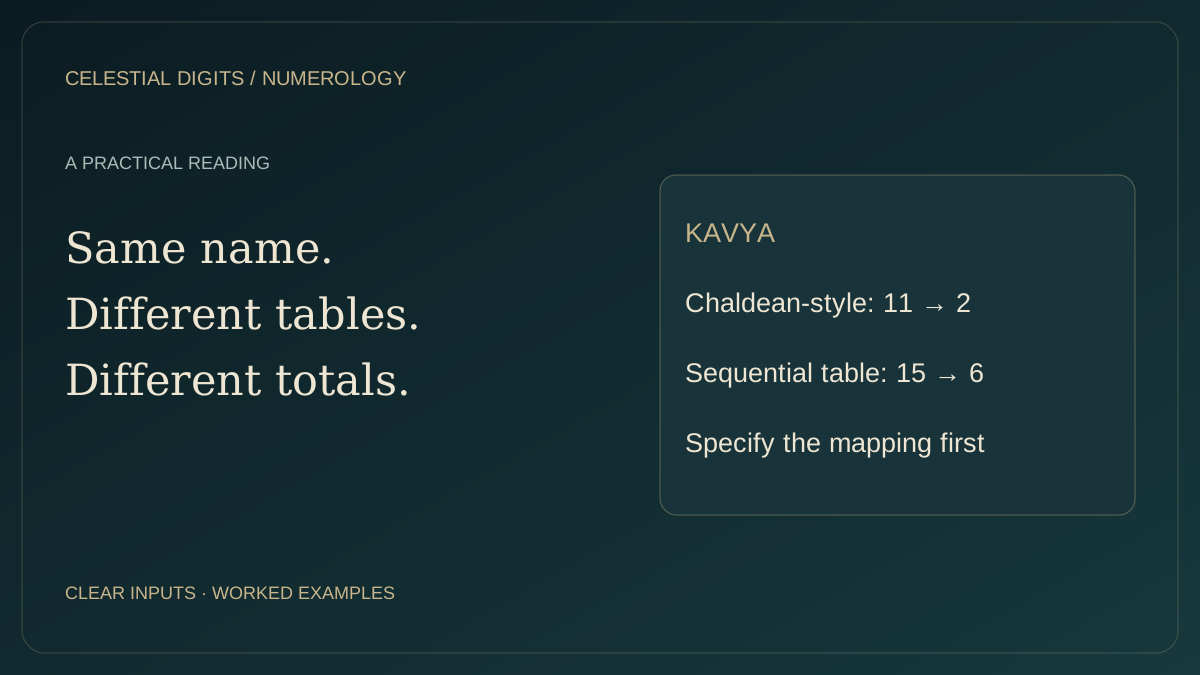
Compare KAVYA letter by letter under two common tables and see why equal labels can conceal different calculation methods.
Moolank 2 and Bhagyank 7: Connection without losing privacy
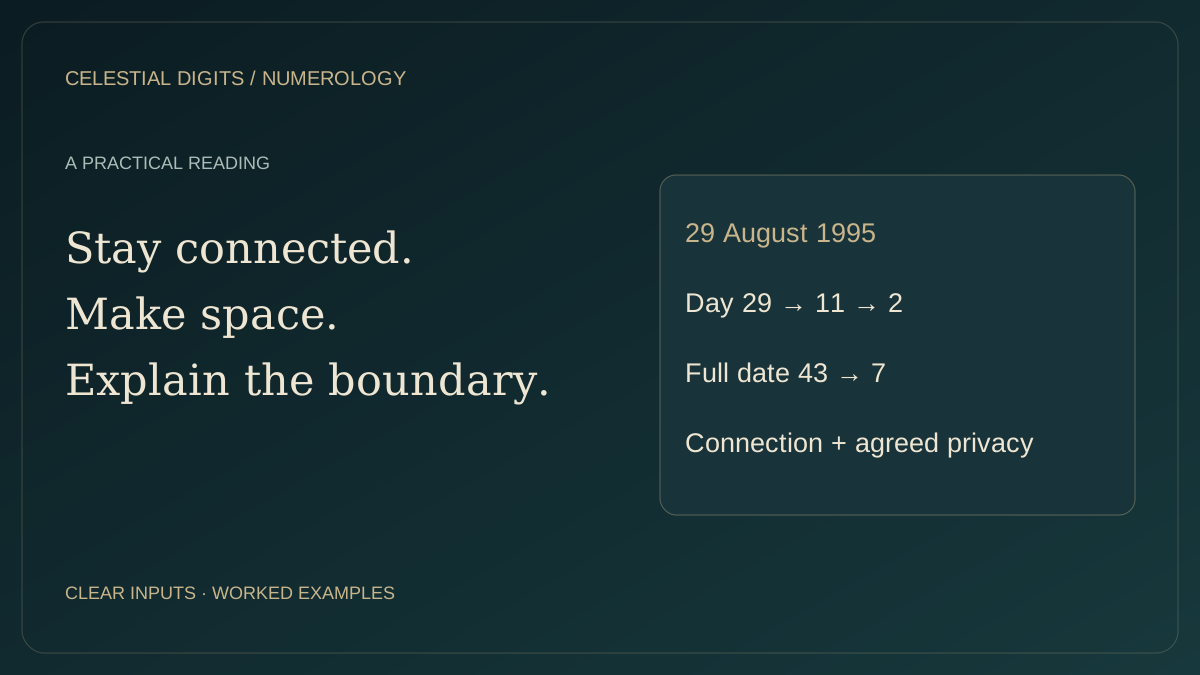
A worked 2–7 calculation and a practical example of asking for space without turning a number pair into a relationship verdict.

Moolank 3 and Bhagyank 6: When teaching becomes an act of care
Work through a 3–6 birthday calculation and explore how knowledge, taste and care can support a useful learning experience.
A little more perspective.
Keep discussions respectful. No harassment, hate, sexual content or spam. Comments are reviewed before publication. Report concerns from a comment menu, or contact [email protected].
Checking your session…