
Earning Well but Saving Little: Income, Wealth and Expenses in a Birth Chart
Separate income, accumulated wealth and expenses in a Vedic chart. Follow a Virgo-ascendant example without turning a wealth yoga into a money guarantee.
“Will I have money?” can mean a higher salary, reliable monthly cash flow, family assets, less debt or enough savings to stop worrying. Those are different questions. A reading that answers all of them with “your eleventh house is strong” is missing the distinction.
The useful starting point is what comes in, what remains, and what goes out. An astrological worksheet can keep those themes separate. Actual income and spending records are still the evidence for someone's financial position.
Three houses, three questions#
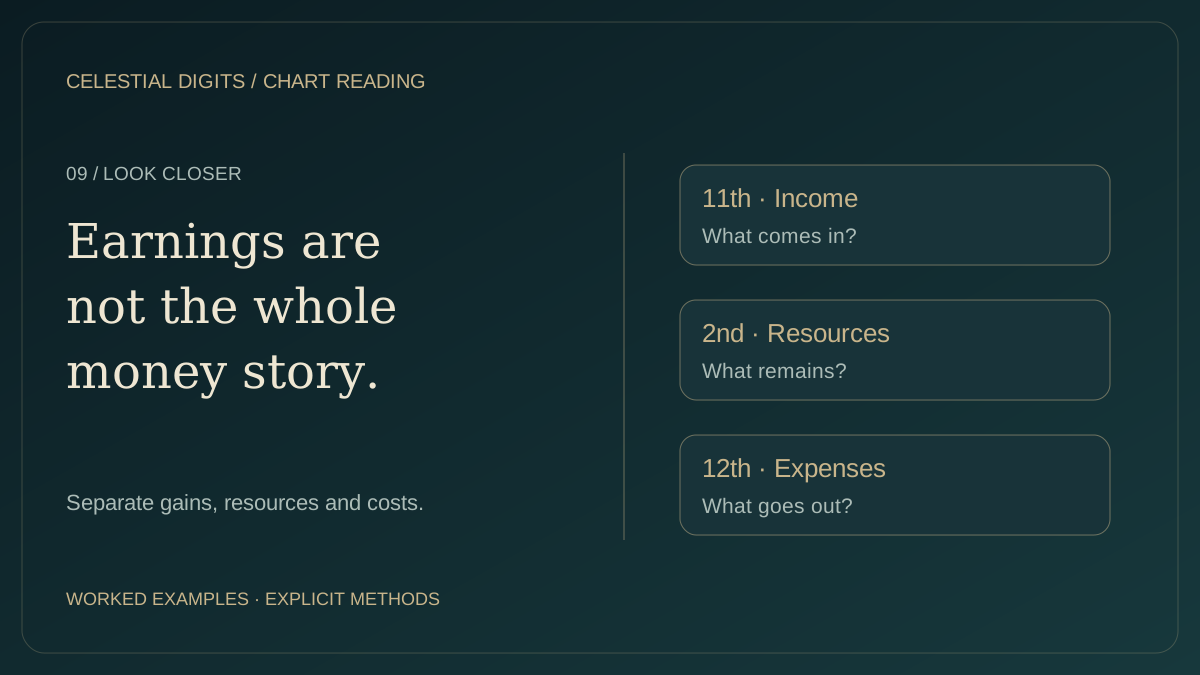
The house descriptions in Brihat Parashara Hora Shastra, chapter 11 associate the second with wealth and family, the eleventh with income, and the twelfth with expenses. Applying these categories to a modern salary and savings question is an interpretive adaptation, not a formula for calculating a bank balance.
| Starting point | Question for the reading | What to establish outside the chart |
|---|---|---|
| Second house and lord | What supports or complicates retained resources? | Existing savings, assets and family commitments |
| Eleventh house and lord | How are gains and income being discussed? | Income sources, regularity and actual receipts |
| Twelfth house and lord | What expenditures or outflows matter? | Recurring expenses, one-off costs and chosen spending |
| Tenth house and lord | How does work connect to this question? | Employment, business activity and responsibilities |
This is a starting map, not an exhaustive wealth assessment. A question about property adds a different emphasis from one about salary. Inheritance, shared finances and borrowing should not be silently treated as earned income.
A Virgo-ascendant map you can verify#
Using whole-sign houses and conventional sign rulers:
| House | Sign for Virgo rising | Lord |
|---|---|---|
| Second | Libra | Venus |
| Tenth | Gemini | Mercury |
| Eleventh | Cancer | Moon |
| Twelfth | Leo | Sun |
Knowing Virgo rises gives us those assignments. It does not tell us where Venus, Mercury, the Moon or the Sun is placed. A generic Virgo reading cannot establish a link between income and expenses without additional positions.
An invented example: income linked with expenses#
Assume Moon in Leo in the twelfth and Venus in Libra in the second. We are supplying just two positions to study a relationship, not presenting a complete birth chart.
The Moon, as eleventh lord, occupies the twelfth. Venus, as second lord, occupies its own sign in the second and also carries ninth-house ownership. A traditional reader now has both an income–expenditure connection and a separate resource-related placement to examine.
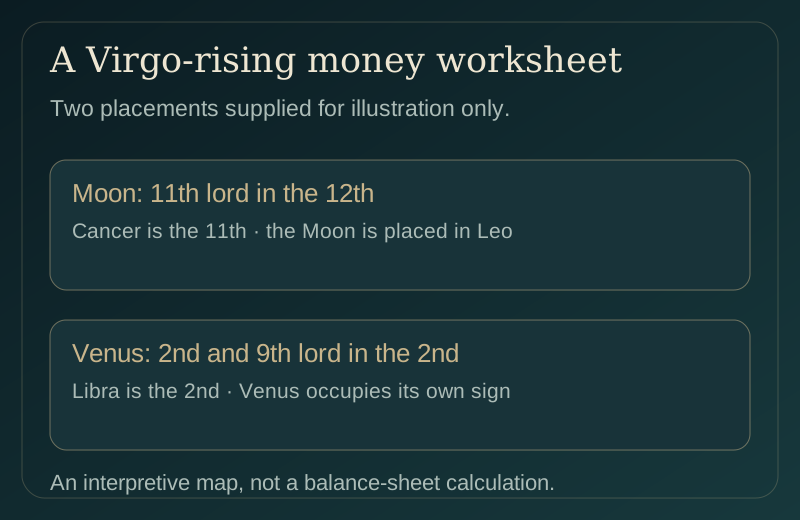
One possible topic is income being committed to significant outgoings. But those outgoings might be education, a move, family support, a business cost or an avoidable expense. The placement does not identify which explanation is true.
The Venus placement also prevents a simplistic conclusion that every rupee must disappear. Someone can have substantial retained assets while experiencing tight monthly cash flow. Another person can have a high salary but few accumulated assets. Ask about the actual situation before assigning meaning to the pattern.
Compare three stories that a vague prediction could confuse#
Consider three fictional people with the same monthly income:
- One spends much of it on a temporary course and expects that cost to end.
- One supports relatives and has a regular obligation that they value.
- One has unpredictable work receipts and must cover costs before being paid.
“Expenses are high” fits all three, but it explains almost nothing. A useful consultation asks what is recurring, what is temporary, and what the person wants to understand. It does not relabel every expense as loss or every low savings month as a negative planetary result.
These stories are discussion prompts, not interpretations proven by the hypothetical Moon placement.
What changes in a dasha reading?#
Suppose the person asks about a Moon–Venus period. First verify that these are actually the current mahadasha and antardasha lords, with their start and end dates. Do not infer the running period from the ascendant.
Then bring both sets of responsibilities into the reading: the Moon's eleventh-house ownership and supplied twelfth-house placement; Venus's second- and ninth-house ownership and supplied second-house placement. Record other relevant conditions rather than automatically calling the entire period profitable or wasteful.
It is reasonable within a traditional reading to discuss the relationship between gains, commitments and resources. It is not reasonable to turn the dasha labels into an amount of money or a guaranteed pay-rise date. The strong mahadasha lord example shows why strength and favourable outcomes should not be equated.
Does a Dhana Yoga guarantee wealth?#
A named combination is a rule to examine, not a financial guarantee. Identify the exact houses and planets involved, confirm the stated conditions, and keep the definition separate from the proposed result. See the Dhana Yoga guide for the traditional combinations, then return to the specific question: income, accumulated resources or both?
A yoga label cannot tell you whether a property can be sold quickly, whether a business invoice will be paid, or whether a proposed investment is suitable. Those require evidence beyond astrology. No chart placement supplies a reliable return forecast.
Bring a better question to the chart#
Instead of “Am I destined to be rich?”, try: “I earn regularly, but a recent relocation has changed my expenses. How would you distinguish income, retained resources and this temporary period in a traditional reading?”
In your birth-chart report, record the second, tenth, eleventh and twelfth lords with their actual placements. Keep sign lordship separate from nakshatra lordship, and use the current dated dasha breakdown. Our dispositor-chain examples can help trace the sign-lord connections without inventing missing positions.
This is an educational framework for an astrological conversation, not financial planning or investment advice. Its value is in making the question and method explicit; it should not override your actual numbers.
Related Posts
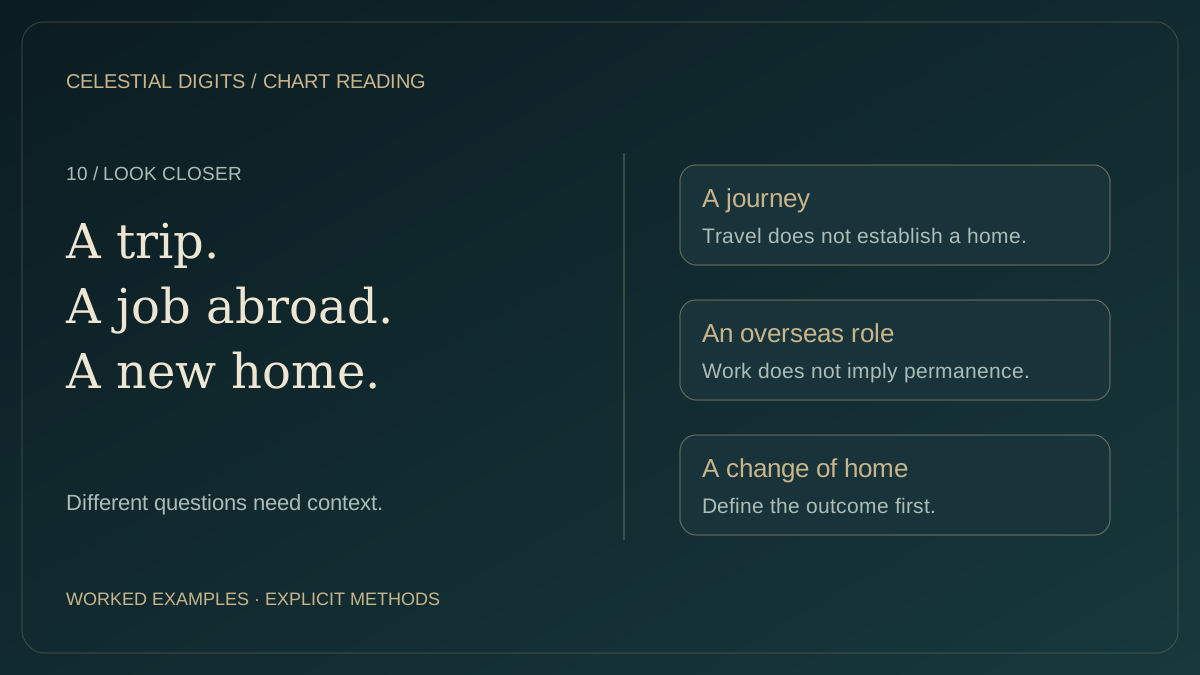
Foreign Travel, Work or Permanent Settlement? Read the Question First
Separate a foreign trip, overseas employment and a lasting change of home. Use a Virgo-ascendant worksheet to read houses, lordships and timing together.
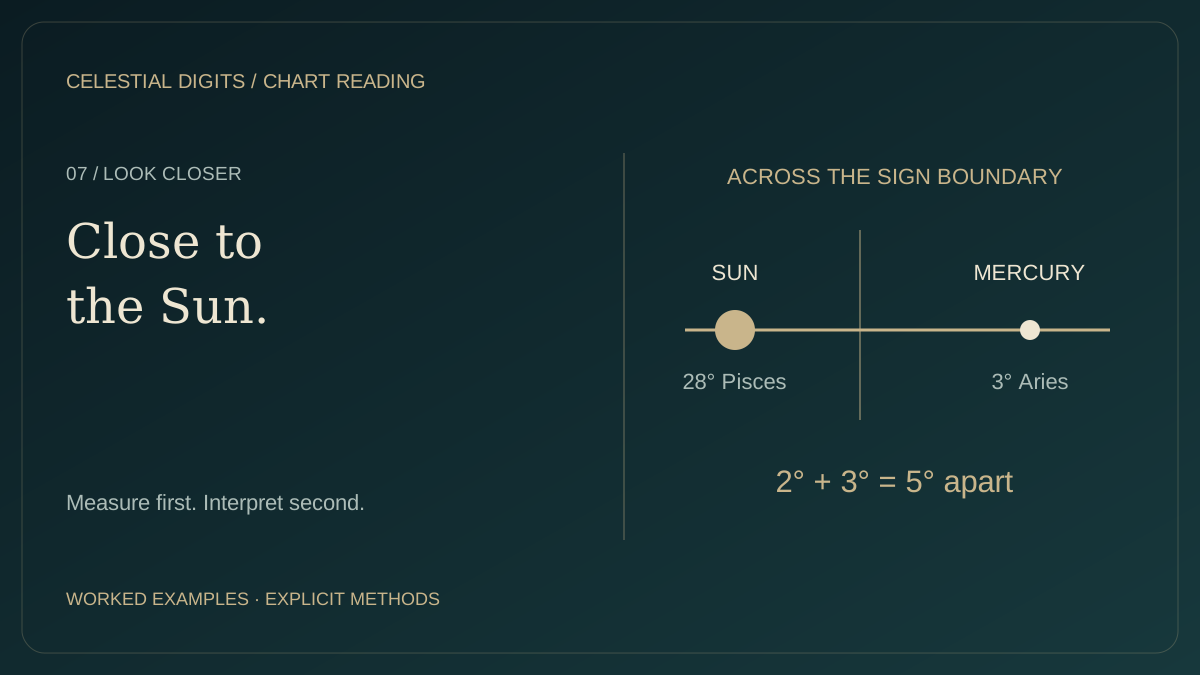
Combust Planets: Does Being Close to the Sun Always Mean Weakness?
Measure a planet's distance from the Sun with worked examples. Understand combustion, sign boundaries, retrograde motion and differing software rules.
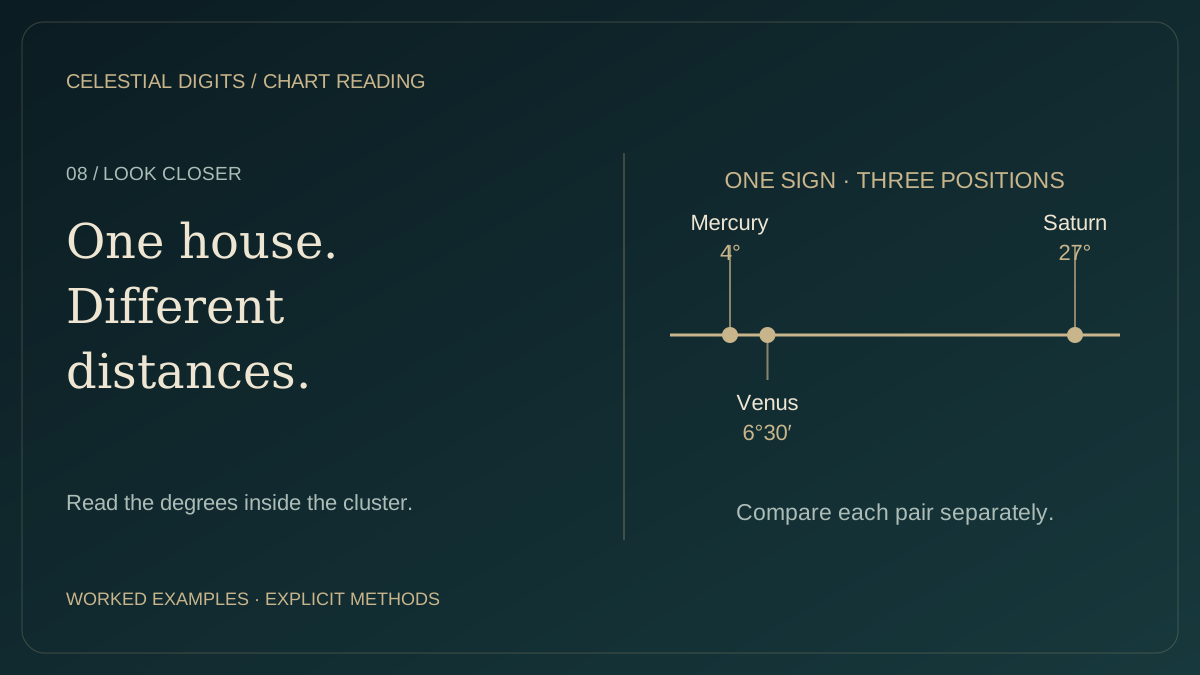
Same House, Different Degrees: How Close Is a Planetary Conjunction?
Compare same-sign conjunctions with actual degree gaps. Work through a three-planet cluster, cross-sign proximity and applying versus separating motion.
A little more perspective.
Keep discussions respectful. No harassment, hate, sexual content or spam. Comments are reviewed before publication. Report concerns from a comment menu, or contact [email protected].
Checking your session…