
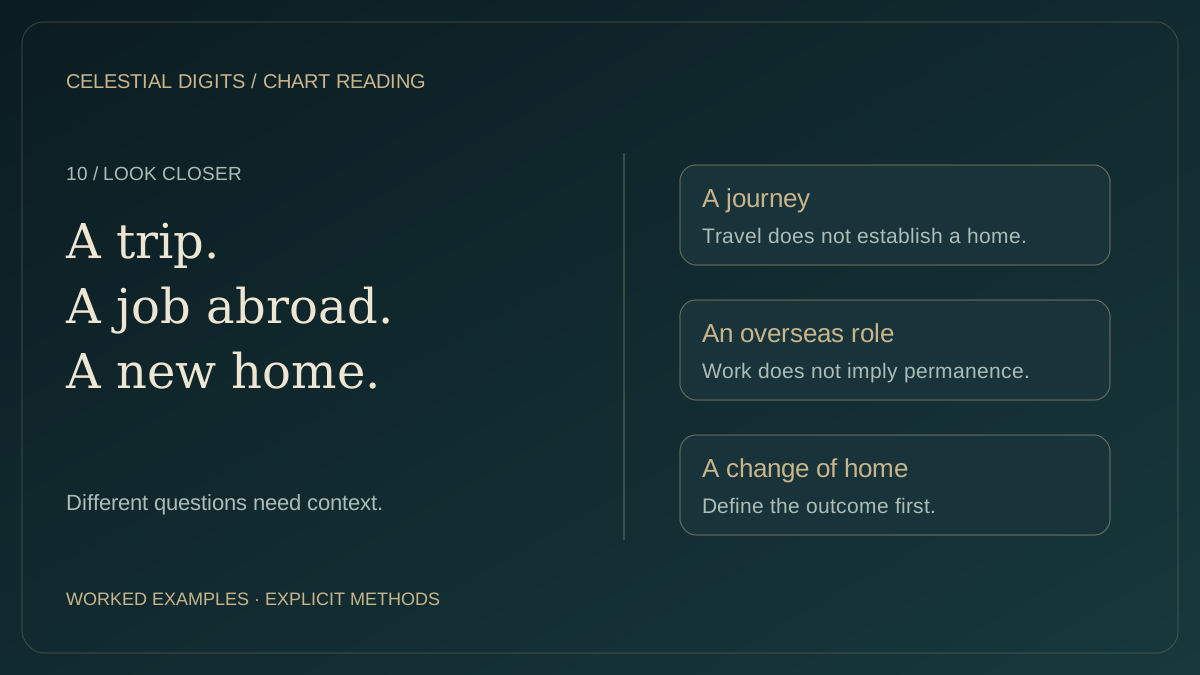
Foreign Travel, Work or Permanent Settlement? Read the Question First
Separate a foreign trip, overseas employment and a lasting change of home. Use a Virgo-ascendant worksheet to read houses, lordships and timing together.
You work from Bengaluru for a company in London. Your friend spends six months studying in Berlin. A third person moves abroad with their family and establishes a new home. All three involve another country. They are not the same event.
Yet an online reading may describe all three as “foreign settlement.” If we want an interpretation to mean anything, we need to define the outcome before looking for a chart combination.
Four questions hiding inside “Will I go abroad?”#
| Question | What would count as the event? | What it does not necessarily include |
|---|---|---|
| Travel | A journey outside the home country | A new job or long-term home |
| Study abroad | Enrolment and physical attendance abroad | Employment after the course |
| Overseas work | Actually working abroad under an arrangement | Permanent residence |
| Settlement | Establishing an ongoing home abroad | A specific citizenship or immigration status |
Remote work for a foreign client should be recorded separately from physical relocation. A business trip is not a permanent move. If the question changes halfway through a consultation, update it explicitly rather than counting any international contact as a successful prediction.
Why the twelfth house cannot carry the entire answer#
Traditional house meanings distribute the relevant subjects. In Brihat Parashara Hora Shastra, chapter 11, home and land, journeys, profession and expenses appear across several houses; the tenth-house list even includes living in foreign lands. That is a useful corrective to treating the twelfth as a universal foreign-settlement switch.
The worksheet below is our way of organising a modern question using those broad traditional categories. It is not a quoted classical “visa formula.” It uses the fourth for home, ninth for wider travel and learning, tenth for work, and twelfth for distance-related themes and expenditure. Other houses may matter to the specific purpose of a trip.
A house map for Virgo rising#
| Topic in this worksheet | House | Sign | Lord |
|---|---|---|---|
| Home and roots | Fourth | Sagittarius | Jupiter |
| Wider travel and learning | Ninth | Taurus | Venus |
| Work and public responsibility | Tenth | Gemini | Mercury |
| Expenditure and distance-related themes | Twelfth | Leo | Sun |
These are whole-sign assignments. They do not tell us the actual placements of Jupiter, Venus, Mercury or the Sun. Two people with Virgo rising can have very different configurations and periods.
Example one: a work–distance connection#
Imagine Sun in Gemini in the tenth house for Virgo rising. The twelfth lord is now placed in the tenth. That supplies a connection a reader may investigate when the question concerns overseas work.
Possible expressions include working across borders, working for a distant institution, spending on professional activity, or a different combination of those themes. The placement alone does not distinguish them. Ask whether the person is applying for relocation, working remotely or travelling occasionally.
Mercury is the lord of the sign occupied by the Sun. Its position is still missing. A dispositor check therefore stops at an unanswered question rather than manufacturing a supportive Mercury.
Example two: a home–distance connection#
Now examine a separate invented fragment: Jupiter in Leo in the twelfth house for Virgo rising. Jupiter rules the fourth and seventh houses. Here the fourth-house lord connects with the twelfth, making a question about a distant home more directly relevant than it was in the first fragment.
It still does not tell us that a move occurs, is wanted or becomes permanent. The seventh-house ownership is also part of Jupiter's role; a family or partnership question may be relevant, but it should be asked rather than assumed.
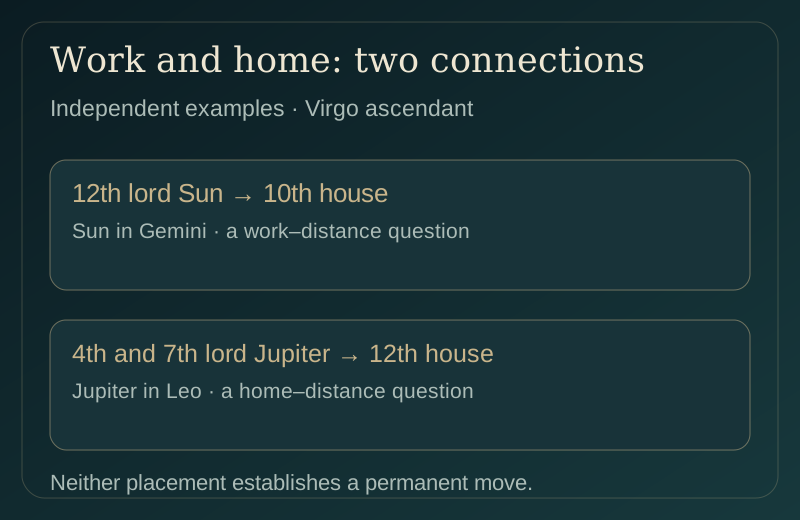
The two fragments can be considered together only if both placements are actually present in the person's chart. Examples from separate articles are not evidence about a real horoscope.
What would a more complete reading need?#
Start with the relevant house lords, their actual positions, their condition and the relationships used by the chosen method. Label aspects separately from conjunctions or sign exchanges. Three descriptions of the same placement are not three independent confirmations.
Keep an explicit alternative explanation beside each interpretation. Could this work connection describe foreign clients without a move? Could this home theme describe living away from the birthplace within the same country? A useful reading should acknowledge those possibilities before an event occurs.
An empty twelfth house does not settle the question either. It still has a sign lord. Conversely, several planets there cannot tell us the country, route of travel or length of residence.
Timing: specify which milestone you mean#
A move can involve an application, a job offer, approval, departure and the start of a new household. Those are distinct dates. Predicting “movement this year” and later selecting whichever milestone happened is too flexible to assess fairly.
For a traditional timing discussion, write the mahadasha, antardasha and pratyantardasha with dates. Explain how their lords relate to the defined question. Add transit context afterwards; a transit through the twelfth cannot supply missing natal conditions or guarantee a departure.
Our pratyantardasha worked example shows how to follow nested periods without confusing the current subperiod with an entire mahadasha.
Does moving change the natal chart?#
The original birth event stays the same. Replacing the birthplace with the destination while retaining the birth time is not a correction to your birth record. Some practitioners use a separately labelled relocation technique; it should not overwrite the natal chart or silently replace its houses. Read whether moving abroad changes your birth chart for that distinction.
Likewise, a Navamsa or another divisional chart needs its own label and method. Do not move a planet between charts until a desired settlement combination appears.
A useful consultation brief#
Bring the exact question, your actual birth details and the practical circumstances. For example: “I am considering a two-year overseas role, with my family staying here initially. I want to discuss work-related travel separately from a later change of family home.”
Use the birth-chart report to inspect the placements and dated periods, and the career and relocation guide to separate the related topics. A chart cannot determine immigration eligibility or guarantee an application result; current requirements and the person's circumstances remain decisive. The astrological framework is a traditional interpretation, not a substitute for those facts.
Related Posts
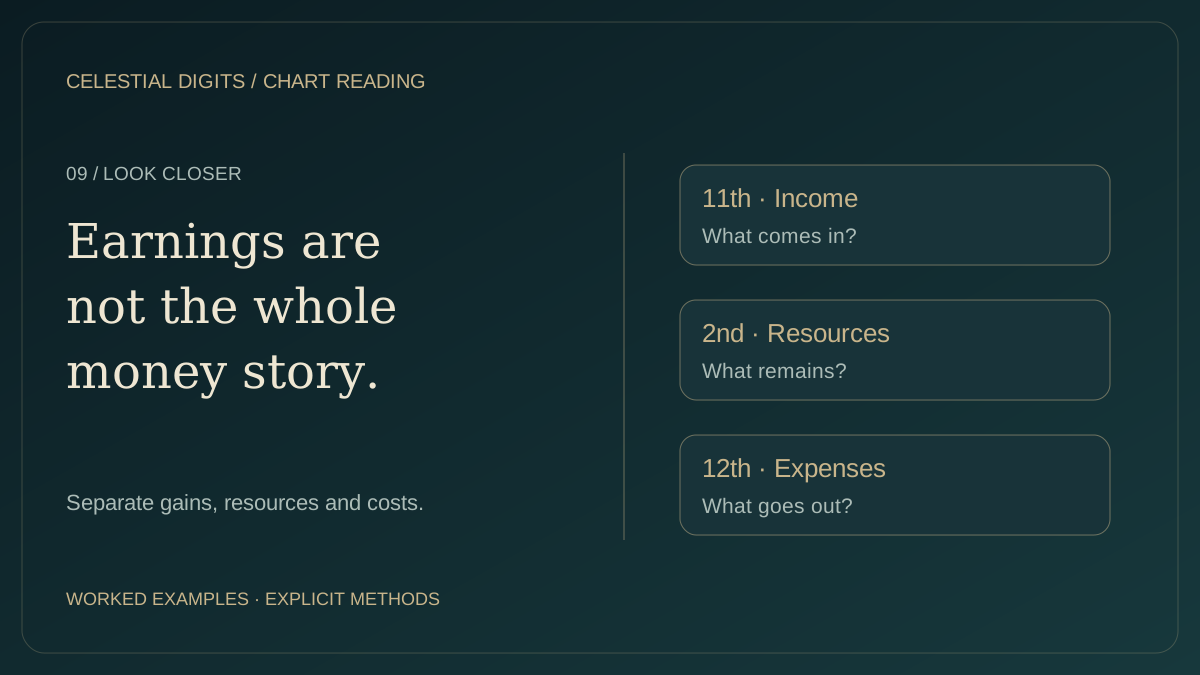
Earning Well but Saving Little: Income, Wealth and Expenses in a Birth Chart
Separate income, accumulated wealth and expenses in a Vedic chart. Follow a Virgo-ascendant example without turning a wealth yoga into a money guarantee.
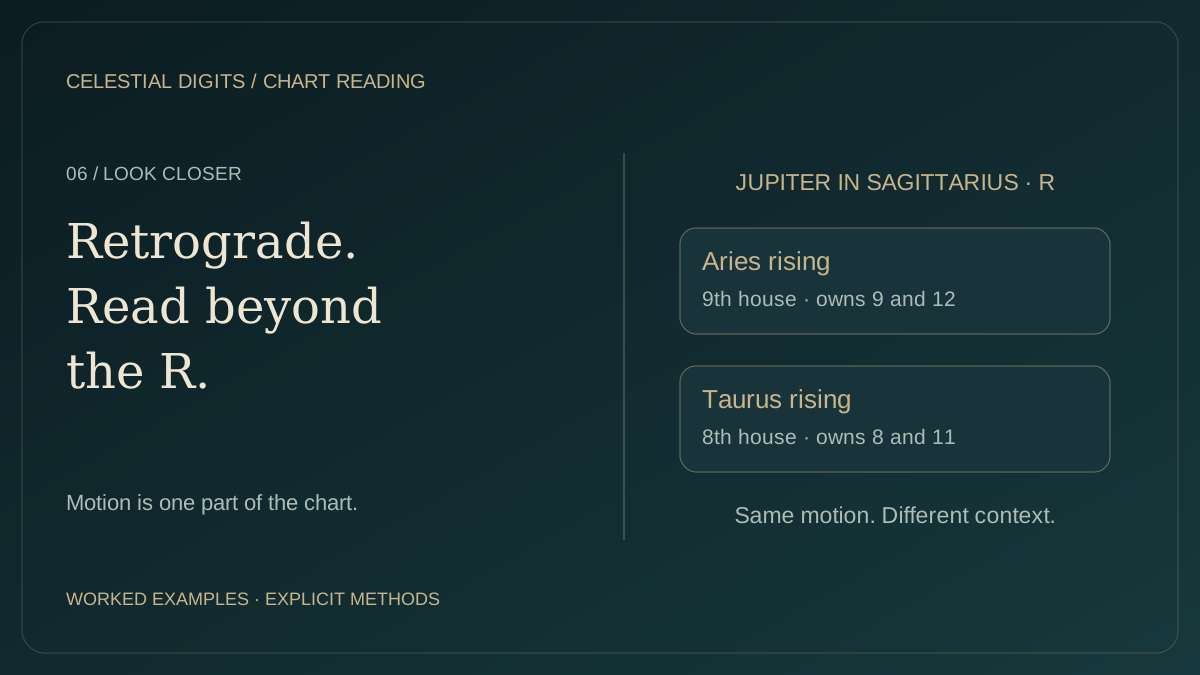
Retrograde Planets in Your Birth Chart: Stronger, Delayed or Misunderstood?
Read natal retrograde planets without blanket predictions. Separate motion, dignity, house lordship and timing with two worked chart examples.
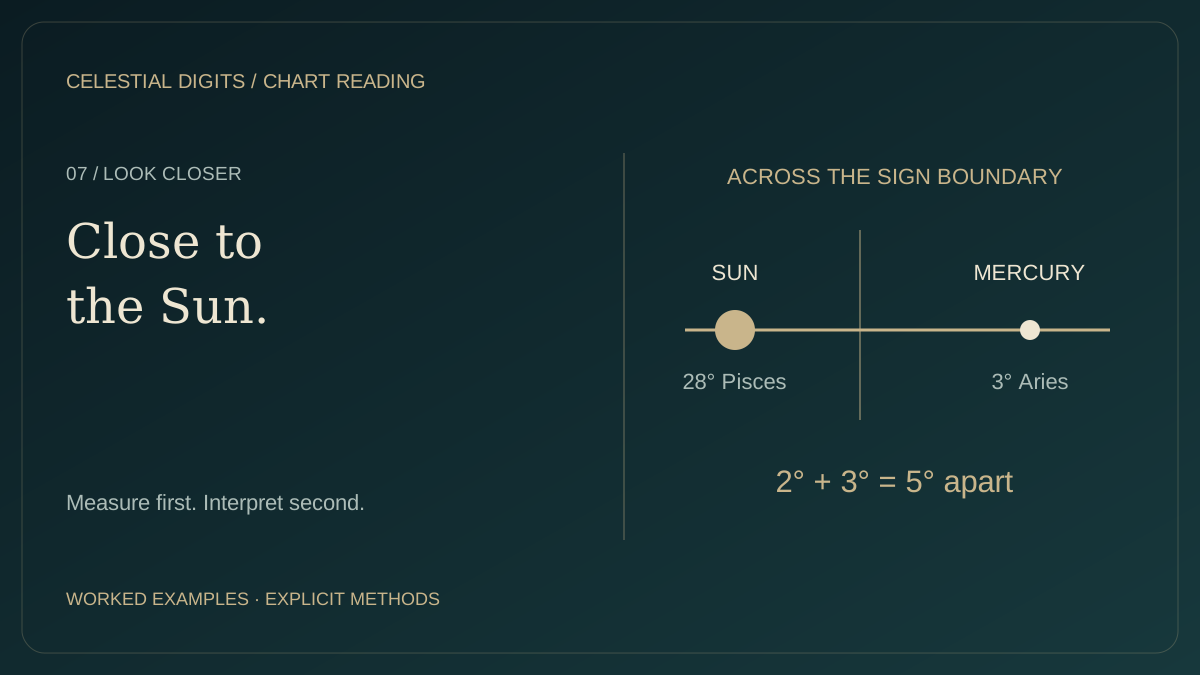
Combust Planets: Does Being Close to the Sun Always Mean Weakness?
Measure a planet's distance from the Sun with worked examples. Understand combustion, sign boundaries, retrograde motion and differing software rules.
A little more perspective.
Keep discussions respectful. No harassment, hate, sexual content or spam. Comments are reviewed before publication. Report concerns from a comment menu, or contact [email protected].
Checking your session…