
Shadbala: The Six-Fold Planet Strength System Explained Simply
Plain-English guide to shadbala in Vedic astrology: the six balas, rupa thresholds per planet, strong vs weak planet results, and how strength shapes dashas.
Shadbala — literally "six-fold strength" — is the classical Jyotish method for measuring how much working power a planet actually has in a chart. Dignity tells you whether a planet is comfortable; shadbala tells you whether it can get things done.
The distinction matters more than beginners expect. A planet is like an employee: dignity is its job title, but shadbala is its actual capacity — health, position, timing, motivation, seniority, and workplace support all combined into one score. An exalted planet with low shadbala is a director who is always out of office. A debilitated planet with high shadbala is an underpaid worker who somehow ships everything.
The one-sentence essence: shadbala measures a planet's ability to deliver its promises, independent of whether those promises are pleasant.
Brihat Parashara Hora Shastra defines six component strengths, sums them in units called virupas (60 virupas = 1 rupa), and gives each planet a minimum passing score. This guide explains each component in plain English, the thresholds, what the numbers mean in real life, and how to use shadbala without drowning in arithmetic.
The Six Balas, Each in Plain English#
1. Sthana Bala — Positional Strength#
What it captures: how good the planet's seat is. This is the largest component, built from the planet's sign dignity (exaltation to debilitation on a sliding degree scale), own-navamsa and friendly-varga placements across seven divisional charts (saptavargaja bala), odd/even sign fit, and kendra placement. Everyday translation: a person's results depend first on where they sit — the right department, the right city, the right desk. A planet with high sthana bala operates from home ground.
2. Dig Bala — Directional Strength#
What it captures: whether the planet faces its natural direction. Each planet has one angle of the chart where it is at full directional power: Jupiter and Mercury in the 1st house (east), Sun and Mars in the 10th (south/zenith), Saturn in the 7th (west), Moon and Venus in the 4th (north/nadir). Strength tapers to zero at the opposite house. Everyday translation: some people are built for the front desk, some for headquarters, some for the field. Sun in the 10th is a leader standing where leaders stand; Saturn in the 7th endures where endurance is the job.
3. Kala Bala — Temporal Strength#
What it captures: whether the planet was born "on shift." This bundle scores day versus night birth (Moon, Mars, Saturn are stronger at night; Sun, Jupiter, Venus by day; Mercury always), the paksha (benefics gain in the bright fortnight, malefics in the dark), the year, month, weekday, and hora lords, and the Moon's proximity to the Sun. Everyday translation: a night-shift specialist hired for night shifts. The same competence, arriving at the right time, counts double.
4. Chesta Bala — Motional Strength#
What it captures: the planet's effort and drive. Computed from a planet's speed and motion relative to its mean position — retrograde and slow-moving planets score high, planets racing at top speed score differently, and the Sun and Moon have their own substitute rules. Everyday translation: this is the motivation metric. A retrograde planet, whatever else it means, is a planet straining hard — and retrograde planets with high chesta bala often produce intense, effortful, eventually substantial results in their significations.
5. Naisargika Bala — Natural Strength#
What it captures: the planet's inherent luminosity. This one is fixed for every chart in existence, ranked by brightness: Sun highest, then Moon, Venus, Jupiter, Mercury, Mars, Saturn lowest. Everyday translation: raw seniority. It never changes, which is exactly why it decides nothing by itself — it only breaks ties.
6. Drik Bala — Aspectual Strength#
What it captures: the planet's social environment. Benefic aspects on the planet add strength; malefic aspects subtract it. It is the only bala that can go negative. Everyday translation: colleagues. The most capable worker underperforms in a hostile office, and a modest one overperforms with good mentors. A planet hemmed by Jupiter's and Venus's aspects works in a supportive room.
Rupas and the Pass Marks#
The six components are totalled in virupas and expressed in rupas. Because the natural strengths differ, each planet has its own minimum requirement to count as strong:
- Sun: 6.5 rupas (390 virupas)
- Moon: 6.0 rupas (360)
- Mars: 5.0 rupas (300)
- Mercury: 7.0 rupas (420)
- Jupiter: 6.5 rupas (390)
- Venus: 5.5 rupas (330)
- Saturn: 5.0 rupas (300)
Software usually prints both the total and the ratio (actual ÷ required). Read the ratio: above 1.0 the planet is fit to deliver; 1.2–1.5+ it is a workhorse of the chart; below 1.0 it will need external help (good dasha, good transits, conscious effort) to produce; below about 0.8 its houses and significations chronically underperform without deliberate support.
Note the design: Mercury needs the most because it is an adapter — imitative, dependent on context. Mars and Saturn pass with least because even modest malefic strength is plenty of force.
How to Check Shadbala in Your Chart#
- Open the shadbala table in any Jyotish software — it lists the six balas, totals in rupas, and the required-strength ratio per planet.
- Rank the seven planets by ratio, not raw rupas. Note the strongest and the weakest.
- For the strongest planet, list the houses it rules and occupies — these life areas have an engine behind them.
- For any planet under 1.0, do the same — these areas need process and patience, not assumptions.
- Check the strongest planet's nature for your lagna (functional benefic or malefic) before celebrating.
- Cross-check upcoming dasha lords against their ratios: this previews how loudly each period will play.
Strong-but-Malefic vs Weak-but-Benefic#
Here is the interpretive heart of shadbala, and the step most people skip: strength is volume, not virtue.
- A strong functional malefic — say an 8th-lord Saturn at 1.4 ratio — delivers its difficult agenda efficiently and on schedule. The transformations, separations, and pressure it signifies arrive full-sized. The consolation is real, though: a strong malefic's events are decisive and complete. The surgery is thorough; the restructuring actually restructures. Strong malefics break things cleanly and build something on the site.
- A weak functional benefic — a 9th-lord Jupiter at 0.7 — means the chart's luck-channel exists but whispers. Fortunate openings appear and slip away; mentors show up but move on; the native must chase what others receive. The promise is intact, the delivery is thin.
- A strong benefic is the chart's engine — build a life strategy on its houses.
- A weak malefic is often the most comfortable configuration of all: the difficult agenda exists but lacks the muscle to fully execute. Its dashas nag rather than wound.
So the practical question is never "is this planet strong?" but "what exactly is this strength in service of?" — which houses, which functional role, which promises.
Shadbala and Dasha Delivery#
Shadbala's most reliable use is forecasting how loudly a dasha will play.
- The mahadasha of a high-shadbala planet is eventful. Its house promises materialise as concrete happenings — appointments, marriages, purchases, relocations — rather than moods. If you want to know which decade of the Vimshottari sequence will be the busiest, rank the dasha lords by shadbala ratio.
- The dasha of a low-shadbala planet runs quiet or frustrating: plans stall, events arrive in diluted form, and the native often describes the period as "waiting." Not disastrous — underpowered.
- Antardashas modulate this: a weak antardasha lord inside a strong mahadasha gives a slow chapter in a fast decade, and vice versa.
- Chesta bala specifically colours the texture: high-chesta (often retrograde) dasha lords give effortful periods where the native pushes and eventually breaks through.
When Shadbala Contradicts Dignity#
The famous puzzle: a debilitated planet with high shadbala. Say Mercury in Pisces — debilitated — but retrograde (high chesta bala), in the 1st house (full dig bala), aspected by Jupiter (positive drik bala), ratio 1.3. Which verdict wins?
Both, in different columns. Dignity describes quality and comfort; shadbala describes capacity and output. This Mercury works unconventionally — intuitive leaps instead of linear logic, awkward paperwork, scattered speech — but it works, prolifically. The native may be a successful writer whose process looks like chaos. Debilitation with strength delivers results with rough edges; check also whether neechabhanga formally applies.
The reverse case — exalted but low shadbala — is the polished non-performer: excellent taste, correct instincts, little output. An exalted Venus at 0.7 ratio knows exactly what a beautiful life looks like and struggles to build one without help.
Rule of thumb: dignity predicts the style of results; shadbala predicts the quantity.
Common Mistakes to Avoid#
- Reading raw rupas instead of the ratio. Jupiter at 6.4 rupas has failed its 6.5 requirement; Saturn at 5.4 has passed its 5.0. Always divide by the planet's own pass mark.
- Equating strength with auspiciousness. A strong 6th-lord gives strong enemies and strong recoveries. Identify the functional role first.
- Letting shadbala override everything. Combustion, debilitation context, yogas, and house afflictions still apply. Shadbala is one instrument on the dashboard.
- Micro-reading decimal differences. A 1.05 versus 1.10 ratio means nothing; calculation methods vary between softwares. Read in bands: clearly weak, adequate, clearly strong.
- Ignoring birth-time error. Dig bala and several kala components shift with the ascendant. An uncertain birth time makes fine shadbala claims unreliable.
- Forgetting the Moon's special case. A bright-fortnight Moon far from the Sun scores high; a dark Moon scores low — and this alone reshapes the emotional tone of the whole chart.
Practical Upaya and Action Plan#
- Build on your strongest planet. Choose career direction, major commitments, and long projects in the life areas ruled by your highest-ratio planet — that is where effort converts to outcome at the best rate.
- Scaffold the weak benefics. If your 9th or 5th lord is under 1.0, replace luck with systems: written plans, standing mentors, deadlines. Weak planets respond to structure the way weak muscles respond to training.
- Prepare for strong-malefic dashas. Before the mahadasha of a strong functional malefic, reduce leverage and finish pending obligations — the period will execute decisively, so decide in advance what you want executed.
- Time launches by strength. Between two workable windows, launch in the dasha or antardasha of the stronger lord.
- Strengthening a weak planet through its mantra, fasting day, or gemstone should be taken up only under qualified guidance; behavioural strengthening — living out the planet's best signification daily — is safe for everyone.
Related Vedic Reads#
- Vimshottari Dasha for Beginners: Mahadasha and Antardasha Together
- Retrograde Planets in Vedic Astrology: Real Results
- Debilitated Planets: Cancellation and Remedies
- Vargottama Planets: Same Sign in D1 and D9
- Ashtakavarga for Beginners: Bindus, Strength, and Transits
Final Take#
Shadbala answers one question with a number: can this planet deliver? Read the ratio, not the raw score; ask what the strength serves before calling it good; and use it to predict which dashas will be loud and which will whisper. Strength is capacity — what the capacity builds is up to the rest of the chart, and to you.
For personalized guidance on this topic with your exact data, get a detailed Vedic Reading.
Related Posts

Vargottama Planets: Why the Same Sign in D1 and D9 Creates Strength
Jyotish guide to vargottama planets: exact degree spans that create same-sign D1 and D9 placement, planet-wise results, vargottama lagna, and dasha effects.

Jupiter in Cancer 2026–2027: Dates and All 12 Ascendants
Jupiter in Cancer from June 2, 2026: verified dates, the 2027 return and detailed guides for all 12 ascendants, with lordships and aspects.
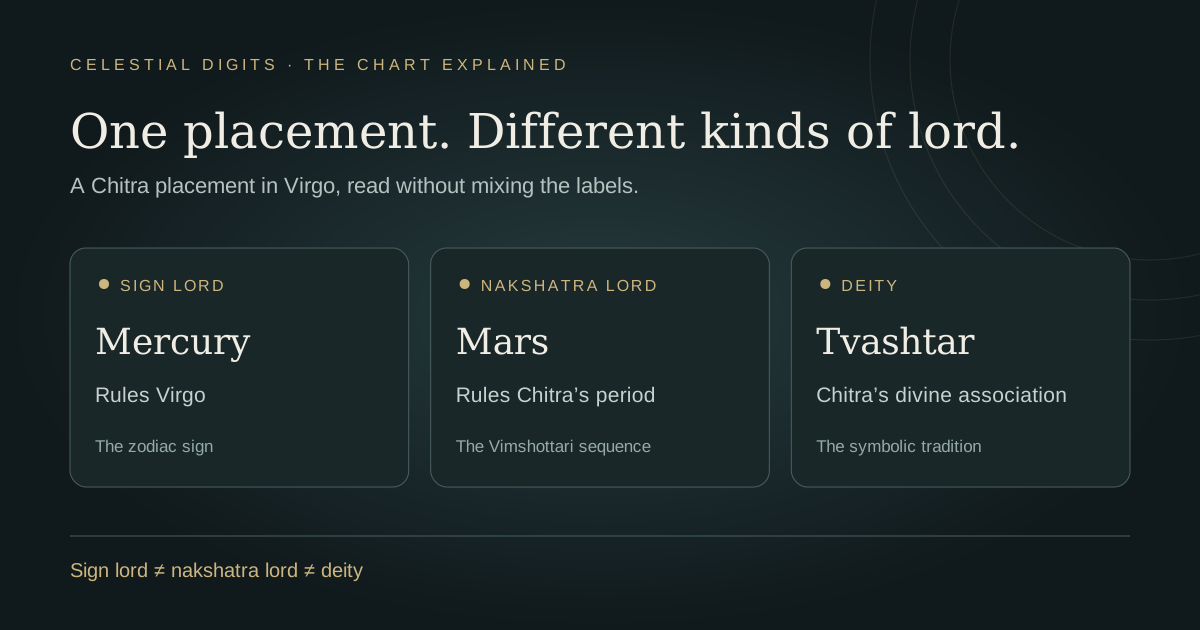
Nakshatra Lord vs Sign Lord vs Deity: Who Rules Your Chart?
Separate sign lord, nakshatra lord and deity with clear examples from Chitra, Revati and Krittika, plus a practical way to read your own chart.
A little more perspective.
Keep discussions respectful. No harassment, hate, sexual content or spam. Comments are reviewed before publication. Report concerns from a comment menu, or contact [email protected].
Checking your session…