

Vimshottari Dasha for Beginners: How to Read Mahadasha and Antardasha Together
Learn how to read Vimshottari Mahadasha and Antardasha together using house activation, lordship, dignity, and timing logic rooted in Jyotish.
Vimshottari Dasha is one of the most important timing systems in Jyotish because it answers the question a birth chart alone cannot answer: when does a promised result become active?
Beginners usually learn the names of the Mahadashas first, then get overwhelmed when real life does not match simple statements like "Jupiter dasha is always good" or "Saturn dasha is always hard." That is where Antardasha becomes essential.
The Mahadasha shows the larger karmic chapter. The Antardasha shows which sub-theme inside that chapter is currently active. If you read only one and ignore the other, predictions become vague very quickly.
This article is written as a practical beginner guide, but without flattening the tradition into shortcuts.
Classical Footing#
The Vimshottari system is classically tied to the Moon's nakshatra at birth and a full cycle of 120 years. Brihat Parashara Hora Shastra treats Vimshottari as a primary nakshatra-based dasha system and gives methods for Mahadasha, Antardasha, and further subdivisions. In other words, the classical method is already layered. It was never meant to be read as one planet in isolation for twenty years.
That point matters.
If your current Mahadasha is Venus, you are not living "pure Venus" every day for twenty years. You are living Venus through Sun, Venus through Moon, Venus through Mars, Venus through Rahu, and so on, each with different results.
What Vimshottari Dasha Actually Does#
Vimshottari does not replace the natal chart. It activates what is already promised in it.
Think of it in three steps:
- The natal chart shows the raw promise.
- The dasha shows which planets and houses are active now.
- Transit helps trigger timing inside that active period.
If the chart does not support an event, dasha alone cannot manufacture it from nothing. It can only activate the available karmic material.
The Nine Mahadashas and Their Standard Durations#
The Vimshottari order is fixed:
| Planet | Years | General Theme |
|---|---|---|
| Ketu | 7 | detachment, pruning, karmic resets, internalization |
| Venus | 20 | relationships, comfort, agreements, art, values |
| Sun | 6 | authority, identity, role clarity, visibility |
| Moon | 10 | mind, home, nourishment, emotional responsiveness |
| Mars | 7 | action, conflict, effort, courage, surgery, competition |
| Rahu | 18 | ambition, foreign or unusual paths, acceleration, confusion |
| Jupiter | 16 | growth, wisdom, children, teaching, blessing, ethics |
| Saturn | 19 | duty, time, delay, structure, accountability |
| Mercury | 17 | learning, business, skill, analysis, trade, messaging |
These broad themes are useful, but they are only the first layer.
Mahadasha vs Antardasha#
The cleanest beginner model is this:
- Mahadasha: the major chapter
- Antardasha: the active subchapter
If Mahadasha is the wider climate, Antardasha is the current weather system moving through it.
For example:
- Saturn Mahadasha may bring a long phase of responsibility, restructuring, and reality-testing.
- Saturn-Venus Antardasha inside it can shift the focus toward relationship decisions, home comfort, agreements, or aesthetics within that Saturnian framework.
- Saturn-Mars Antardasha can instead bring conflict, hard effort, deadlines, repairs, surgery, or competitive pressure.
The Mahadasha does not disappear. The Antardasha modifies how it manifests.
How Antardasha Duration Works#
Each Mahadasha contains all nine Antardashas in the same planetary order. Their durations are proportional to the Vimshottari year allotment.
The standard formula is:
Mahadasha years x Antardasha planet years / 120
So if you are in Jupiter Mahadasha (16 years) and want the duration of Jupiter-Venus Antardasha, the proportion is:
16 x 20 / 120 = 2.67 years
You do not need to hand-calculate every period if software already gives the dates, but understanding the logic helps you stop treating Antardasha as a minor footnote. It is structurally built into the system.
The First Rule: Judge the Mahadasha Lord Properly#
Before reading the Antardasha, judge the Mahadasha lord in the natal chart:
- Which house does it occupy?
- Which houses does it own?
- Is it strong by sign, dignity, or varga support?
- Is it afflicted by combustion, debility, harsh conjunction, or pressure from nodes?
- What houses does it aspect?
- Is it connected to the topic you are asking about?
This tells you what kind of chapter is opening.
What to Look for in the Mahadasha Lord#
- House placement: where the planet delivers results
- House lordship: which life departments it activates
- Natural significations: what the planet naturally governs
- Condition: whether it can deliver smoothly or with strain
Example:
If the Mahadasha lord owns the 10th and 11th houses and sits strongly in an upachaya, career, gains, networks, promotion, and ambition naturally become major chapter themes.
If the Mahadasha lord owns the 6th and 8th and is weak or afflicted, the chapter may revolve more around conflict, health, debt, rupture, service, repair, or pressure.
The Second Rule: Judge the Antardasha Lord With the Same Seriousness#
Now read the Antardasha lord exactly the same way.
Beginners often treat Antardasha as "small" and therefore optional. That is a mistake. The Antardasha often tells you which event within the larger chapter becomes concrete now.
Check:
- Its natal house placement
- Its ownership
- Its dignity
- Its links with the Mahadasha lord
- Its links with the question you are asking
The Third Rule: Study the Relationship Between the Two Planets#
This is where real interpretation starts.
The Mahadasha lord and Antardasha lord should be read together, not one after the other like separate horoscope blurbs.
Look for:
- conjunction
- mutual aspect
- sign exchange
- nakshatra connection
- one planet placed in the other's house
- shared connection to the same house or karaka
Why This Matters#
If both planets activate the same area of life, results become much more visible.
Examples:
- both connect to the 7th house: relationship and marriage themes rise
- both connect to the 10th house: career becomes loud
- both connect to the 4th and 12th: relocation, home change, or withdrawal may intensify
- both connect to the 5th: children, study, creativity, speculation, romance, or teaching themes become more likely
A Simple Step-by-Step Reading Method#
Here is a beginner-safe workflow that actually works.
Step 1: Start With the Topic#
Do not ask, "What will Saturn-Venus give?"
Ask:
- What does Saturn-Venus indicate for marriage?
- What does Saturn-Venus indicate for career?
- What does Saturn-Venus indicate for relocation?
Prediction becomes cleaner when tied to a specific life domain.
Step 2: Identify the Relevant Houses#
Some useful house clusters:
- Career: 2, 6, 10, 11
- Marriage: 2, 7, 11
- Romance: 5, 7, 11
- Property/Home: 4, 11, 12
- Children: 5, 9, Jupiter
- Foreign move: 9, 12, 3, Rahu
Step 3: Judge the Mahadasha Lord#
Ask whether the Mahadasha lord strongly touches the topic houses by ownership, placement, aspect, or conjunction.
Step 4: Judge the Antardasha Lord#
Do the same for the Antardasha lord.
Step 5: Combine Them#
Now ask:
- Are both supporting the same topic?
- Is one supportive and the other obstructive?
- Does one give the event while the other gives the cost?
Step 6: Confirm in the Relevant Divisional Chart#
Use the appropriate varga if the question is specific:
- D9/Navamsa for marriage and deeper relational maturation
- D10/Dasamsa for profession and public work
Do not start with the varga before checking the main chart. Use it as refinement.
Step 7: Use Transit for Timing Windows#
Once dasha clearly activates the topic, transit helps show when the event is likely to crystallize.
Three Worked Examples#
These are teaching examples, not promises.
Example 1: Career Promotion#
Suppose a native is in:
- Mahadasha of the 10th lord, placed strongly in the 11th
- Antardasha of the 2nd lord, aspecting the 10th
This is already strong for career gains because:
- the 10th brings profession and status
- the 11th brings gains and recognition
- the 2nd adds income and role consolidation
If Jupiter or Saturn transit also supports the 10th or 11th, a promotion window becomes more realistic.
Example 2: Marriage#
Suppose the native is running:
- Mahadasha of the 7th lord
- Antardasha of Venus, placed in the 11th and linked to the 2nd
This can support marriage because:
- the 7th activates partnership
- Venus supports relationship and agreement
- the 2nd supports family formation
- the 11th supports fulfillment and social approval
If D9 confirms and transit Jupiter supports the 7th house or its lord, the period becomes much more event-capable.
Example 3: Mixed Results in a Good Mahadasha#
Suppose the native is in a strong Jupiter Mahadasha, but enters Jupiter-Ketu Antardasha.
The larger Jupiter period may still be good overall, but the Ketu subperiod can bring:
- detachment from prior goals
- spiritual turn
- pruning of friendships or work paths
- unexpected closure before expansion resumes
This is why "good dasha" does not mean every month feels outwardly pleasant.
How House Ownership Changes Everything#
One of the biggest beginner mistakes is judging planets only by natural benefic or malefic categories.
That is not enough.
A natural benefic can still run a difficult period if it owns hard houses and is under pressure. A natural malefic can still give major growth if it owns excellent houses and is strong.
Example#
Saturn is naturally heavy, but for some ascendants it can become a powerful yoga-producing planet.
Jupiter is naturally benefic, but if it rules difficult houses and is weak, its period may still bring stress mixed with wisdom.
So always ask:
What is this planet doing in this specific chart?
The Planet Alone Never Tells the Full Story#
Do not reduce dashas to slogans like:
- Venus dasha means marriage
- Saturn dasha means suffering
- Rahu dasha means chaos
- Jupiter dasha means blessings
All four statements are incomplete.
Better versions would be:
- Venus dasha can highlight relationships, agreements, pleasure, vehicles, aesthetics, and values, depending on house ownership and condition.
- Saturn dasha can bring burden, but also rank, authority, endurance, and stable achievement.
- Rahu dasha can bring confusion, but also breakthrough, foreign exposure, and nontraditional success.
- Jupiter dasha can bless, but may also expand whatever problem already exists if judgment is weak.
What to Track in Real Life#
If you want to learn your own dasha patterns properly, track real events by date.
Record:
- job changes
- relocations
- relationship beginnings or endings
- health flare-ups
- financial jumps or drops
- court, debt, or family matters
After 2 to 3 years of data, you will begin seeing how your Mahadasha and Antardasha actually behave in your chart.
Common Beginner Mistakes#
1. Reading Only the Mahadasha#
This produces broad statements with poor timing.
2. Ignoring House Lordship#
Natural planet meaning is not enough.
3. Ignoring the Natal Promise#
Dasha activates what exists. It does not invent a new destiny from nowhere.
4. Forgetting That Antardasha Can Modify a Good Chapter#
A strong Mahadasha can still contain difficult subperiods. A difficult Mahadasha can still contain relief pockets.
5. Using Transit Without Dasha Support#
Transit may create mood, pressure, or background movement, but major events usually need dasha activation too.
A Practical Short Formula#
If you want one useful beginner formula, use this:
Mahadasha = what chapter is running
Antardasha = what part of that chapter is active now
Transit = when it gets triggered
That one frame will save you from a lot of confusion.
Related Vedic Reads#
- Mahadasha Change in Vedic Astrology: A Practical Guide for the First 180 Days
- How to Judge Transit and Dasha Together Without Confusion
- How to Read a Vedic Chart Step-by-Step for Beginners
- Get Vedic Astrology Report
Final Take#
To read Vimshottari properly, stop asking what one planet "means" in the abstract. Ask how the Mahadasha lord and Antardasha lord work together through house ownership, placement, strength, and timing.
That is where real interpretation begins.
For a chart-specific dasha reading using your birth data, get a detailed Vedic Astrology Report.
Continue reading#
Related Posts
Mahadasha Change in Vedic Astrology: A Practical Guide for the First 180 Days
Understand what to expect in the first six months after a Mahadasha shift, with practical routines, decision filters, and grounded Vedic upaya.
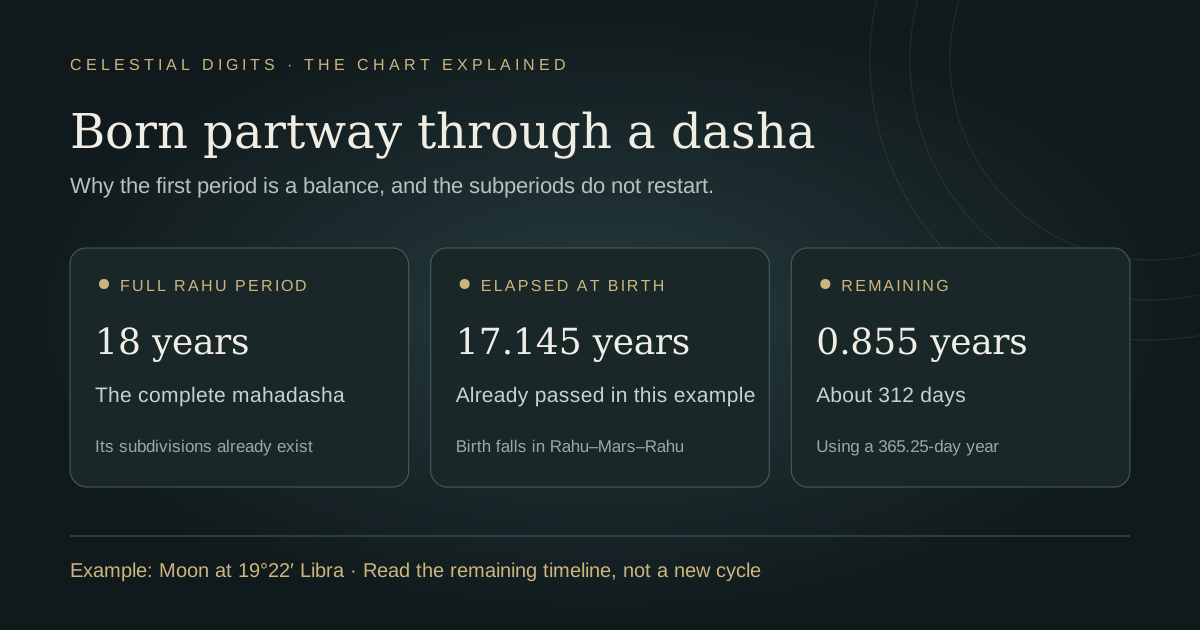
Why Was My First Mahadasha So Short? Dasha Balance at Birth
Calculate the remaining mahadasha at birth from the Moon's nakshatra, and see why the first antardasha must not restart from the mahadasha lord.

When Do Yogas Activate? Mahadasha, Antardasha and Transit Checks
Understand yoga activation, relevant major and sub-periods, transit notes, and exactly what Active, Dormant and upcoming windows mean in Celestial Digits.
A little more perspective.
Keep discussions respectful. No harassment, hate, sexual content or spam. Comments are reviewed before publication. Report concerns from a comment menu, or contact [email protected].
Checking your session…