
Combust Planets: Does Being Close to the Sun Always Mean Weakness?
Measure a planet's distance from the Sun with worked examples. Understand combustion, sign boundaries, retrograde motion and differing software rules.
“Your Mercury is combust” sounds like a complete diagnosis. It is actually the beginning of a calculation question: how close is Mercury to the Sun, and which rule was used to label it?
The next question is interpretive: how should that condition be weighed alongside Mercury's house ownership, sign placement and other factors? Treating the label as “Mercury no longer works” skips that second question entirely.
What combustion describes#
Combustion, commonly called asta in chart discussions, concerns a planet's proximity to the Sun and its association with being obscured by the Sun's brightness. Traditional texts discuss heliacal rising and setting—the circumstances in which a planet becomes visible or disappears near the Sun.
For historical context, Surya Siddhanta, chapter 9, verses 6–9 gives different visibility parameters for different planets and distinguishes phases of Mercury and Venus. Those astronomical visibility parameters should not be presented as identical to every modern software's simple longitude cutoff. Actual visibility also depends on geometry and observing conditions.
Here we use shortest ecliptic-longitude separation to demonstrate the arithmetic used in a simplified chart check. This is not a full heliacal-visibility calculation or a rule for deciding whether a planet can be seen from a particular location tonight.
Calculate the gap before reading the label#
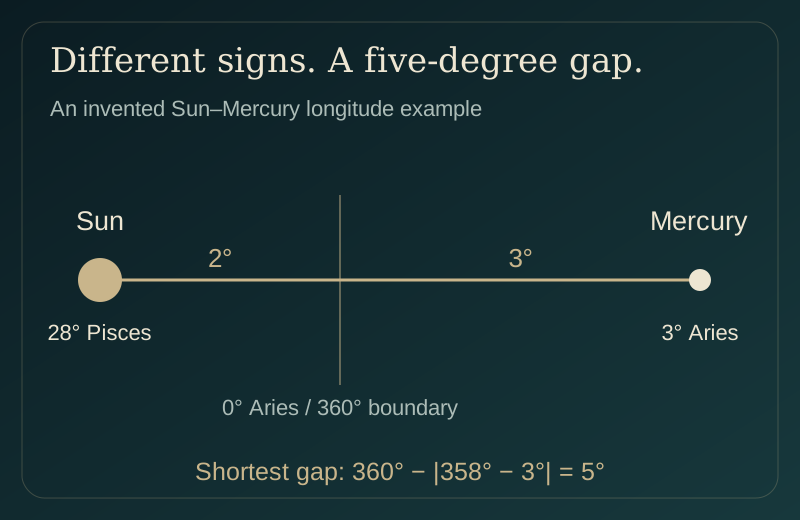
Convert each position to an absolute longitude between 0° and 360°. Aries starts at 0°, Taurus at 30°, Gemini at 60°, and so on. Find the absolute difference; if that difference exceeds 180°, subtract it from 360°.
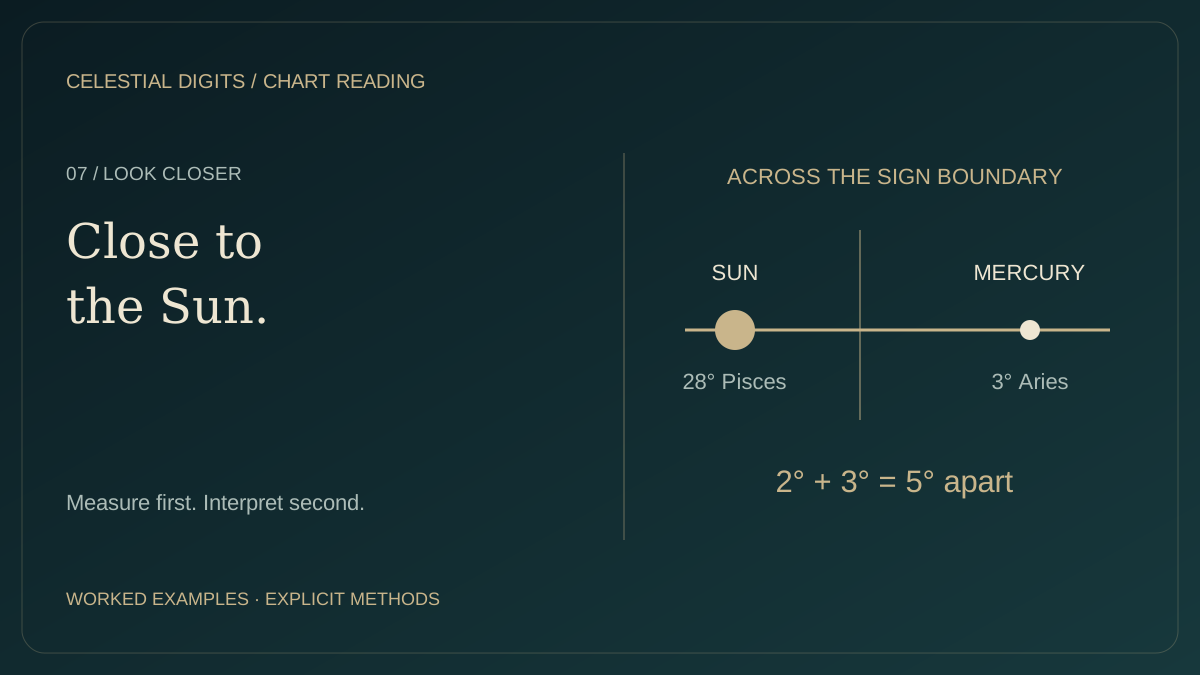
For example, Sun at 28° Pisces has longitude 358°. Mercury at 3° Aries has longitude 3°. The direct subtraction gives 355°, but the shorter gap across the zodiac boundary is:
360° − 355° = 5°
They occupy different signs, yet they are close in longitude. A combustion check that only searches for planets in the Sun's sign would miss this case.
One stated convention, three different cases#
For the following examples only, adopt a 14° direct-Mercury cutoff and a 12° retrograde-Mercury cutoff, with positions strictly inside the cutoff flagged as combust. These are declared working conventions for the exercise, not a promise that every reader or software uses identical rules.
| Invented positions | Mercury's motion | Shortest gap | Result under this convention |
|---|---|---|---|
| Sun 28° Pisces; Mercury 3° Aries | Direct | 5° | Inside 14°: flagged |
| Sun 10° Leo; Mercury 23° Leo | Direct | 13° | Inside 14°: flagged |
| Sun 10° Leo; Mercury 23° Leo | Retrograde | 13° | Outside 12°: not flagged |
The last two rows deliberately hold the longitudes fixed to isolate the rule change. They are independent hypothetical inputs, not two consecutive moments in a real ephemeris.
If a report differs on the third case, inspect its motion-dependent convention before calling its longitude calculation wrong. At an exact threshold, also check whether the implementation uses “less than” or “less than or equal to.” Avoid deciding a borderline case from rounded display values.
Close to the Sun and well placed can both be true#
Suppose Virgo rises, with Sun at 10° Virgo and direct Mercury at 15° Virgo. These are illustrative positions, not a full calculated horoscope.
Mercury is five degrees from the Sun, so our stated convention flags it. It is also in its own sign and its exaltation sign. For Virgo rising, it owns the first and tenth houses and occupies the first whole-sign house. The Sun owns the twelfth house.
None of those facts needs to erase another. A reader considering professional identity could examine how the first and tenth houses connect through Mercury, then weigh the Sun association. The calculation does not prove that the person lacks intelligence, cannot communicate or will fail professionally.
Similarly, naming a Sun–Mercury combination does not automatically remove the proximity condition. A conjunction label and a combustion flag answer different questions. See how close a conjunction really is.
What about marriage and Venus?#
“Combust Venus means no marriage” skips the ascendant, seventh house, its lord and the actual relationship question. It also turns a conditional astrological assessment into a categorical prediction about a person.
A more useful worksheet records Venus's Sun distance and the convention used, then examines its specific role in the chart. Is Venus the seventh lord for this ascendant, an occupant of the seventh, or being used as a natural relationship significator? Those are distinct roles. Do not assume a condition on one significator cancels every other factor.
An interpretation about recognition, autonomy or pressure within relationships may be worth discussing if it fits the person's circumstances. The chart alone does not establish anyone's behaviour or the future of their marriage.
Why two reports may disagree#
Check the birth timestamp first, then the unrounded longitudes, motion status, threshold and boundary rule. Confirm both programs are comparing the same chart rather than a natal placement with a transit.
Changing a zodiac's zero point by the same offset for both bodies does not change their shortest longitude separation. It can change sign labels. That means an ayanamsha difference by itself cannot explain a different Sun–planet gap when both positions otherwise use the same astronomical inputs.
Keep this distinction when exporting your chart data: a useful record includes the two positions, their gap, the planet's motion and the criterion used—not just combust: true.
Read the condition without turning it into a verdict#
Use the measured gap to make the comparison reproducible. Use house ownership and the rest of the chart to explain why the condition might matter to the question. Keep any predicted outcome tentative.
For the related motion question, read natal retrograde planets. For the broader framework, start with reference points and planetary strength. These examples teach a calculation and a traditional interpretive approach; they do not establish that proximity to the Sun causes events in human lives.
Related Posts
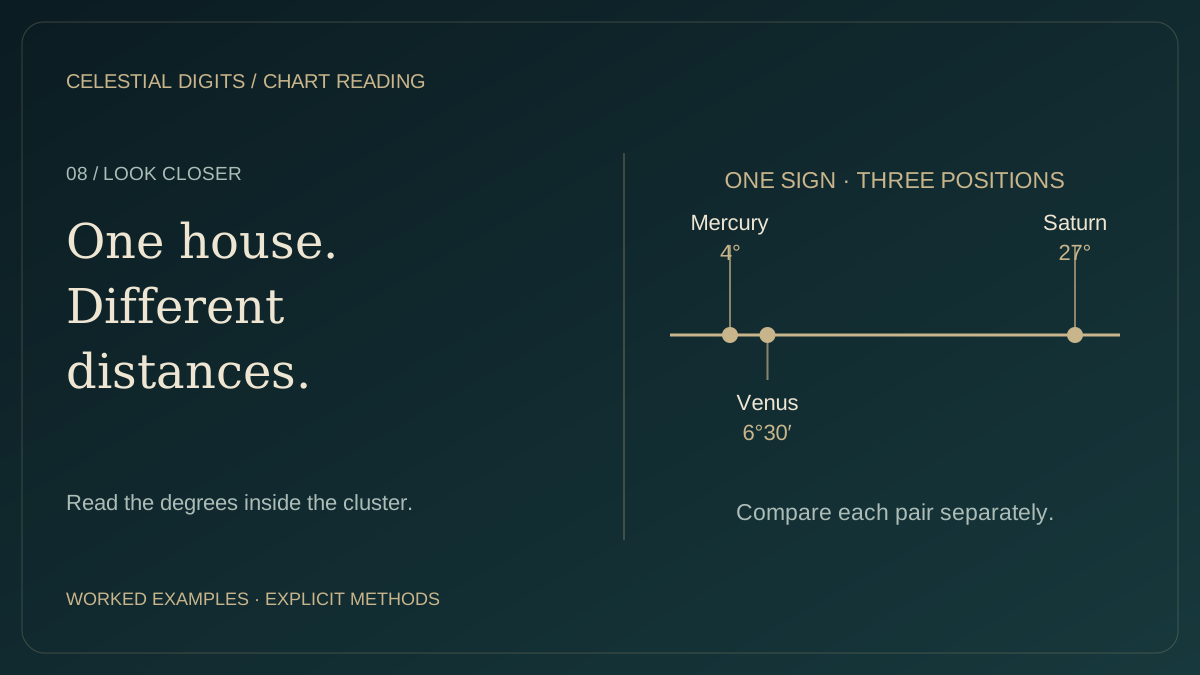
Same House, Different Degrees: How Close Is a Planetary Conjunction?
Compare same-sign conjunctions with actual degree gaps. Work through a three-planet cluster, cross-sign proximity and applying versus separating motion.
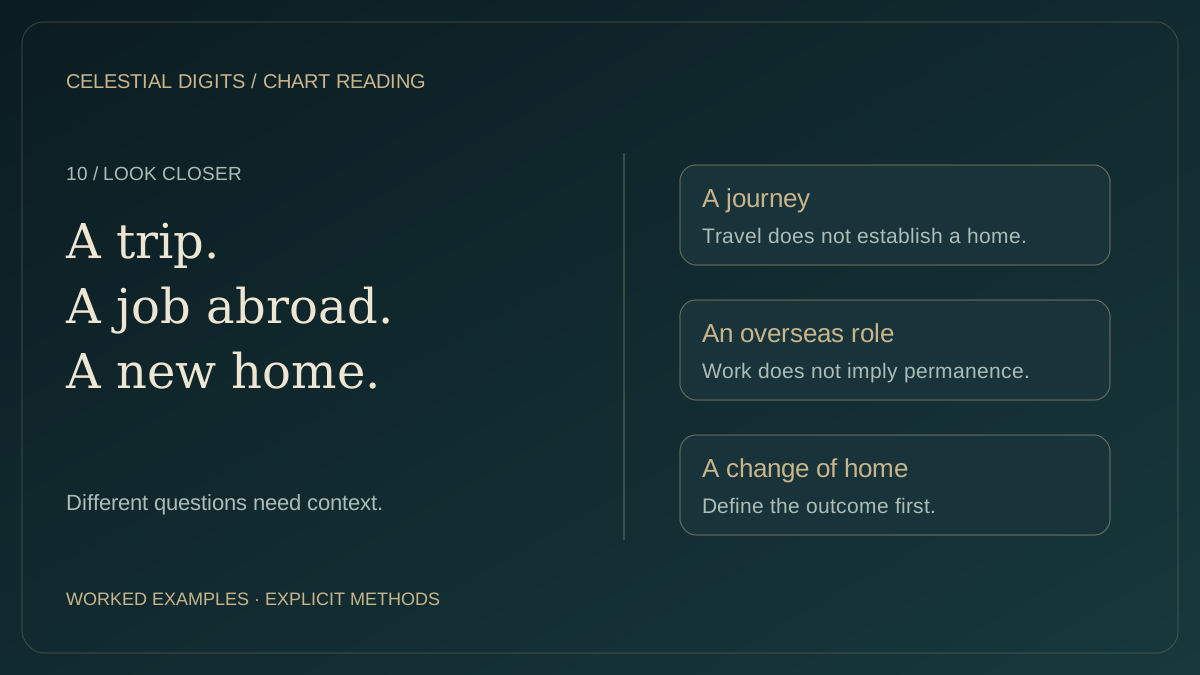
Foreign Travel, Work or Permanent Settlement? Read the Question First
Separate a foreign trip, overseas employment and a lasting change of home. Use a Virgo-ascendant worksheet to read houses, lordships and timing together.
Earning Well but Saving Little: Income, Wealth and Expenses in a Birth Chart
Separate income, accumulated wealth and expenses in a Vedic chart. Follow a Virgo-ascendant example without turning a wealth yoga into a money guarantee.
A little more perspective.
Keep discussions respectful. No harassment, hate, sexual content or spam. Comments are reviewed before publication. Report concerns from a comment menu, or contact [email protected].
Checking your session…