
Dispositor Chains Explained: Follow a Planet's Sign Lord
Trace a dispositor chain with worked examples. Learn where chains end, how exchanges form loops, and why sign lords are not nakshatra lords.
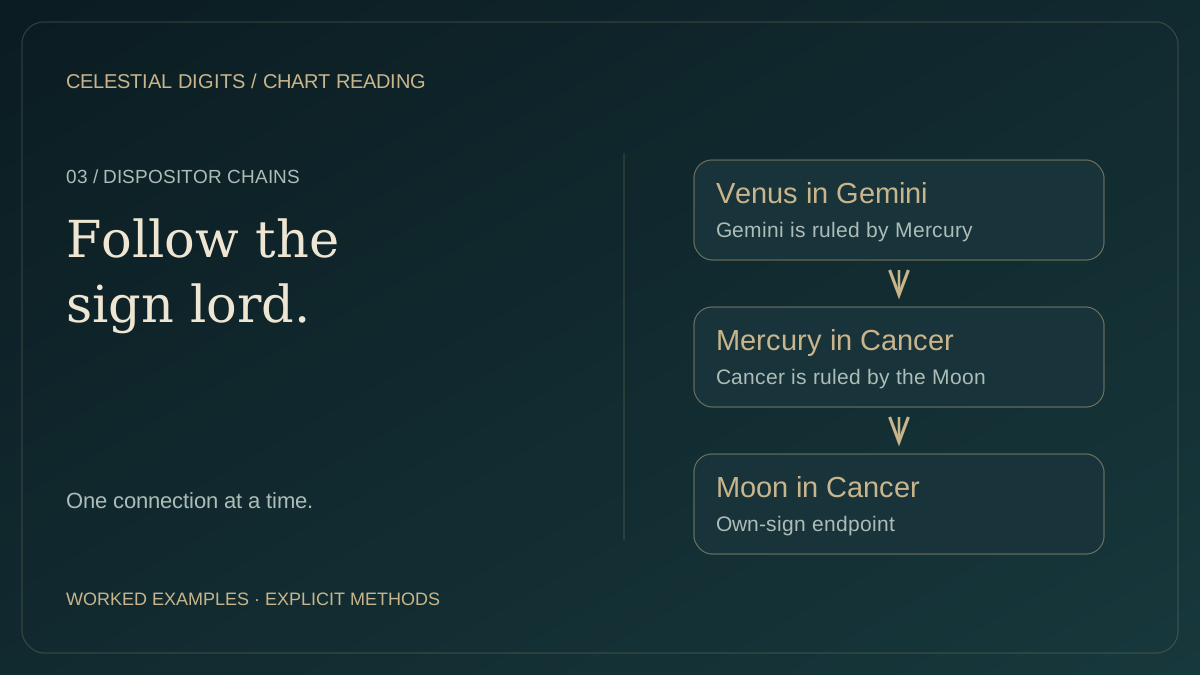
You find Venus in Gemini, read a Venus-in-Gemini description and stop. A dispositor check asks the next useful question: where is Mercury, the lord of Gemini?
Following that relationship can reveal connections you miss when reading each planet as an isolated paragraph. It is also an easy place to confuse a sign lord with a nakshatra lord, or to invent a single “most powerful planet” from an incomplete chart.
We will trace three invented examples. The arrows show sign ownership only. They are not planetary aspects, astronomical paths or evidence of measured causal influence.
What is a dispositor?#
In a sign-based reading, a planet's dispositor is the ruler of the sign it occupies. Venus in Gemini has Mercury as its sign dispositor. Mercury's own position then tells you whether the chain continues.
Here we use the conventional seven-planet sign rulers:
| Sign or signs | Ruler used in this guide |
|---|---|
| Aries, Scorpio | Mars |
| Taurus, Libra | Venus |
| Gemini, Virgo | Mercury |
| Cancer | Moon |
| Leo | Sun |
| Sagittarius, Pisces | Jupiter |
| Capricorn, Aquarius | Saturn |
Traditional sign ownership is set out in the sign descriptions of Brihat Parashara Hora Shastra, chapter 4. Some systems use additional co-lord conventions. Keep those separate rather than switching rulers halfway through a chain.
Example one: a chain that ends at an own-sign planet#
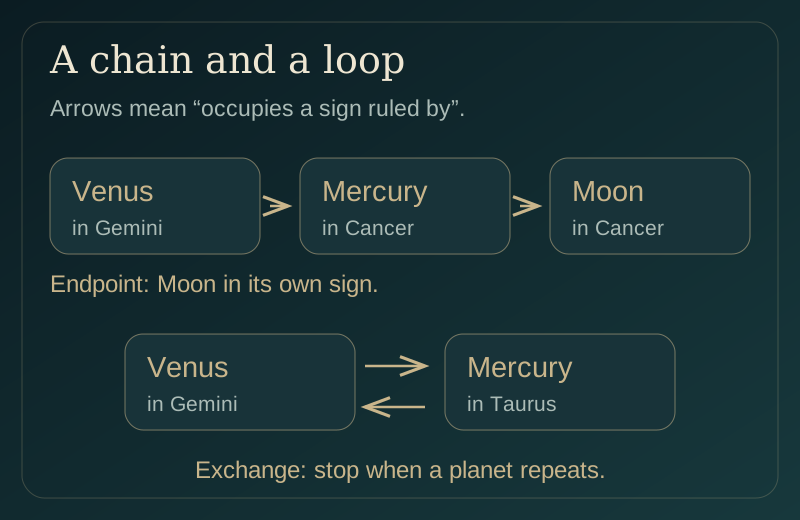
Assume these three positions:
- Venus in Gemini.
- Mercury in Cancer.
- Moon in Cancer.
Follow the sign of the planet at each step:
Venus → Mercury → Moon → Moon
Venus is in Mercury's sign. Mercury is in the Moon's sign. The Moon is in its own sign, so the process stops at the Moon; writing the final self-link makes that stopping condition explicit.
This establishes the Moon as the endpoint for this chain. It does not establish the Moon as the final dispositor of the entire chart. We have not supplied the Sun, Mars, Jupiter or Saturn, and their chains could end elsewhere.
For a whole-chart exercise, repeat the process from every planet and check whether all paths reach the same own-sign endpoint. State whether the nodes are included and what rulership convention you use.
What could the connection contribute to a reading?#
A practitioner examining Venus-related subjects might next inspect Mercury and the Moon instead of treating Venus's sign description as a complete answer. Their actual conditions, house ownership and placements remain necessary.
For instance, an invented reading worksheet might ask whether the person's relationship concerns involve communication and home arrangements. Those are questions suggested by a symbolic interpretation, not facts discovered by drawing arrows. The chart fragment alone cannot tell us whether the person is married, happy, wealthy or professionally successful.
An endpoint does not absorb the identity of every planet that reaches it. Venus remains Venus. It also does not become stronger merely because a chain is long.
Example two: an exchange has no single endpoint#
Now use Venus in Gemini and Mercury in Taurus:
Venus → Mercury → Venus
The two planets occupy each other's signs. This is a sign exchange, commonly called parivartana. Stop when a planet repeats; continuing to write the same names creates no new information.
To interpret the exchange, first determine the houses involved. With an invented Aries ascendant, Taurus is the second house and Gemini the third. Mercury occupies the second and Venus the third. Venus also owns the seventh house; Mercury also owns the sixth. A claim about the exchange should disclose those additional responsibilities rather than simply calling it a wealth yoga.
With another ascendant, the same sign exchange involves different houses. This is why an exchange diagram by itself does not classify the quality of the result.
Example three: a longer loop#
Consider Sun in Virgo, Mercury in Libra, and Venus in Leo:
Sun → Mercury → Venus → Sun
Each planet leads to another until the Sun repeats. This is a three-planet cycle in the dependency map. It is not a two-planet mutual exchange, and this guide does not assign it a classical named yoga or automatic result.
That distinction prevents a subtle error: a graph can be mathematically correct while the astrological label attached to it is unsupported.
Sign lord, nakshatra lord and house lord#
For Venus at 10° Gemini, the sign lord is Mercury. That position lies in Ardra, whose Vimshottari nakshatra lord is Rahu. These are two separate relationships.
If you are tracing the sign-dispositor chain, the next step is Mercury. Substituting Rahu changes the method. A star-lord analysis can be performed separately, with its own stated rules.
House lordship adds another label. For Aries rising, Venus owns the second and seventh houses, regardless of the sign it occupies. The planet ruling Venus's occupied sign is not automatically the same as the houses Venus itself rules. Our sign lord, nakshatra lord and deity guide separates these terms.
Try the method without guessing missing positions#
Open the planetary table in your birth-chart report. Make a two-column list: planet, then occupied sign. Look up each sign's ruler, draw one arrow, and repeat until you reach an own-sign planet or a repeated planet.
If a position is missing, mark the chain incomplete. Build D1 and D9 chains separately; do not jump into the other chart because an endpoint there looks more favourable. The D1/D9 worked example explains why chart labels must remain attached to every placement.
Method note: The diagrams are original teaching examples using conventional sign ownership. Tracing a dependency is reproducible; interpreting it is a traditional practice, not an independently validated prediction.
Related Posts
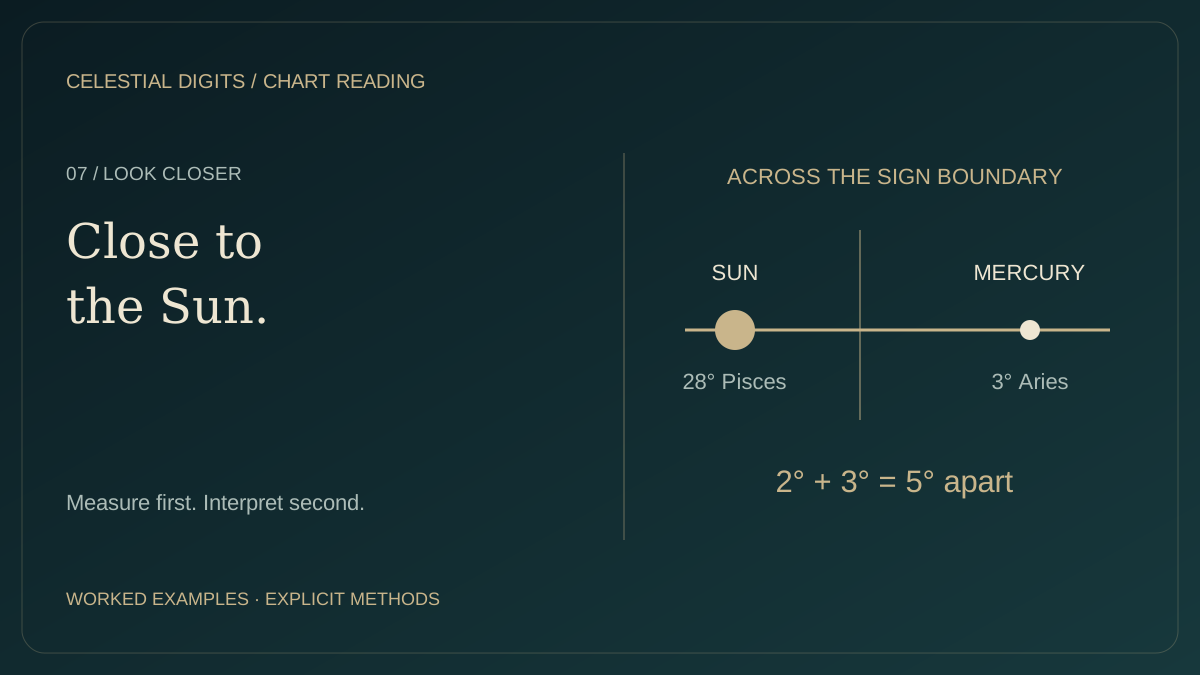
Combust Planets: Does Being Close to the Sun Always Mean Weakness?
Measure a planet's distance from the Sun with worked examples. Understand combustion, sign boundaries, retrograde motion and differing software rules.
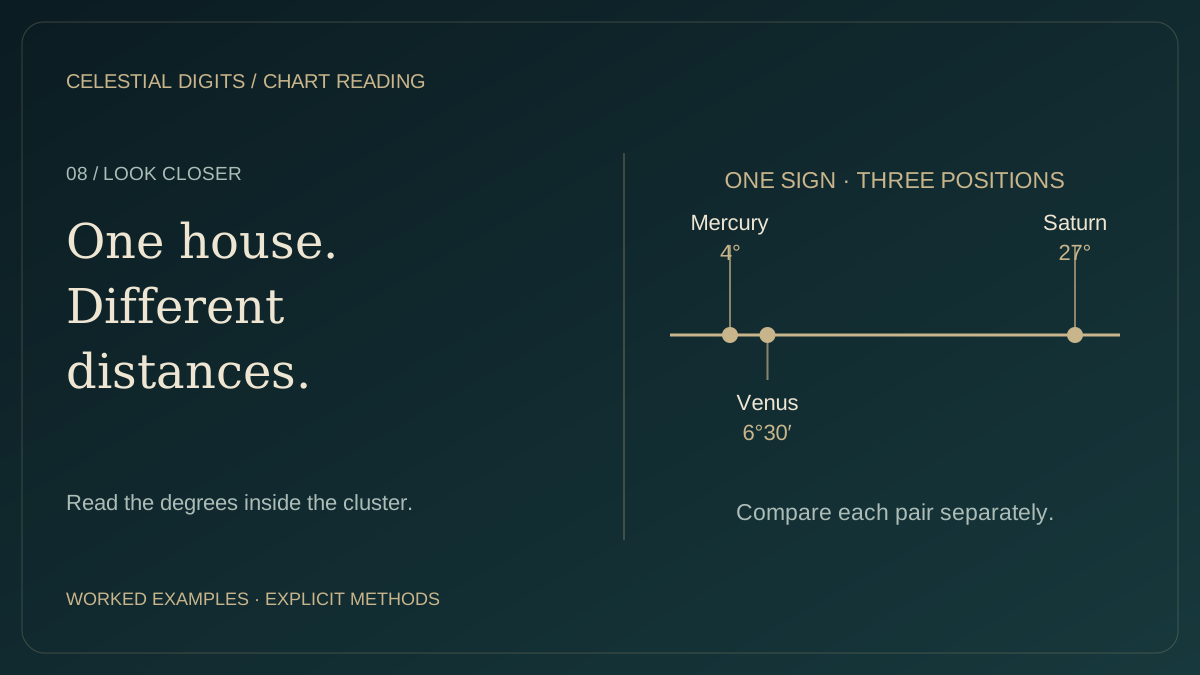
Same House, Different Degrees: How Close Is a Planetary Conjunction?
Compare same-sign conjunctions with actual degree gaps. Work through a three-planet cluster, cross-sign proximity and applying versus separating motion.
Foreign Travel, Work or Permanent Settlement? Read the Question First
Separate a foreign trip, overseas employment and a lasting change of home. Use a Virgo-ascendant worksheet to read houses, lordships and timing together.
A little more perspective.
Keep discussions respectful. No harassment, hate, sexual content or spam. Comments are reviewed before publication. Report concerns from a comment menu, or contact [email protected].
Checking your session…