
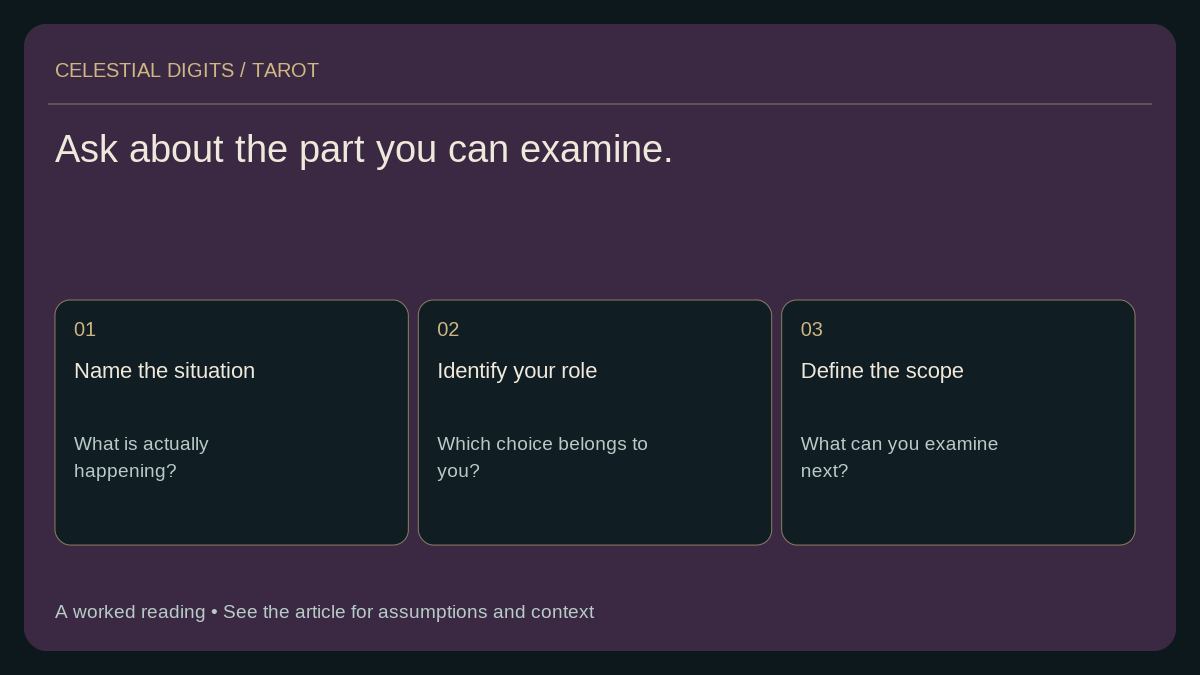
How to Ask a Tarot Question That Produces a Useful Reading
Rewrite vague or intrusive tarot questions into focused prompts about choices, communication and practical next steps.
A tarot question determines what the reading is trying to do. “What will happen to me?” leaves almost unlimited room for interpretation. “What should I examine before accepting this additional responsibility?” creates a much clearer task.
Better questions do not make tarot an objective forecasting instrument. They make the conversation more specific, less intrusive and easier to connect with real decisions.
Start with the concern underneath the wording#
Suppose someone asks, “Will my colleague sabotage me?” The underlying concern may be unclear responsibilities or a missed deadline. A spread cannot establish the colleague's hidden intention. It can help the reader reflect on what they observed, what remains uncertain and how to communicate.
A more useful question is: “What do I need to clarify with my colleague before the next deadline?” That preserves the concern without treating suspicion as a fact.
Rewrite three common questions#
| Original question | More useful reflective question |
|---|---|
| Will I become successful? | What strength and obstacle should I examine in this project? |
| Does my partner secretly want to leave? | What do I need to understand and communicate about our current distance? |
| Which choice is destined for me? | What trade-offs am I overlooking in each available option? |
The rewritten versions still allow difficult answers. They simply focus on the reader's knowledge, choices and responsibilities rather than claiming access to someone else's mind or a fixed future.
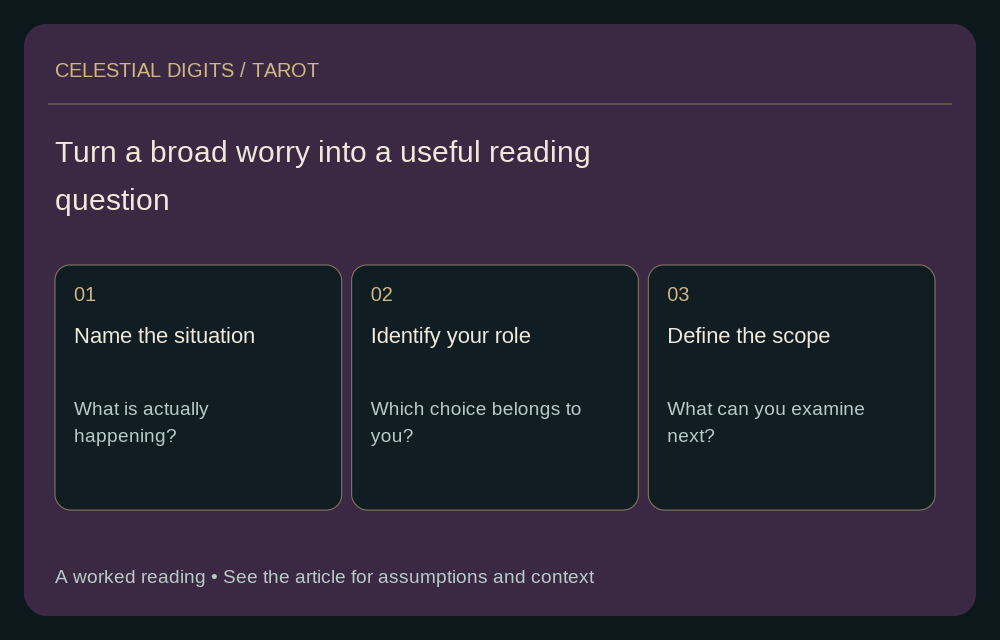
Build a spread that matches the question#
For a fictional volunteer deciding whether to coordinate a new programme, use three positions: available capacity, neglected requirement and next conversation. Those positions fit a question about responsibility better than a generic past–present–future layout.
Before drawing, write what each position means. Available capacity includes actual time and skill; it is not permission to ignore exhaustion. Neglected requirement invites investigation; it does not prove that the reader has failed. Next conversation points toward clarification rather than predicting another person's response.
The cards can supply images and associations to explore each position. The volunteer still needs the programme's schedule, expectations and support arrangements.
Use a workable scope#
A question about the next planning meeting is easier to examine than a question about the next twenty years. A shorter scope does not guarantee accuracy, but it gives the reading a clearer connection to action and later reflection.
Avoid asking the same question repeatedly because the first spread was unwelcome. If important circumstances change, record what changed and ask a genuinely revised question.
Know when the question needs another kind of answer#
Some uncertainties need documents, direct conversation or qualified advice. Cards cannot diagnose an illness, determine whether a contract is enforceable or verify an investment claim. A reflective spread can explore how you feel about seeking help; it cannot supply the missing professional assessment.
Likewise, a question about another person's consent or boundaries should be answered by listening to that person. A favourable card is not permission to override an explicit no.
End with a sentence you can use#
A useful reading might conclude: “Before agreeing, I will ask who covers the role when I am unavailable.” That is more actionable than “the universe supports leadership.” Record the question, the interpretation and what you actually learned afterwards.
Our approach uses Rider–Waite–Smith symbolism with contemporary reflective questions. For historical context, see Waite's The Pictorial Key to the Tarot. Practise the method with our complete three-card reading and guide to choosing a reversal convention.
Related Posts
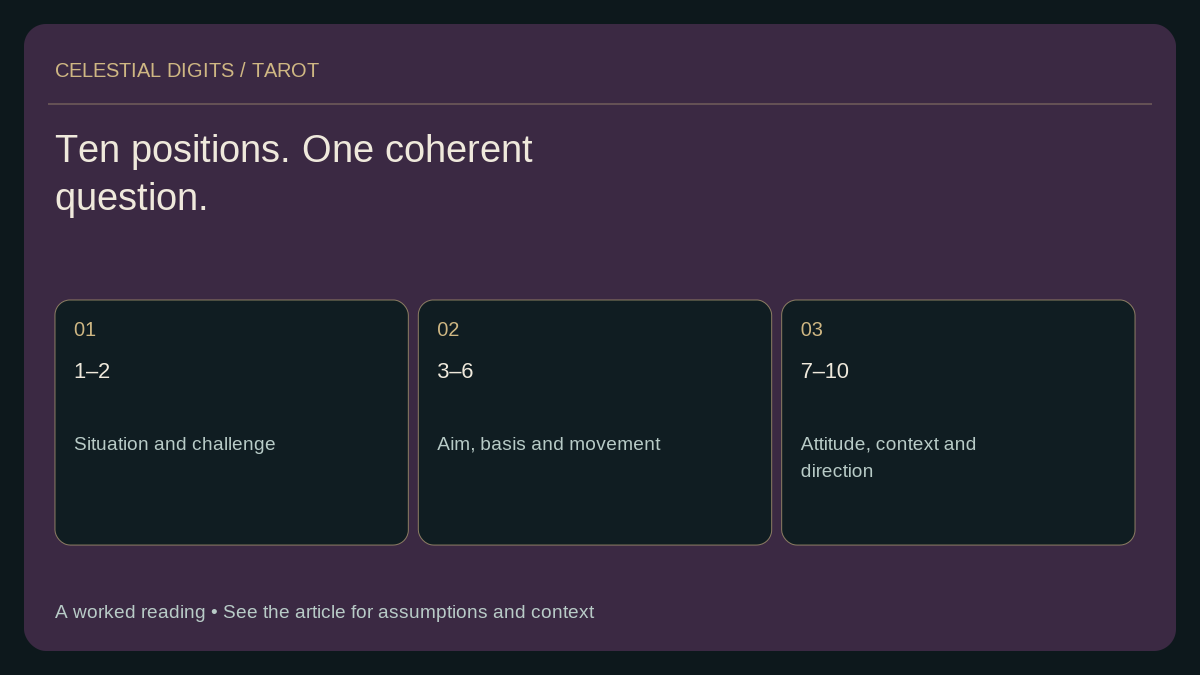
The Celtic Cross Explained Through One Complete Example
Follow all ten Celtic Cross positions in a fictional creative-project reading, then combine the cards into a practical, conditional interpretation.
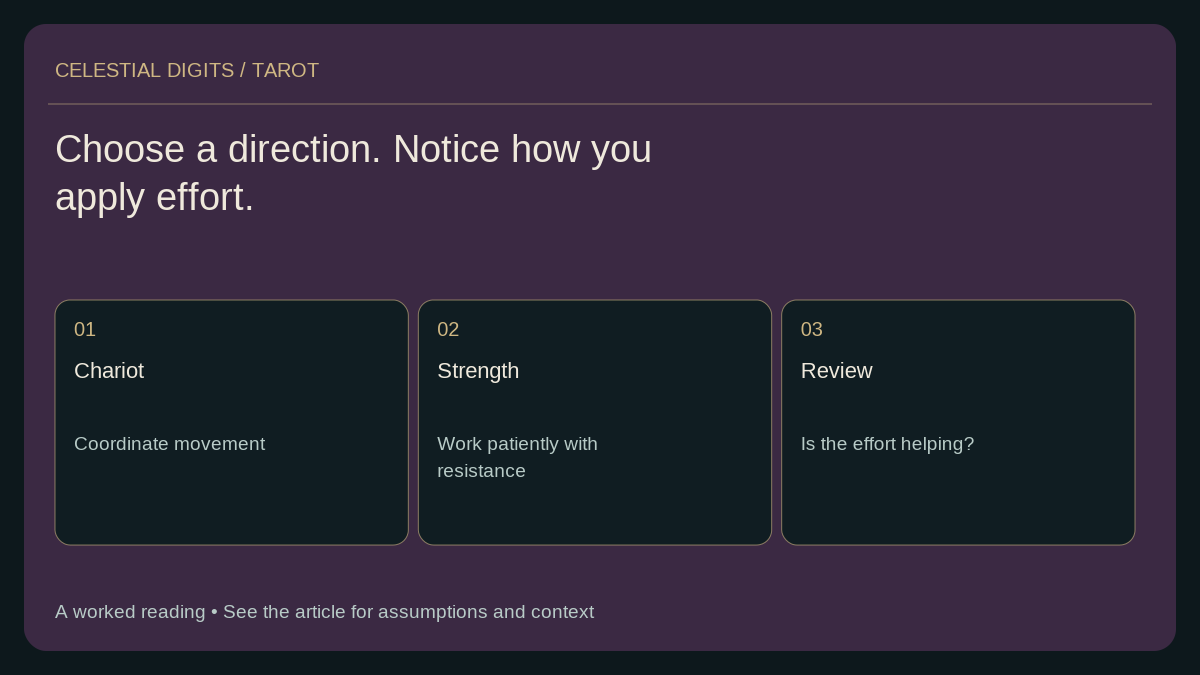
The Chariot vs Strength: Direction, Persistence and Resistance
Compare purposeful direction with patient self-regulation through a rehearsal example, without treating either card as a command to push harder.
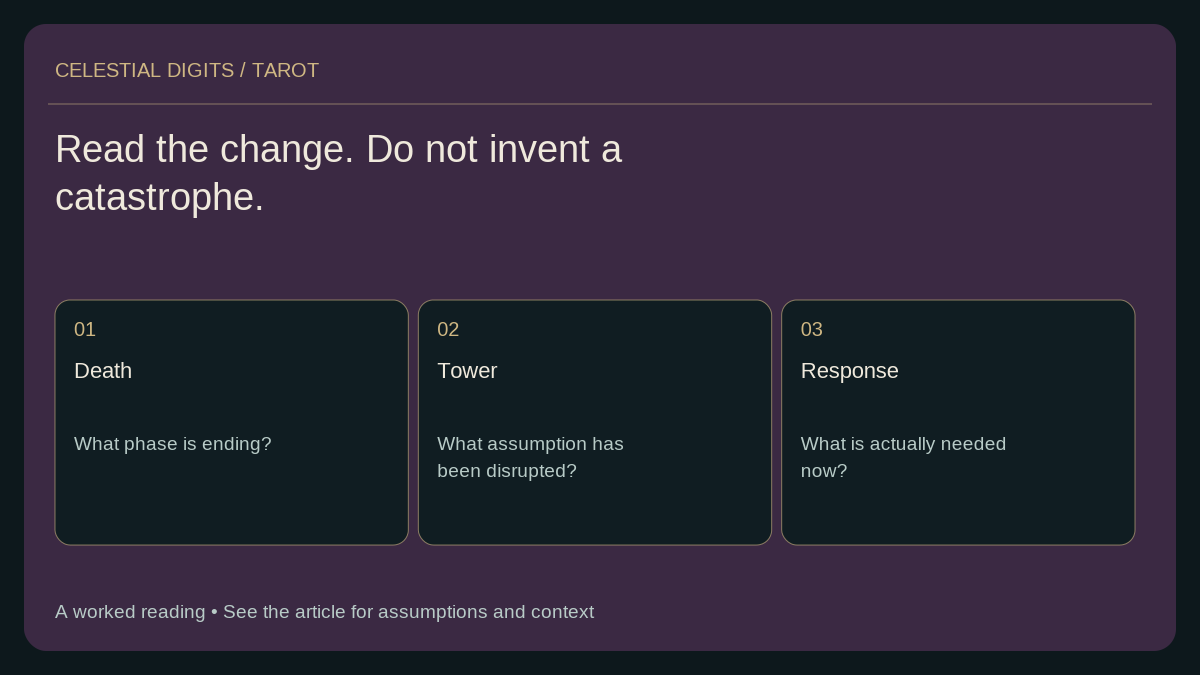
Death vs The Tower: Endings, Disruption and What Comes Next
Compare two often-feared tarot cards through project examples, separating symbolic change from literal predictions of disaster.
A little more perspective.
Keep discussions respectful. No harassment, hate, sexual content or spam. Comments are reviewed before publication. Report concerns from a comment menu, or contact [email protected].
Checking your session…