
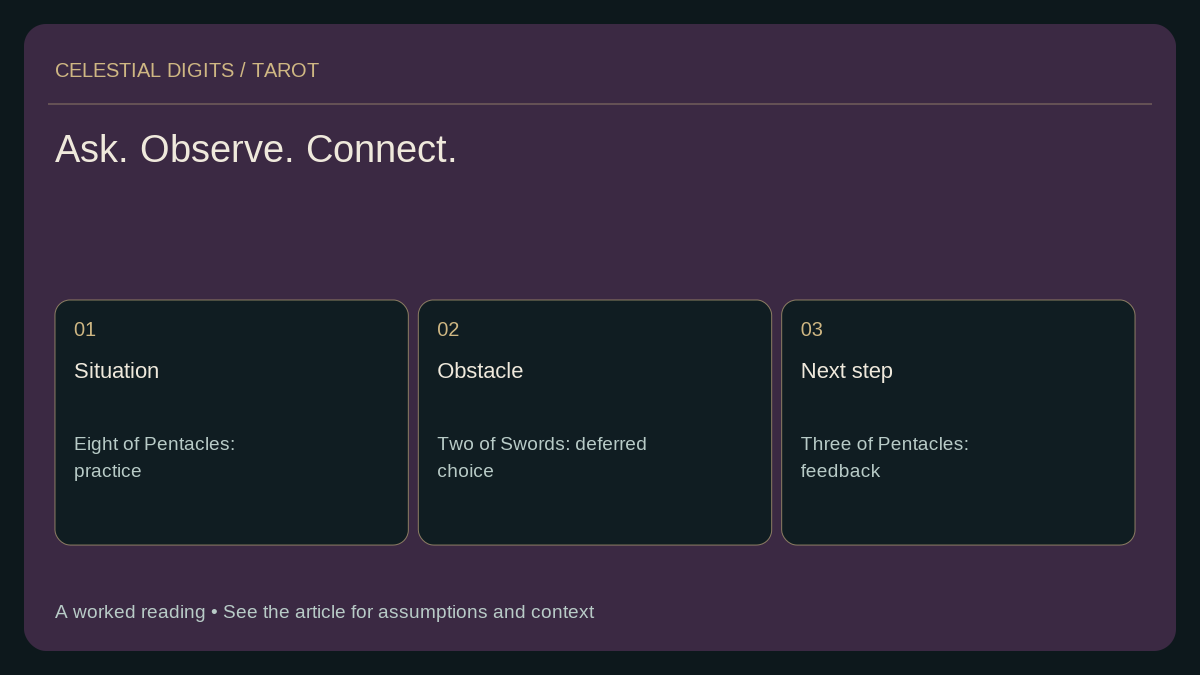
How to Read Tarot: A Complete Three-Card Beginner Example
Follow a Rider–Waite–Smith three-card reading from a clear question to a practical next step, with an illustrated sample spread.
A beginner tarot reading becomes much easier when every card has a job. Instead of drawing three images and trying to tell an entire future, define three positions: situation, obstacle and useful next step. Then connect what you see to one specific question.
This guide uses Rider–Waite–Smith imagery and a fictional learning scenario. The cards below were selected to teach the process; they were not presented as a random draw or a reading for a real client.
Start with a question that leaves room to act#
Our fictional reader, Leena, is learning illustration. She asks: “What should I examine before offering my first small commission?” That question is more useful than asking whether she will become famous. It names an activity, a decision and a scale small enough to investigate.
Write the question and position meanings before drawing. If the positions change after you see the cards, it becomes easy to rearrange the reading until it says what you hoped to hear.
Observe each image before assigning a meaning#
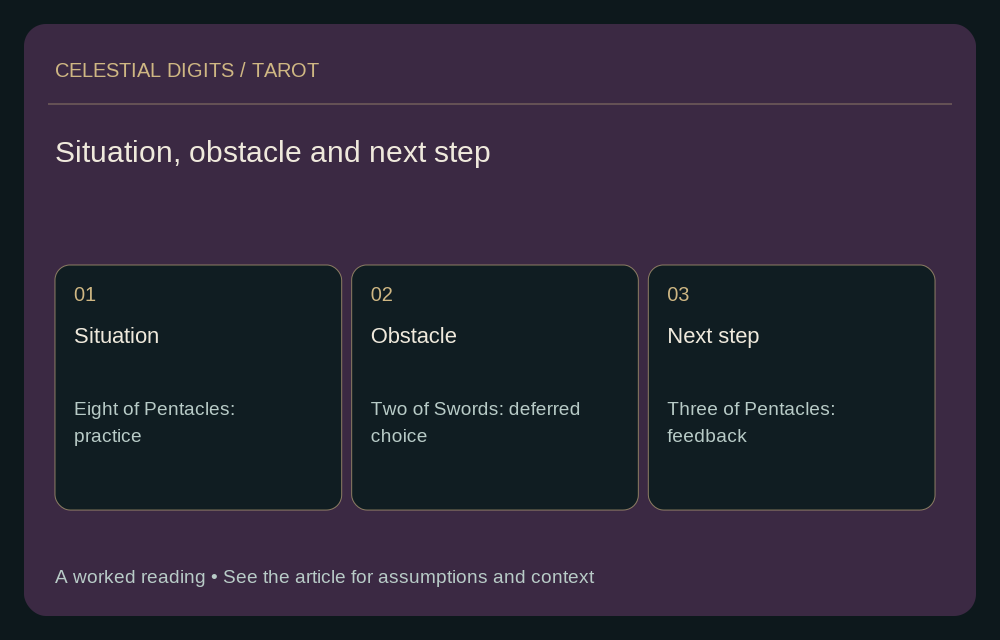
In the Eight of Pentacles, a craftsperson works on repeated pentacles. In the Two of Swords, a seated blindfolded figure holds crossed swords. In the Three of Pentacles, a skilled worker appears with two other figures in an architectural setting.
Those are visual observations. “Leena needs peer feedback” is an interpretation. Keeping the two separate makes the reading easier to explain and less dependent on memorised keywords.
| Position | Selected card | Question raised by the image |
|---|---|---|
| Situation | Eight of Pentacles | What skill is being developed through repetition? |
| Obstacle | Two of Swords | Which decision is being postponed? |
| Next step | Three of Pentacles | Who can assess the work or clarify expectations? |
Connect the cards to the actual situation#
Leena has been practising regularly but has not chosen the type of commission she can reliably complete. The Eight offers a way to discuss that practice. The Two suggests exploring the unresolved choice rather than assuming she lacks talent. The Three invites feedback and a shared definition of the finished work.
A practical interpretation could be: choose one small service, ask a knowledgeable person to review three examples, and write a simple scope before accepting a commission. That action comes from applying the images to the stated situation, not from a claim that the cards know a future customer's intentions.
If Leena had already made those decisions, the interpretation would need revisiting. Her circumstances should not be bent to fit the spread.
What the reading cannot establish#
These cards do not prove market demand, guarantee payment or reveal whether a particular customer is honest. Pricing, deadlines and agreements still need ordinary investigation. A tarot reading can organise reflection; it cannot replace missing information with certainty.
Avoid assigning every card to another person. The Two of Swords need not mean that a rival is blocking Leena. It can describe a question or stance within the reading itself.
Close with one observable action#
Record the question, cards, position meanings, interpretation and one action. After a week, note what happened and what did not fit. That record is more useful than drawing repeatedly until the spread feels reassuring.
A. E. Waite's The Pictorial Key to the Tarot is a historical companion to this deck tradition. Our three-position exercise and Leena scenario are contemporary teaching examples, not Waite's original spread. Continue with Major versus Minor Arcana and the four suits to build the vocabulary behind this reading.
Related Posts
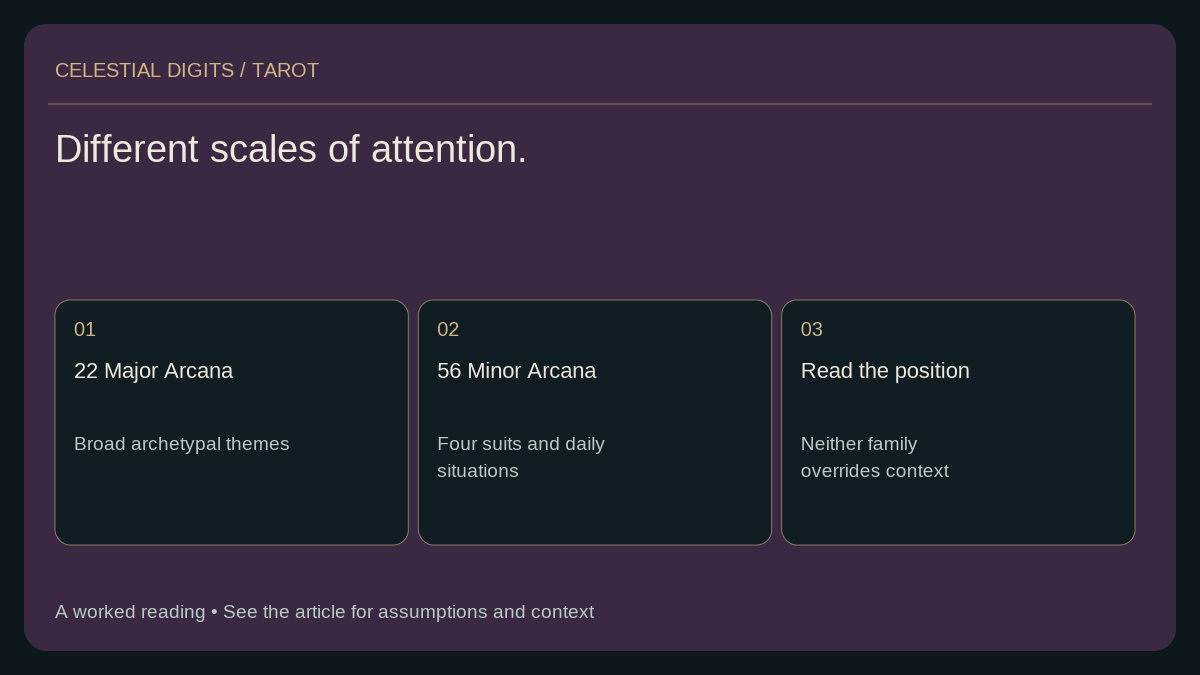
Major vs Minor Arcana: Big Themes and Everyday Situations
Understand the 22 Major and 56 Minor Arcana through two sample readings, without treating a Major card as an inevitable event.
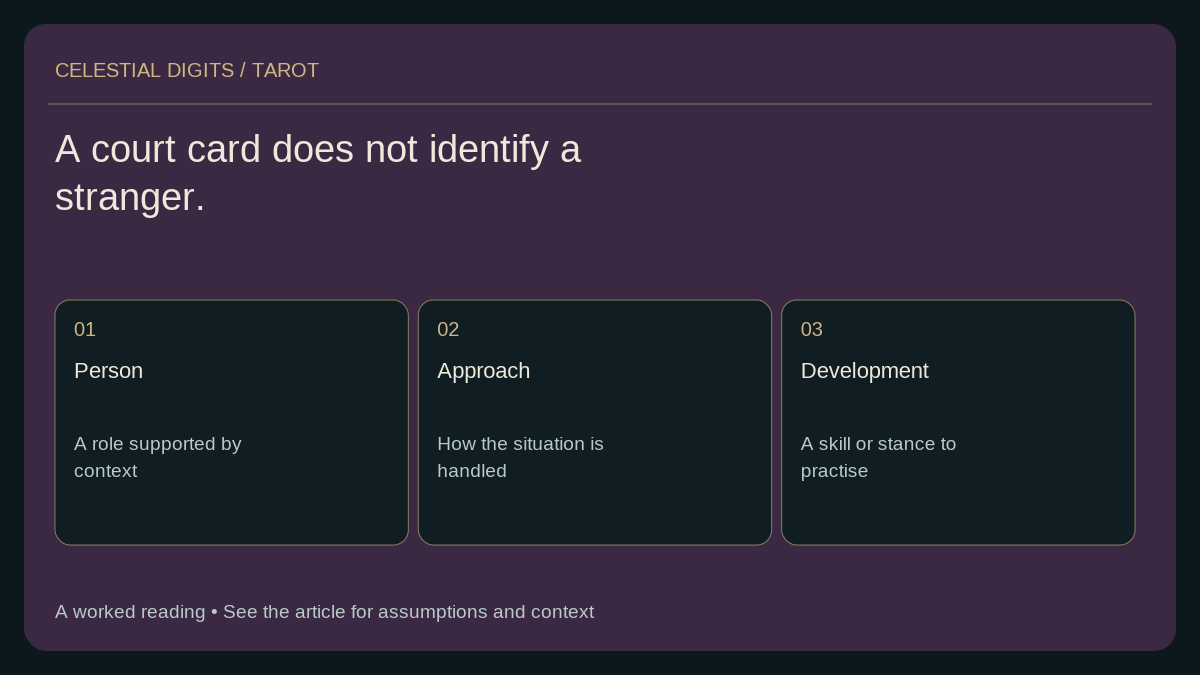
Tarot Court Cards: People, Roles or Parts of Yourself?
Read Page, Knight, Queen and King through a practical project example without assigning fixed genders, ages or hidden intentions.
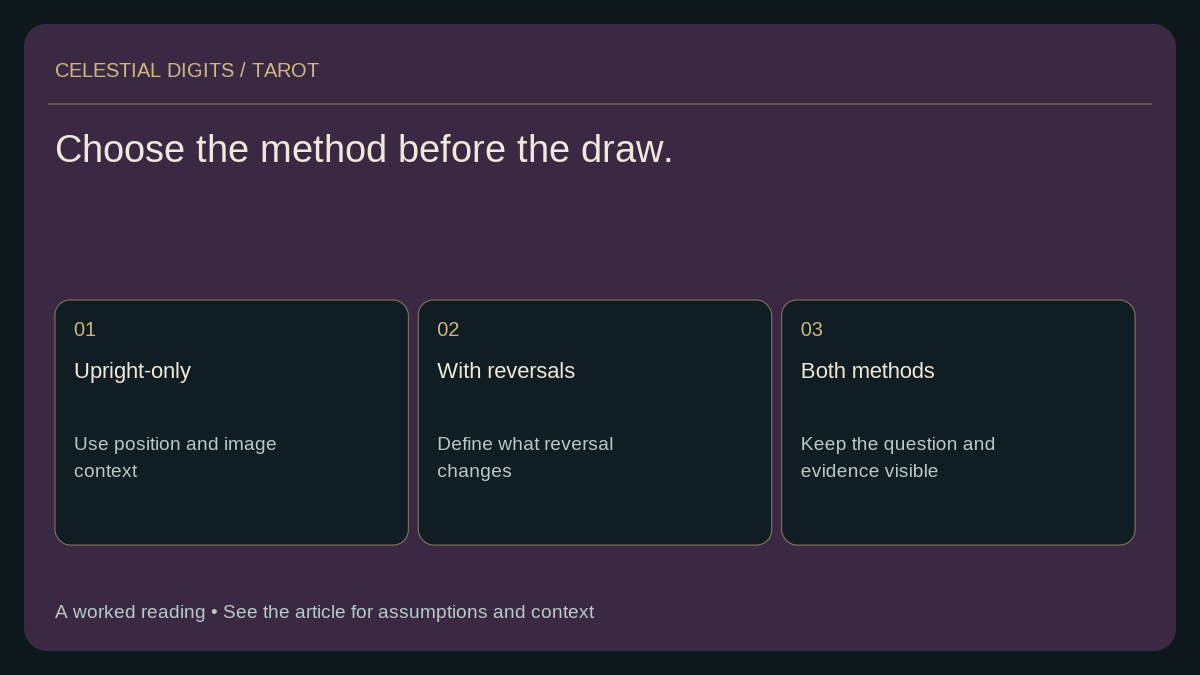
Do You Need Reversed Tarot Cards? Two Consistent Reading Methods
Compare an upright-only reading with an explicitly defined reversal method using a work-and-practice example.
A little more perspective.
Keep discussions respectful. No harassment, hate, sexual content or spam. Comments are reviewed before publication. Report concerns from a comment menu, or contact [email protected].
Checking your session…