
Chandra Bala: Count the Moon’s Position in Electional Astrology
Use a Virgo Moon example to calculate relative sign positions and understand how Chandra Bala differs from Tara Bala and a full electional reading.
Chandra Bala is a traditional assessment of the transiting Moon's sign relative to the natal Moon sign. It is often considered when selecting a time for a new undertaking.
It should not be confused with a complete measurement of the Moon's strength in a birth chart. Nor is it Tara Bala, which compares nakshatras rather than signs.
Count from the natal Moon, inclusively#
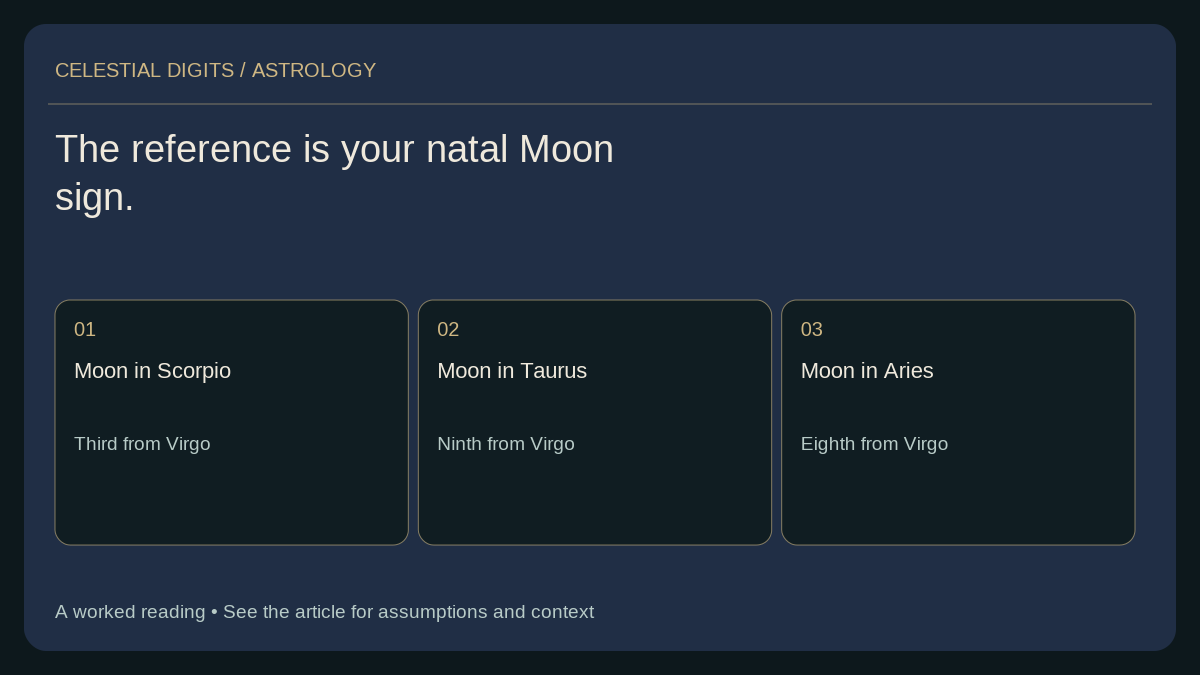
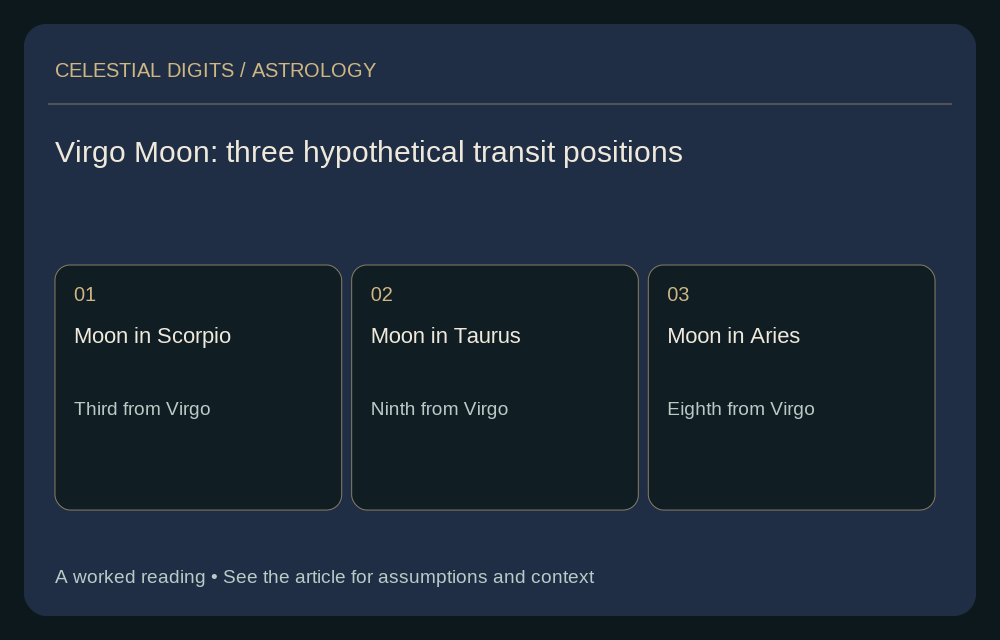
Take a fictional natal Moon in Virgo. Virgo is one, Libra two and Scorpio three. A transit Moon in Scorpio is therefore third from the natal Moon.
Continue around the zodiac: Sagittarius four, Capricorn five, Aquarius six, Pisces seven, Aries eight and Taurus nine. These are relative sign positions, not necessarily houses from the person's ascendant.
| Transit Moon sign | Count from Virgo | Basic interpretation used here |
|---|---|---|
| Scorpio | 3 | Supportive category |
| Taurus | 9 | Requires the stated convention and context |
| Aries | 8 | Traditionally treated with caution |
Name the convention instead of hiding differences#
A common Panchanga convention treats positions 1, 3, 6, 7, 10 and 11 as favourable. Positions 4, 8 and 12 are generally treated cautiously; 2, 5 and 9 receive additional qualifications in some traditions, including distinctions involving the lunar fortnight.
This guide uses the basic sign-count convention reflected in Drik Panchang's display. It does not claim that every muhurta author applies identical exceptions. If two tools disagree, compare their rules before assuming the Moon's position was calculated incorrectly.
The eighth position is a classification, not a prediction#
The Moon's eighth sign from the natal Moon is commonly called Chandrashtama. In the Virgo example, that is Aries. The label is not evidence that an accident, illness or loss will occur.
Do not postpone necessary care or an urgent practical responsibility because a symbolic classification appears unfavourable. Electional preferences concern optional timing within a tradition; they do not override immediate real-world needs.
Why one day's label may be insufficient#
The Moon changes signs during its journey, so a sign-based result can change at an ingress. A daily summary may describe the position at sunrise while another display shows the position at the selected moment.
Read the timestamp and timezone. A sign change occurs at an instant, while its clock time is displayed differently in different places. Local sunrise and other electional factors also require the intended location. These distinctions matter more than a generic “good day” badge.
Combine it with Tara Bala carefully#
Two people with the same Moon sign can have different birth nakshatras. They may share the same basic Chandra Bala while obtaining different Tara Bala results for a chosen time.
Conversely, matching one favourable factor does not make all other factors favourable. Keep the results in separate fields and explain which purpose is being considered. A wedding, a routine meeting and a study session do not automatically use an identical electional checklist.
Read Tara Bala counting and Panchanga's five limbs.
Sources and scope#
The basic favourable-position convention is visible in Drik Panchang's Chandrabalam tool. Its timing explanation clarifies local end times. The Virgo examples are original. These are traditional timing interpretations, not demonstrated predictions of safety or success.
Related Posts
Jupiter and Saturn in Marriage Timing: Mapping Transit Overlaps
Trace Jupiter and Saturn to a named natal target, distinguish shared-target from separate contacts, and record the actual overlapping window.
Marriage Timing Windows: How to Read a Prediction Timeline
Build a marriage timing worksheet that separates meeting, commitment and marriage, records overlapping windows and keeps quiet periods in the comparison.
Saturn Return vs Sade Sati: Two Different Saturn Cycles
Distinguish a return to natal Saturn from Saturn’s passage around the natal Moon sign, with a reference-point example and clear timing limits.
A little more perspective.
Keep discussions respectful. No harassment, hate, sexual content or spam. Comments are reviewed before publication. Report concerns from a comment menu, or contact [email protected].
Checking your session…