
Tara Bala: Count from Your Birth Nakshatra with a Worked Example
Calculate Tara Bala with inclusive counting, a ninefold cycle and wraparound examples, while keeping it separate from a complete muhurta judgement.
Tara Bala compares a person's birth nakshatra with the nakshatra occupied by the Moon at a chosen time. It is commonly used as one personal factor in electional astrology, or muhurta.
The calculation is a count through a repeating ninefold sequence. It is not the same as comparing Moon signs, and it does not by itself establish whether an entire date is suitable for an event.
Start with inclusive counting#
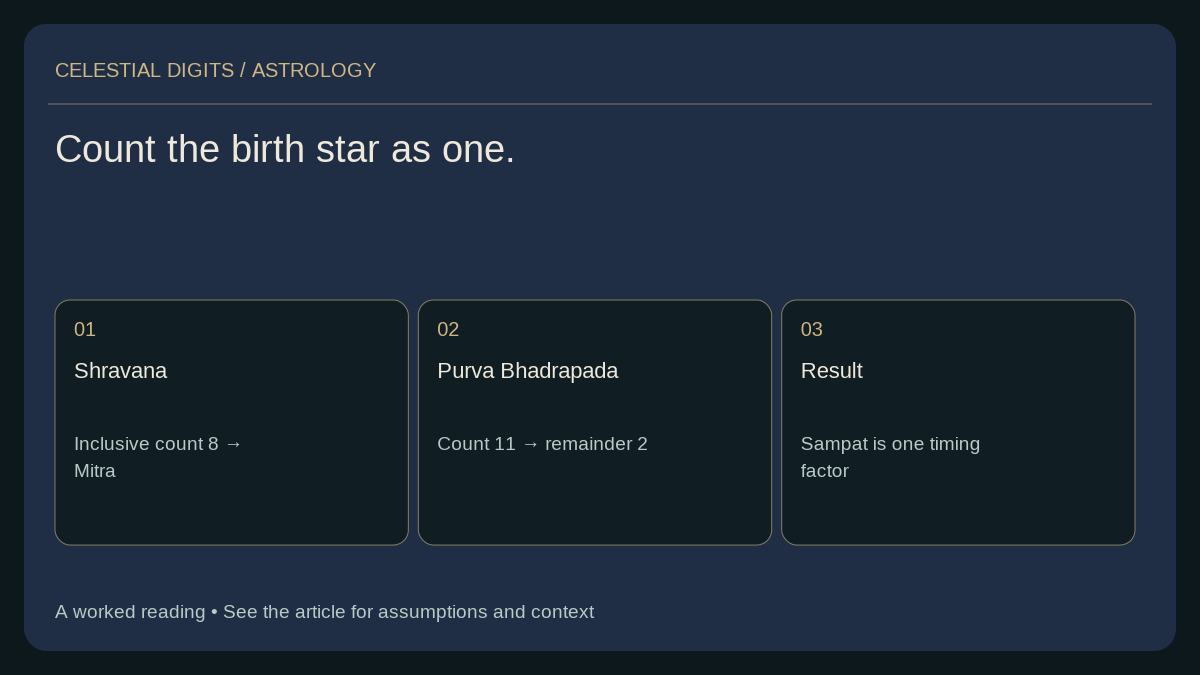
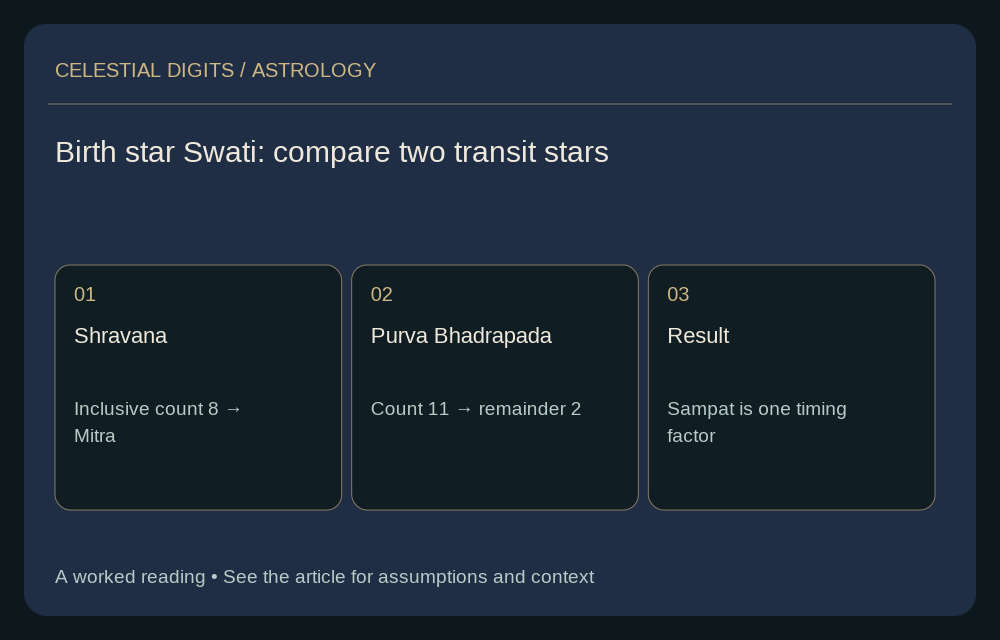
Use a fictional person whose birth nakshatra is Swati. Count Swati as one, Vishakha two, Anuradha three, Jyeshtha four, Mula five, Purva Ashadha six, Uttara Ashadha seven and Shravana eight.
If the transit Moon is in Shravana, the count is eight. That corresponds to Mitra in the usual ninefold sequence.
Continue: Dhanishta nine, Shatabhisha ten and Purva Bhadrapada eleven. Eleven divided by nine leaves two, corresponding to Sampat.
Use the ninefold sequence consistently#
| Remainder | Tara name |
|---|---|
| 1 | Janma |
| 2 | Sampat |
| 3 | Vipat |
| 4 | Kshema |
| 5 | Pratyari or Pratyak |
| 6 | Sadhaka |
| 7 | Naidhana or Vadha |
| 8 | Mitra |
| 0, treated as 9 | Parama Mitra |
Names and transliterations vary. The crucial calculation detail is that a remainder of zero belongs to the ninth category, not to an imaginary category zero.
Check a wraparound example#
Suppose the birth star is Revati and the transit star is Rohini. Count Revati one, Ashwini two, Bharani three, Krittika four and Rohini five. The result is Pratyari.
Do not subtract the star numbers and stop when the result becomes negative. The zodiac is circular, and the count includes both the starting and ending star. In numbered form, the inclusive distance is the wrapped difference plus one.
Interpret the label proportionately#
Categories 2, 4, 6, 8 and 9 are commonly treated as supportive in the basic convention. Other categories require more caution and context, with traditional exceptions depending on purpose and method.
Historical names can sound alarming. A category called Vadha or Naidhana does not establish that harm will occur, and it should not be used to frighten someone. This is a traditional classification, not a measured probability of danger.
Check the actual time, not just the date heading#
The Moon can change nakshatra during the day. A morning and evening appointment may therefore have different Tara Bala. Use a trustworthy Panchanga with the intended time and clearly displayed timezone, and read whether listed times are starts or endings.
Then examine the other relevant muhurta factors. A favourable Tara Bala does not replace practical readiness, consent, availability or the wider electional chart.
Read Chandra Bala by Moon sign and a complete Panchanga calculation.
Sources and scope#
The counting approach is described in B. V. Raman's Muhurtha; the category sequence can also be compared with Drik Panchang's Tarabalam display. The Swati and Revati examples are original. This guide explains a convention, not a guarantee of an event's outcome.
Related Posts
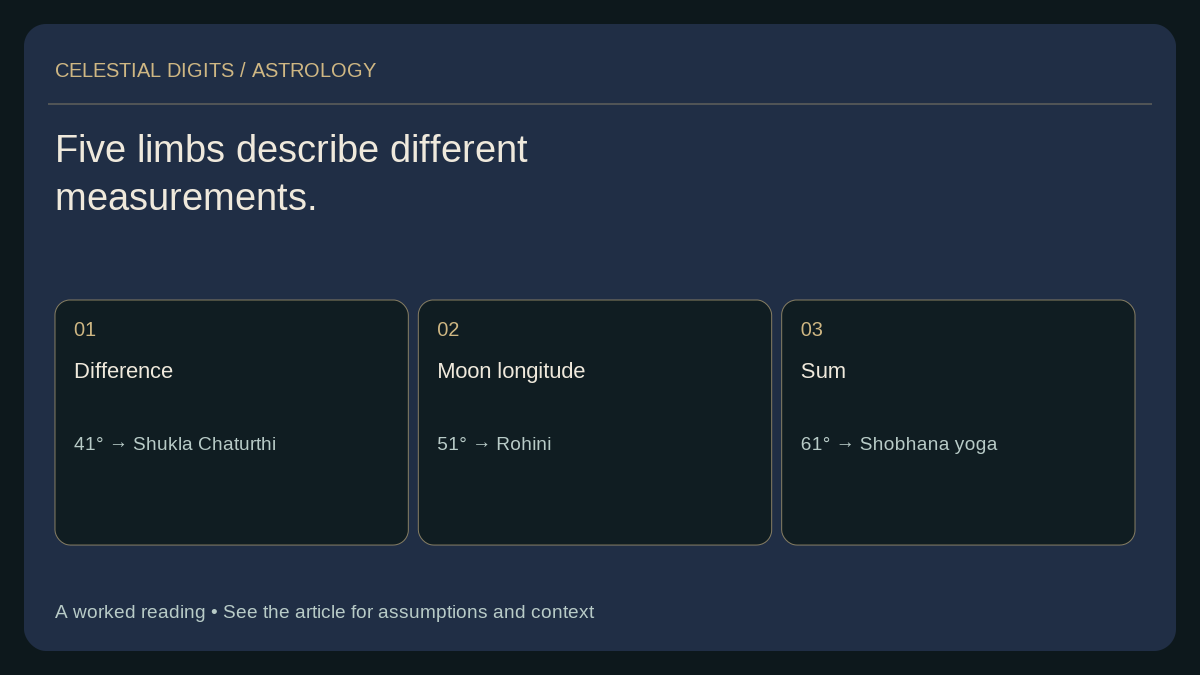
A Panchanga Reading: Tithi, Vara, Nakshatra, Yoga and Karana
Calculate all five Panchanga limbs from a clearly hypothetical example, and learn why a daily label is not an exact event-time calculation.
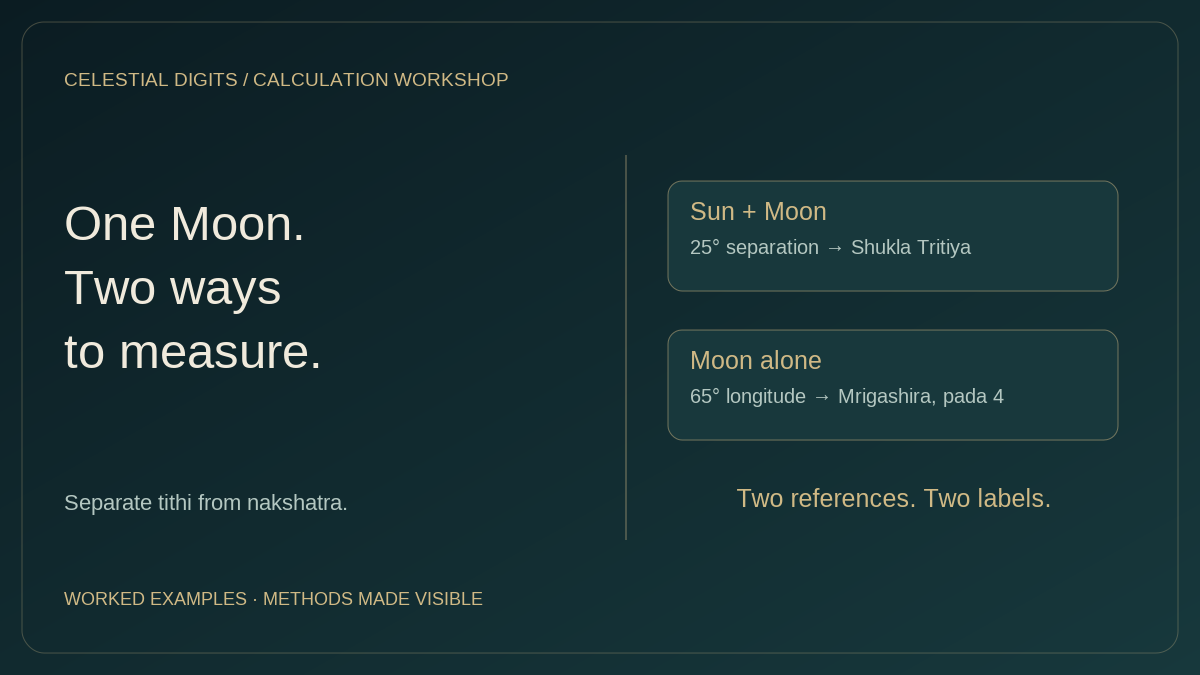
Tithi vs Nakshatra: Two Different Ways to Read the Moon
Calculate tithi from the Sun–Moon angle and nakshatra from lunar longitude, with worked examples, boundary checks and local-calendar distinctions.
Why Was My First Mahadasha So Short? Dasha Balance at Birth
Calculate the remaining mahadasha at birth from the Moon's nakshatra, and see why the first antardasha must not restart from the mahadasha lord.
A little more perspective.
Keep discussions respectful. No harassment, hate, sexual content or spam. Comments are reviewed before publication. Report concerns from a comment menu, or contact [email protected].
Checking your session…