
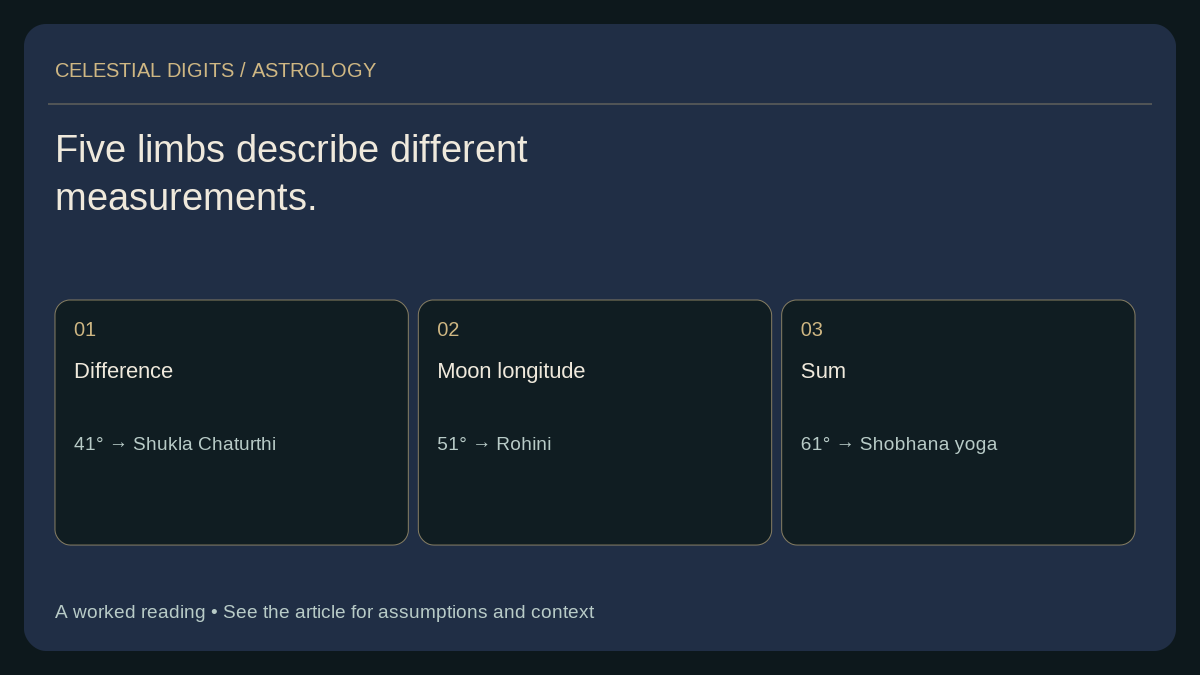
A Panchanga Reading: Tithi, Vara, Nakshatra, Yoga and Karana
Calculate all five Panchanga limbs from a clearly hypothetical example, and learn why a daily label is not an exact event-time calculation.
Panchanga means five limbs: tithi, vara, nakshatra, yoga and karana. These fields describe different calendar or angular relationships. They should not be treated as five interchangeable names for a day.
The worked example below uses deliberately hypothetical positions to make the arithmetic visible. It is not a Panchanga for a real date and should not be used to schedule an event.
State the inputs and reference frame#
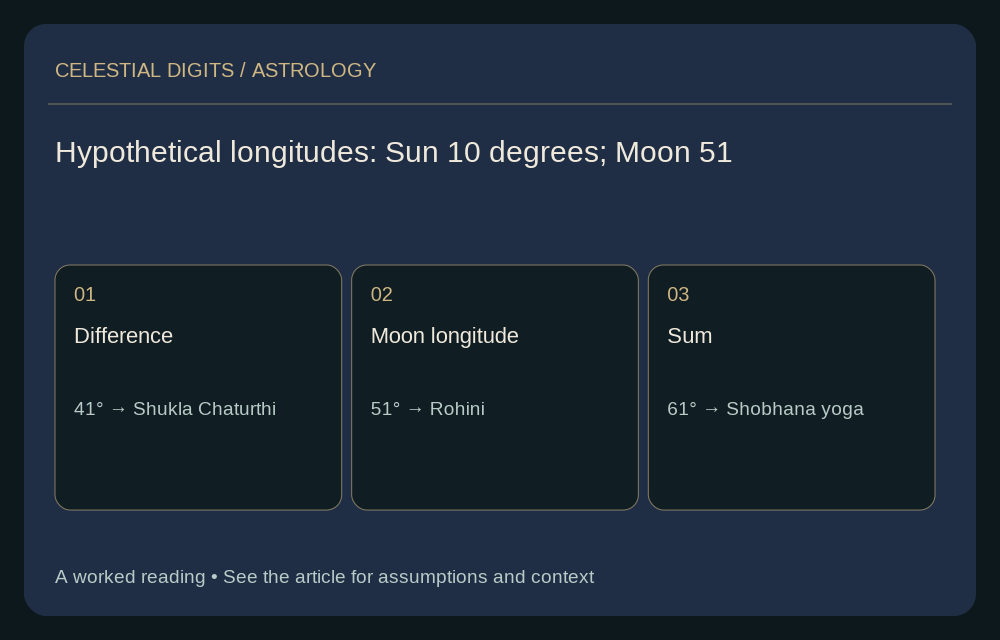
Assume the Sun is at sidereal longitude 10 degrees and the Moon at 51 degrees, measured from zero Aries using the same ayanamsa. Assume the selected local moment is after sunrise on a Thursday.
The Moon–Sun difference is 41 degrees. Their sum is 61 degrees. Keep both values within a full 360-degree circle when necessary; subtraction and addition answer different questions.
Calculate the five fields#
| Limb | Calculation or reference | Result in this example |
|---|---|---|
| Tithi | 41° divided into 12° intervals | Fourth tithi: Shukla Chaturthi |
| Vara | Assumed Thursday after local sunrise | Guruvara |
| Nakshatra | Moon 51° in 13°20′ intervals | Fourth nakshatra: Rohini |
| Yoga | Sum 61° in 13°20′ intervals | Fifth yoga: Shobhana |
| Karana | Difference 41° in 6° intervals | Vanija in the repeating sequence |
For tithi, three complete 12-degree intervals have elapsed, so the fourth is running. The difference is below 180 degrees, placing the example in the waxing half.
Check the nakshatra and yoga boundaries#
Rohini spans 40 degrees to 53 degrees 20 minutes of sidereal longitude. A Moon at 51 degrees falls inside it. The yoga calculation uses the combined longitude instead: four complete 13-degree-20-minute intervals fit into 61 degrees, so the fifth yoga is running.
The word yoga here means a Panchanga limb. It is not a natal-chart combination such as a Raja Yoga. Reusing the same word does not make the calculations equivalent.
Why karana needs a sequence table#
Six complete 6-degree intervals have elapsed at a separation of 41 degrees, placing the moment in the seventh half-tithi slot. The first slot is Kimstughna; the repeating sequence then starts Bava, Balava, Kaulava, Taitila, Gara, Vanija and Vishti. The seventh slot is therefore Vanija.
Do not simply number eleven karana names repeatedly from the start of the month. Seven repeat, while four have fixed positions in the lunar-month sequence.
A position is not an ending time#
These inputs tell us which intervals are active, but not exactly when they end. Boundary times require the changing solar and lunar positions, not an assumption that every tithi lasts twenty-four hours.
Likewise, the weekday convention uses local sunrise in a traditional Panchanga context. A time before sunrise needs care even if the civil calendar has already changed at midnight. Always read the tool's stated convention.
Use a real Panchanga for a real event#
Select the intended location, date and time, then check whether displayed times mark starts or endings. After identifying the five limbs, a traditional election also considers the purpose and other relevant factors; the table alone is not a complete muhurta judgement.
Continue with Tara Bala and Chandra Bala.
Sources and scope#
The interval definitions and karana sequence are described in B. V. Raman's Muhurtha. Drik Panchang explains its end-time display. The hypothetical arithmetic is original. Calendar calculations can be verified independently; claims about auspicious effects remain traditional interpretations.
Related Posts
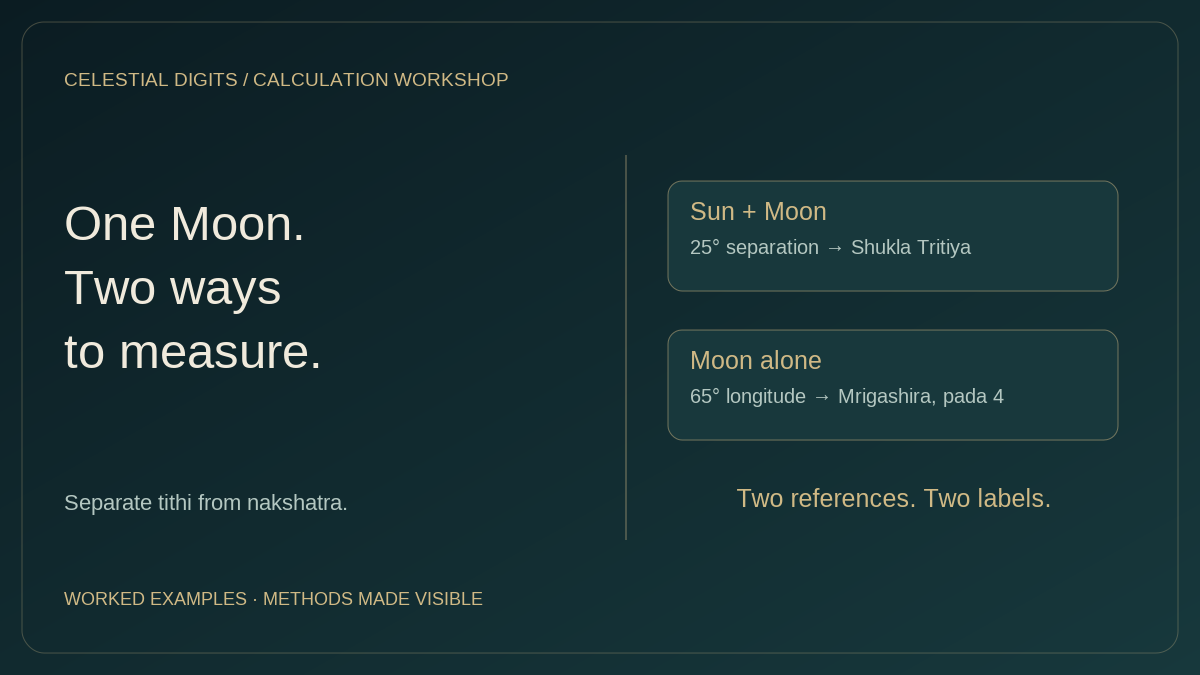
Tithi vs Nakshatra: Two Different Ways to Read the Moon
Calculate tithi from the Sun–Moon angle and nakshatra from lunar longitude, with worked examples, boundary checks and local-calendar distinctions.
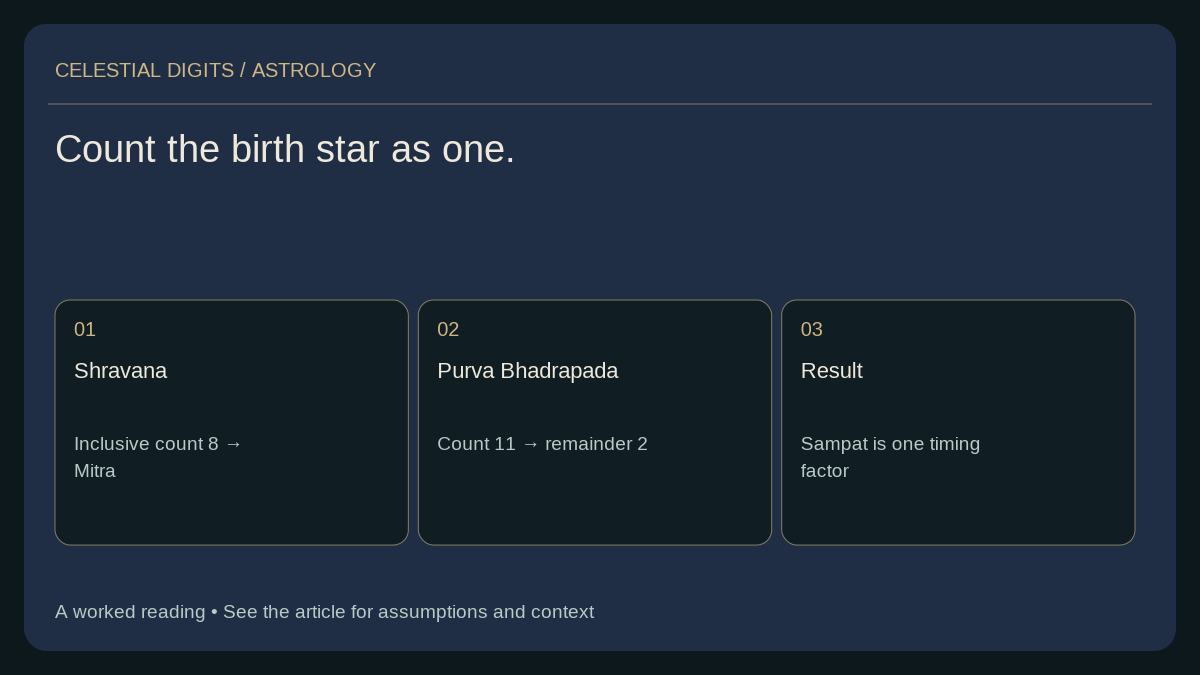
Tara Bala: Count from Your Birth Nakshatra with a Worked Example
Calculate Tara Bala with inclusive counting, a ninefold cycle and wraparound examples, while keeping it separate from a complete muhurta judgement.
Ascendant Nakshatra vs Moon Nakshatra: Why Both Matter
Learn why your ascendant and Moon can have different nakshatras, how to find both, and which one sets your birth star and Vimshottari dasha.
A little more perspective.
Keep discussions respectful. No harassment, hate, sexual content or spam. Comments are reviewed before publication. Report concerns from a comment menu, or contact [email protected].
Checking your session…