
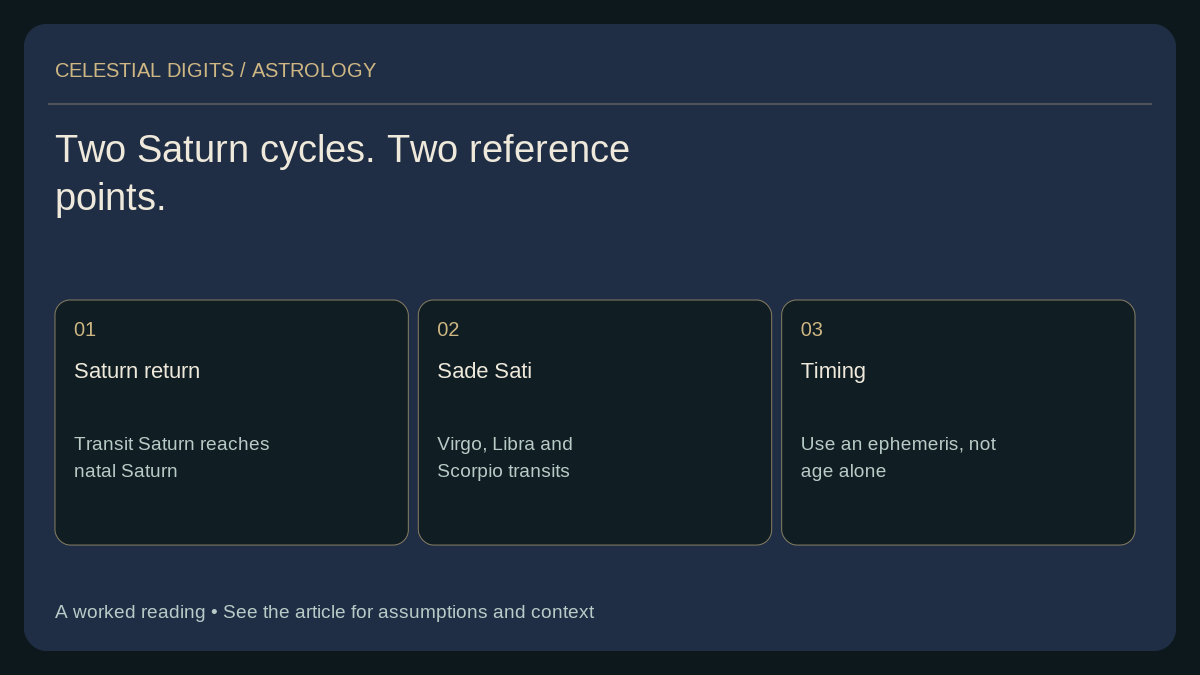
Saturn Return vs Sade Sati: Two Different Saturn Cycles
Distinguish a return to natal Saturn from Saturn’s passage around the natal Moon sign, with a reference-point example and clear timing limits.
A Saturn return and Sade Sati both involve Saturn's movement, but they are not the same event. A return compares transiting Saturn with natal Saturn. Sade Sati compares transiting Saturn's sign with the natal Moon's sign.
Confusing those reference points can make a person believe they are experiencing one cycle when the chart actually shows the other—or both, or neither.
Define the two measurements#
A Saturn return, in its precise form, occurs when transiting Saturn reaches the natal Saturn longitude in the chosen zodiac system. A broader discussion may refer to the surrounding sign passage, but it should say so.
Sade Sati conventionally covers Saturn's transit through the sign before the natal Moon sign, the Moon sign itself and the sign after it. It is therefore a three-sign interval, not one exact degree contact.
| Cycle | Natal reference | What is compared |
|---|---|---|
| Saturn return | Saturn | Longitude, or a stated broader window |
| Sade Sati | Moon sign | Saturn in the preceding, same and following signs |
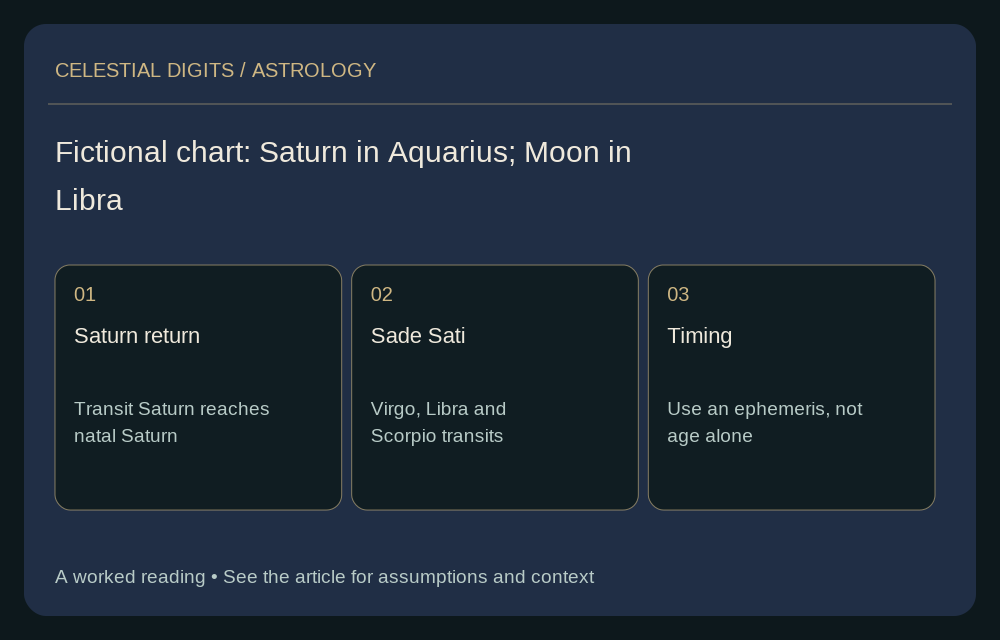
Work through a fictional chart#
Suppose natal Saturn is in Aquarius and the natal Moon is in Libra. The Saturn return concerns Saturn reaching its natal Aquarius position. Sade Sati concerns Saturn's passages through Virgo, Libra and Scorpio.
Those are plainly different areas of the zodiac. No current transit dates are implied by this example; it demonstrates the reference points only. If natal Saturn were near the Moon's sign instead, the two cycles could overlap.
Why approximate ages are not exact dates#
NASA gives Saturn's orbital period as about 29.4 Earth years. That astronomical period explains why returns are discussed around the late twenties and later multiples, but a geocentric astrological return must be calculated from an ephemeris.
Retrograde motion can produce more than one contact with a natal degree. Zodiac choice and, for sidereal work, ayanamsa also matter. Do not derive an exact return date by simply adding a fixed number of calendar years to a birthday.
Why “seven and a half years” is approximate#
Sade Sati's familiar duration reflects Saturn's slow passage through three signs. Actual boundaries depend on sign ingresses, retrograde exits and re-entries. A clear report should show the intervals used rather than implying a perfectly uniform timer.
The phase names describe position relative to the Moon. They do not prove that one phase will produce a specific loss or that every person will experience the same level of difficulty.
Interpret the natal Saturn before predicting#
Saturn's house ownership, natal placement, strength and relationships matter in a personalised reading. Dasha context and actual life circumstances matter too. A return can be used to examine commitments and structure without declaring an inevitable crisis.
Likewise, Sade Sati is a traditional interpretive cycle, not a diagnosis or evidence that someone is cursed. Practical support and decisions should be based on the situation at hand.
Read Mars–Saturn in context and Moon–Saturn without labels.
Sources and scope#
The orbital fact comes from NASA's Saturn facts. The Sade Sati convention is explained by Drik Panchang. Astronomical motion is measurable; claims about personal effects are astrological interpretations, not guaranteed outcomes.
Related Posts
Jupiter Return: What Changes When Jupiter Reaches Its Natal Position?
Understand a Jupiter return, distinguish a sign passage from an exact contact, and interpret it through natal ownership rather than guaranteed luck.

When Do Yogas Activate? Mahadasha, Antardasha and Transit Checks
Understand yoga activation, relevant major and sub-periods, transit notes, and exactly what Active, Dormant and upcoming windows mean in Celestial Digits.
Jupiter and Saturn in Marriage Timing: Mapping Transit Overlaps
Trace Jupiter and Saturn to a named natal target, distinguish shared-target from separate contacts, and record the actual overlapping window.
A little more perspective.
Keep discussions respectful. No harassment, hate, sexual content or spam. Comments are reviewed before publication. Report concerns from a comment menu, or contact [email protected].
Checking your session…