
Reading a Birth Chart: Ascendant, Moon, Nakshatra and Planetary Strength
Separate sign lords from nakshatra lords, compare ascendant and Moon houses, and understand why retrograde, combustion and debilitation are different checks.
“Virgo ascendant, Chitra nakshatra, Mercury lord and Mars lord” can all be correct descriptions of one ascendant. The apparent contradiction comes from using the word lord for two different subdivisions of the zodiac.
Before interpreting a chart, establish what each label measures. A sound calculation and a convincing interpretation are different things: the first can be reproduced from inputs and settings; the second belongs to an astrological tradition and should be presented with uncertainty.
Sign and nakshatra are different grids#
A sign spans 30 degrees. In the equal 27-nakshatra system, a nakshatra spans 13 degrees 20 minutes and each of its four padas spans 3 degrees 20 minutes. Both describe the same longitude using different boundaries.
For a hypothetical ascendant at 29 degrees Virgo:
- The sign is Virgo, whose conventional sign lord is Mercury.
- The longitude lies in Chitra, whose Vimshottari nakshatra lord is Mars.
- It lies in Chitra's second pada.
Mercury has not become Mars, and Chitra is not another name for Virgo. Chitra crosses the Virgo–Libra boundary. This is why a report should label “sign lord” and “nakshatra lord” explicitly rather than exporting an ambiguous lord field.
The Moon's nakshatra is another independent result. If the Moon is in Swati, that does not make Swati the ascendant nakshatra.
Ascendant and Moon: two reference points#
The ascendant is the zodiac point rising at the eastern horizon at the birth time and location. The Moon sign is the sign containing the Moon's longitude. A whole-sign chart counts houses from the ascendant sign; a Moon-reference reading counts signs from the Moon instead.
Imagine Virgo rising and a Libra Moon. Cancer is the 11th sign from Virgo, but the 10th from Libra. A Jupiter-in-Cancer article written for Virgo ascendant and one written for Libra Moon can therefore emphasize different houses without either calculation being wrong.
Do not combine the house labels halfway through a reading. Write “11th from ascendant” or “10th from Moon.” Our ascendant transit series uses the ascendant for its house and lordship framework; it is not a personalized reading of every natal planet.
Ascendant does not reveal the whole chart#
Knowing Virgo rises tells us which signs occupy the whole-sign houses and which planets conventionally rule those signs. It does not tell us where Mercury, Venus or any other planet actually sits, which nakshatras they occupy, or the current dasha.
For example, Virgo's 7th house is Pisces and its conventional lord is Jupiter. Jupiter could occupy many different houses depending on the birth date. A generic Virgo reading cannot assume Jupiter is strong, weak, conjunct Saturn or in a particular Navamsa.
The birth-chart calculator needs birth date, time and place because those missing details change the actual chart. If the time is approximate, say so; fine divisions and the ascendant can be particularly sensitive near boundaries.
Retrograde is a motion label#
Retrograde describes apparent backward motion in geocentric longitude. It does not move a planet into the previous house by itself, change its sign lord, or automatically make it debilitated.
In traditional interpretation, readers may associate retrograde motion with revision or intensified themes. Those are interpretations, not the definition of the astronomical condition. When comparing two reports, first check whether both use the same timestamp and whether “R” refers to natal motion or a current transit.
A retrograde planet can simultaneously be in its own sign, combust or involved in an aspect. These checks are not mutually exclusive, so one badge should not replace the others.
Combustion is about angular separation#
Combustion concerns proximity to the Sun under a specified astrological convention. Different planets and schools can use different thresholds; some distinguish direct and retrograde cases. A useful report needs the Sun's longitude, the planet's longitude and the adopted threshold.
“Both in Gemini” is insufficient. Two planets can be far apart within one sign, while two in adjacent signs can be very close across the boundary. For example, 29 degrees Gemini and 1 degree Cancer are only 2 degrees apart. A sign-only test would miss that proximity.
Combustion should therefore not be used as a shortcut for “career failure” or “marriage failure.” It is one condition in a larger traditional reading.
Debilitation, cancellation and Shadbala#
Debilitation is a sign-based dignity condition in classical astrology. Shadbala is a multi-component strength framework. They answer different questions. A planet can have an unfavorable dignity label yet score strength in other components; strength itself does not guarantee agreeable outcomes.
Likewise, a claimed cancellation of debilitation needs its actual conditions shown. Ask which rule is being applied, which planets satisfy it, and from which reference point. “Neecha bhanga” should not be a blanket reassurance attached to every debilitated planet.
When comparing Shadbala reports, match units first: 60 virupas equal one rupa. Then compare components, not just the total. Different calculation conventions can produce differences; matching a label is not sufficient verification.
A comparison checklist that catches real errors#
Record birth date format, local time, location, time zone, zodiac, ayanamsha and house convention. Compare longitudes before comparing interpretations. Next check sign, nakshatra and pada labels, followed by the relevant strength conditions and dasha dates.
If two sites disagree, preserve both sets of inputs and settings. A one-hour input mistake or a different zodiac can explain much more than a disagreement over an interpretation. Report reproducible differences through our contact page, without posting private birth details publicly.
Method and further reading: Swiss Ephemeris documentation explains astronomical and sidereal calculation choices. Our editorial standards distinguish those reproducible calculations from traditional interpretations. For derived Jaimini points, continue with the Arudha worked examples.
Work through the details#
Continue with natal retrograde motion and strength, combustion and Sun-distance calculations, and conjunctions measured by degree. Each guide separates the calculated condition from its interpretation.
Related Posts
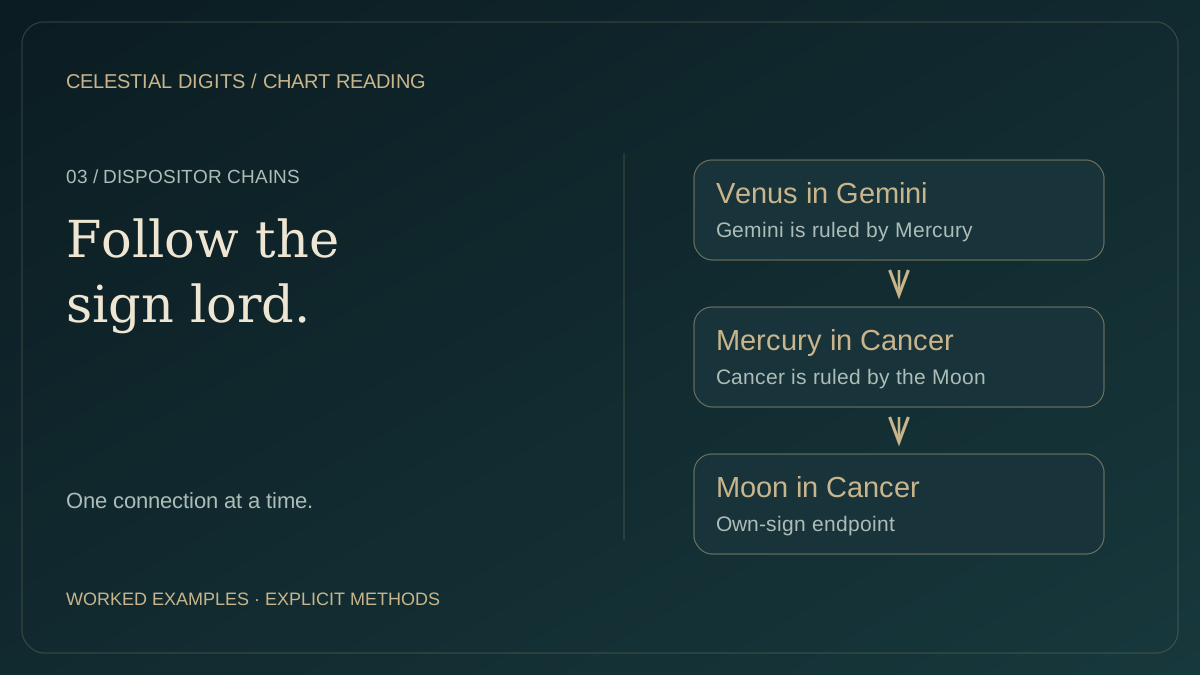
Dispositor Chains Explained: Follow a Planet's Sign Lord
Trace a dispositor chain with worked examples. Learn where chains end, how exchanges form loops, and why sign lords are not nakshatra lords.
Bhava Chalit vs Rashi Chart: Why Did My Planet Change Houses?
Understand sign placement versus house assignment, why Rashi and Bhava Chalit can disagree, and how to compare them without mixing interpretive rules.
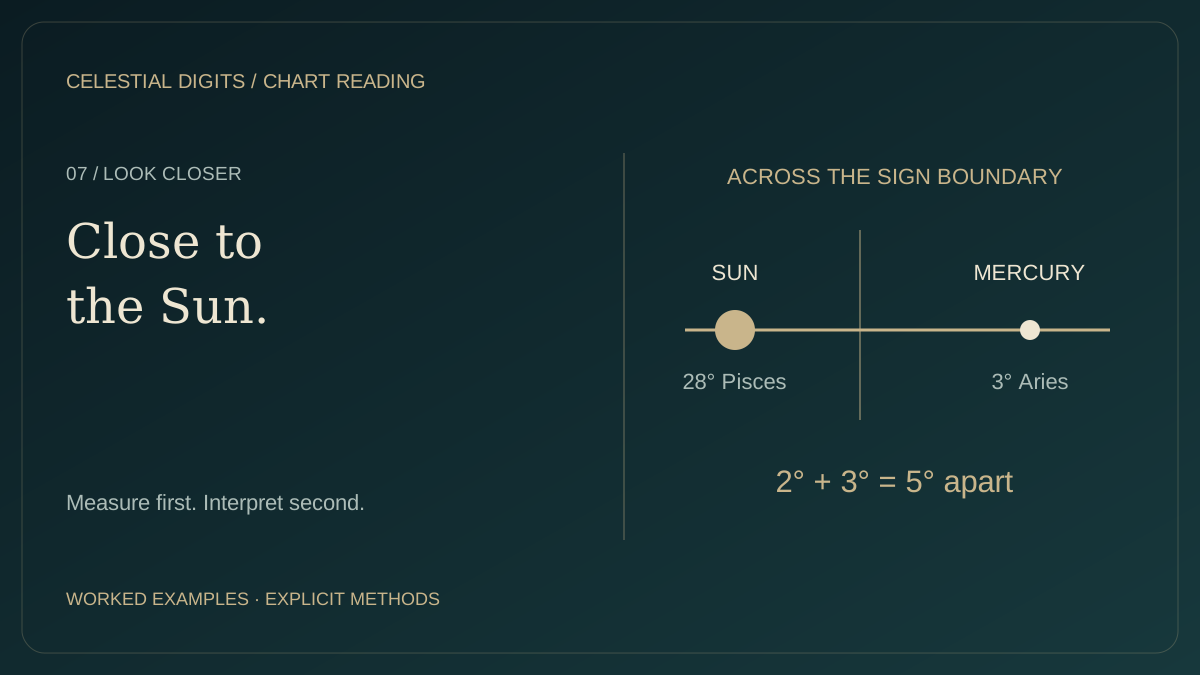
Combust Planets: Does Being Close to the Sun Always Mean Weakness?
Measure a planet's distance from the Sun with worked examples. Understand combustion, sign boundaries, retrograde motion and differing software rules.
A little more perspective.
Keep discussions respectful. No harassment, hate, sexual content or spam. Comments are reviewed before publication. Report concerns from a comment menu, or contact [email protected].
Checking your session…