
Bhava Chalit vs Rashi Chart: Why Did My Planet Change Houses?
Understand sign placement versus house assignment, why Rashi and Bhava Chalit can disagree, and how to compare them without mixing interpretive rules.
A planet can keep its zodiac sign while receiving a different house assignment under another house system. Its astronomical longitude has not jumped. The boundaries used to organize the chart have changed.
“Bhava Chalit” should not be treated as a single universal algorithm. Reports can use different cusp and boundary conventions, and astrological schools differ in how they combine a sign chart with a house chart. Ask which method produced the report before trying to reconcile its conclusions.
Separate three pieces of information#
| Information | Question it answers |
|---|---|
| Longitude | Where is the planet along the zodiac? |
| Sign | Which thirty-degree zodiac segment contains it? |
| House | Which house boundary scheme places it in this life-area division? |
In a whole-sign chart, the ascendant's sign becomes house one. Each subsequent sign becomes the next house. In a cusp-based method, house divisions need not coincide with sign boundaries. The Swiss Ephemeris programming documentation documents multiple house algorithms, so the word “house” alone is not a complete calculation specification.
A geometric example, not a prediction#
Imagine a planet at 2° Virgo. For a Leo whole-sign ascendant, Virgo is the second house. Now suppose a separately specified cusp-based report assigns that longitude to its first house.
You would record Virgo, house two under whole sign; Virgo, house one under the other report's method. You would not change the sign to Leo. This example explains the distinction; it is not a claim that a particular birth instant necessarily produces those boundaries.
Keep the actual cusp values when comparing a real chart. Saying that a planet “moved back a house” without recording the method makes the explanation impossible to audit.
What should happen to dignity and yogas?#
A sign-based property, such as own-sign placement, should not be casually changed because the house assignment changes. A yoga rule explicitly counted from the Moon also needs that stated reference, not whichever chart view happens to be open.
Where a yoga includes a house condition, its treatment can depend on the interpretive school and the implementation. Do not automatically create a yoga from one convention and cancel it using another. State the rule, reference point and house method together.
The Yoga series uses clearly described formation checks and separates an app's detection rule from a complete traditional judgment. That distinction matters more than selecting the chart that returns the largest number of positive labels.
How this relates to Celestial Digits#
The standard D1 calculation uses whole-sign houses. The KP section has its own cusp-oriented workflow. Those are not simply two decorative layouts. North and South Indian views, by contrast, render the same selected chart data differently.
If you compare the standard chart with KP output, preserve the displayed settings and degrees. Do not assume every standard-workspace detector has been recalculated using the KP method.
A reliable comparison process#
- Confirm that the birth date, time and place are identical.
- Compare planetary longitudes and the zodiac reference before houses.
- Record the house calculation method and cusp values where available.
- Identify which rule you are trying to apply and whether it depends on signs, houses or both.
- Keep the interpretation conditional if the chosen schools disagree.
If the mismatch is actually between two different websites, begin with the kundli troubleshooting guide. If only the drawing is unfamiliar, use the North versus South Indian guide.
Discussion: Was your confusion about a planet's sign or its house? You can describe the distinction without sharing a full personal chart.
Related Posts
Reading a Birth Chart: Ascendant, Moon, Nakshatra and Planetary Strength
Separate sign lords from nakshatra lords, compare ascendant and Moon houses, and understand why retrograde, combustion and debilitation are different checks.
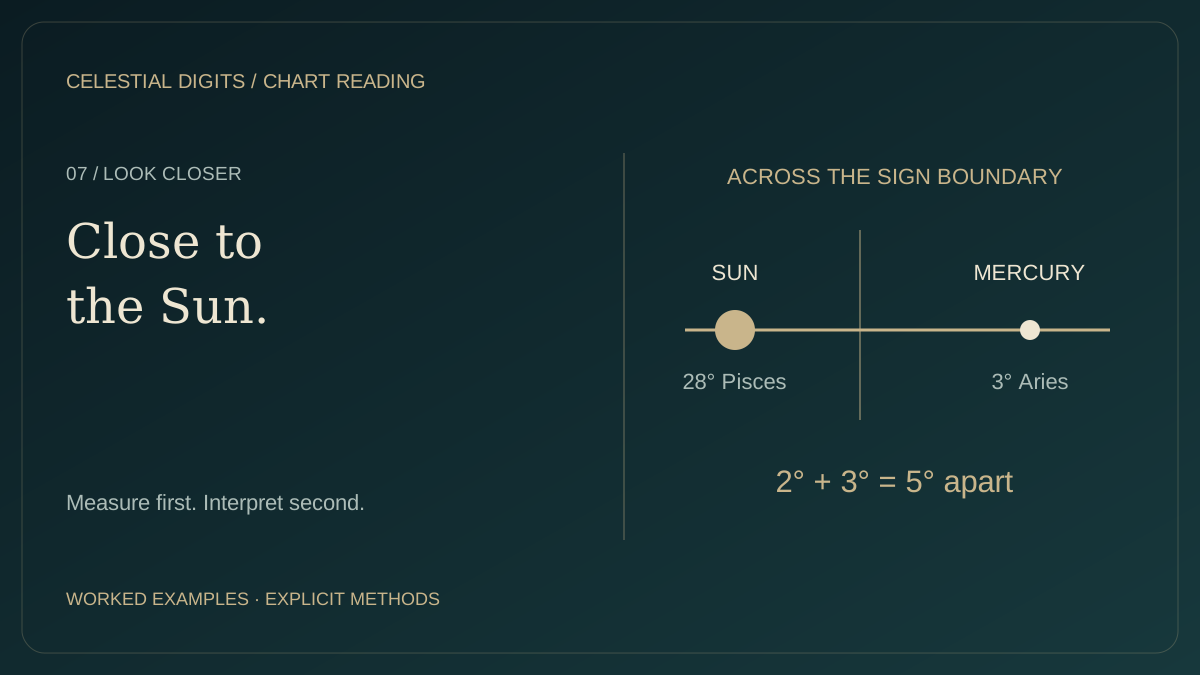
Combust Planets: Does Being Close to the Sun Always Mean Weakness?
Measure a planet's distance from the Sun with worked examples. Understand combustion, sign boundaries, retrograde motion and differing software rules.
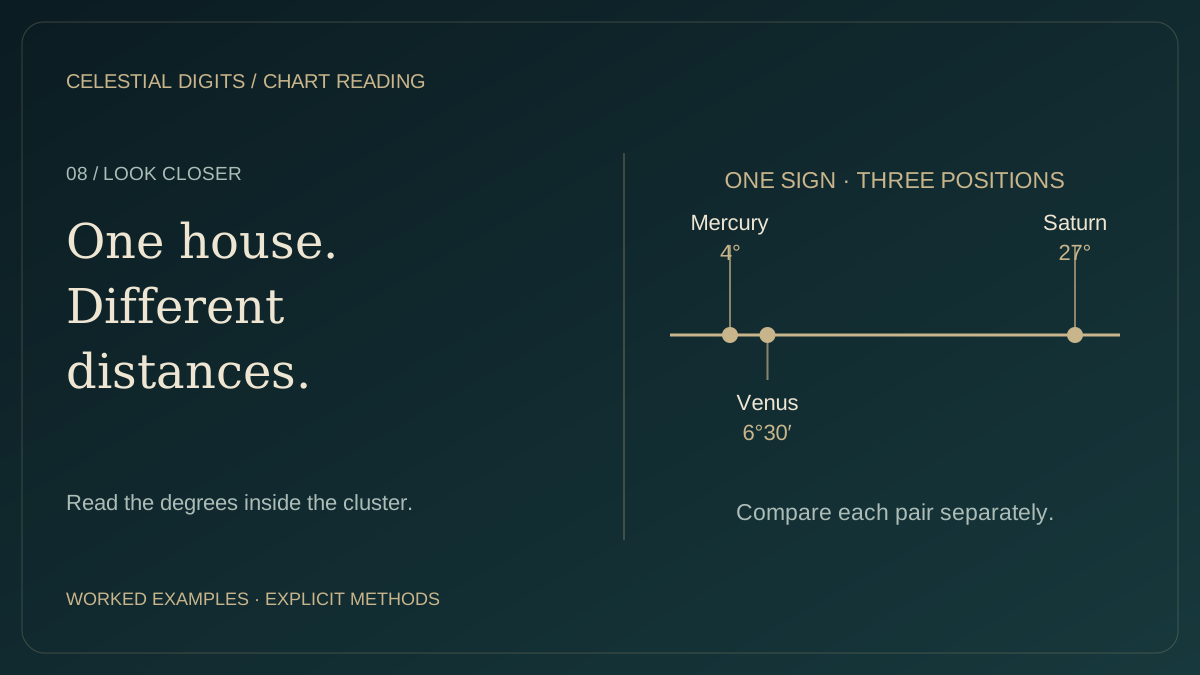
Same House, Different Degrees: How Close Is a Planetary Conjunction?
Compare same-sign conjunctions with actual degree gaps. Work through a three-planet cluster, cross-sign proximity and applying versus separating motion.
A little more perspective.
Keep discussions respectful. No harassment, hate, sexual content or spam. Comments are reviewed before publication. Report concerns from a comment menu, or contact [email protected].
Checking your session…