
Arudha Lagna, Upapada and Darapada: Worked Examples and Common Mix-ups
Learn how AL, UL and A7 use different houses, follow an inclusive-counting example, and see the exception convention used in our Jaimini calculations.
Arudha Lagna, Upapada Lagna and Darapada are derived points, not three names for the ascendant. Confusing them can produce a confident interpretation of the wrong calculation.
This guide documents the inclusive sign-counting convention used by Celestial Digits, including its exceptions. Jaimini traditions differ on some conventions, especially co-lordship. A result should disclose the method rather than claim that every other calculator must match it.
Which house is being projected?#
| Label | Starting house | Traditional interpretive focus |
|---|---|---|
| AL, Arudha Lagna, A1 | 1st | Public image or perceived identity |
| A7, Darapada | 7th | The visible expression of partnership and interaction |
| UL, Upapada Lagna, A12 | 12th | Marriage and the circumstances surrounding its sustenance |
These are traditional symbolic uses, not independently measured personality traits or marriage outcomes. UL is derived from the 12th house, even though it is used in marriage analysis. Calculating the 7th-house projection and labelling it UL is an error.
The basic counting rule#
Take the sign of the relevant house. Count forward from that sign to its selected lord's sign, including the starting sign as one. Count the same number forward from the lord's sign, again including that sign as one. Then apply the exception check.
For an invented Aries ascendant with Mars in Gemini:
- Aries to Gemini is three signs: Aries, Taurus, Gemini.
- Three signs from Gemini are Gemini, Cancer, Leo.
- The provisional AL is Leo.
- Leo is neither Aries nor its opposite sign Libra, so no exception applies.
The result is Arudha Lagna in Leo under this convention. Counting Aries as zero would change the calculation, which is why inclusive counting needs to be explicit.
Two exception examples#
Our implementation adjusts a provisional pada that lands in the starting sign or the 7th sign from it. It moves the result to the 10th from that provisional sign.
Lord in its own sign: Start with Aries and Mars in Aries. The first count is one; the provisional result is Aries. Because it falls on the starting sign, count ten from Aries to obtain Capricorn.
Lord in the fourth sign: Start with Aries and Mars in Cancer. Aries to Cancer is four; four from Cancer reaches Libra. Libra is seventh from Aries, so count ten from Libra to obtain Cancer.
Notice that the exception is applied after the provisional result is found. Moving every result ten signs regardless of where it lands would be wrong. Likewise, “a lord in the seventh always projects to the seventh” is not this method: the provisional result and exception must both be calculated.
A separate Upapada example#
Consider an invented Libra ascendant with Mercury in Capricorn. Its 12th house is Virgo, so the UL calculation begins with Virgo and Mercury, not with Libra or Venus.
Virgo to Capricorn is five signs. Five signs from Capricorn reaches Taurus. Taurus is neither Virgo nor Pisces, the opposite sign, so the exception is not triggered. The resulting UL is Taurus.
This example alone does not determine AL or A7. AL needs Venus's position because Libra is the starting sign for A1. A7 starts from Aries and needs Mars's position. One placement cannot supply all three answers.
Why Scorpio and Aquarius can differ between calculators#
Our Jaimini calculation uses Mars/Ketu as co-lords for Scorpio and Saturn/Rahu for Aquarius. The selection depends on their placements; it is not always the conventional single sign lord used in a Parashari summary.
In our current rule, when just one co-lord occupies the sign itself, the other is selected. When neither occupies it, their degrees within their respective signs are compared. When both occupy it, the conventional planet is selected for this calculation. Other schools can resolve these cases differently.
Therefore, an explanation must show the same lord that generated the pada. Displaying “Saturn” in the explanation while calculating from Rahu would be misleading even if the final sign happened to match.
Reading the point without overstating it#
AL is often discussed as the difference between how someone experiences themselves and how they appear to others. That is a prompt for interpretation, not proof that others see a particular trait. The natal ascendant remains the ascendant; AL does not replace it.
UL and A7 can add questions to a traditional relationship reading, but neither establishes whether a partner is loyal, whether a marriage will last, or when someone must marry. Avoid treating one derived sign as a verdict about another person.
For a fuller reading, keep the natal 7th house, its lord, the Navamsa and the relevant timing framework separate and labelled. Agreement between several symbolic indicators may strengthen a practitioner's interpretation, but it does not turn it into a certainty.
Verify your report#
Open the Jaimini section of the birth-chart report. Note the ascendant, the starting house sign, the selected lord and its sign. Repeat the count above, including the exception. Use Copy JSON to retain the calculation details when comparing results.
If an explanation and result disagree, send the relevant calculation through contact. Include the convention and the exact field that differs; do not publish a full private chart unnecessarily.
Method note: The examples and co-lord rules above were checked against our shared Jaimini calculation code. They describe the product's chosen convention, not a claim that all Jaimini schools agree. See editorial standards and the marriage reading guide.
Related Posts
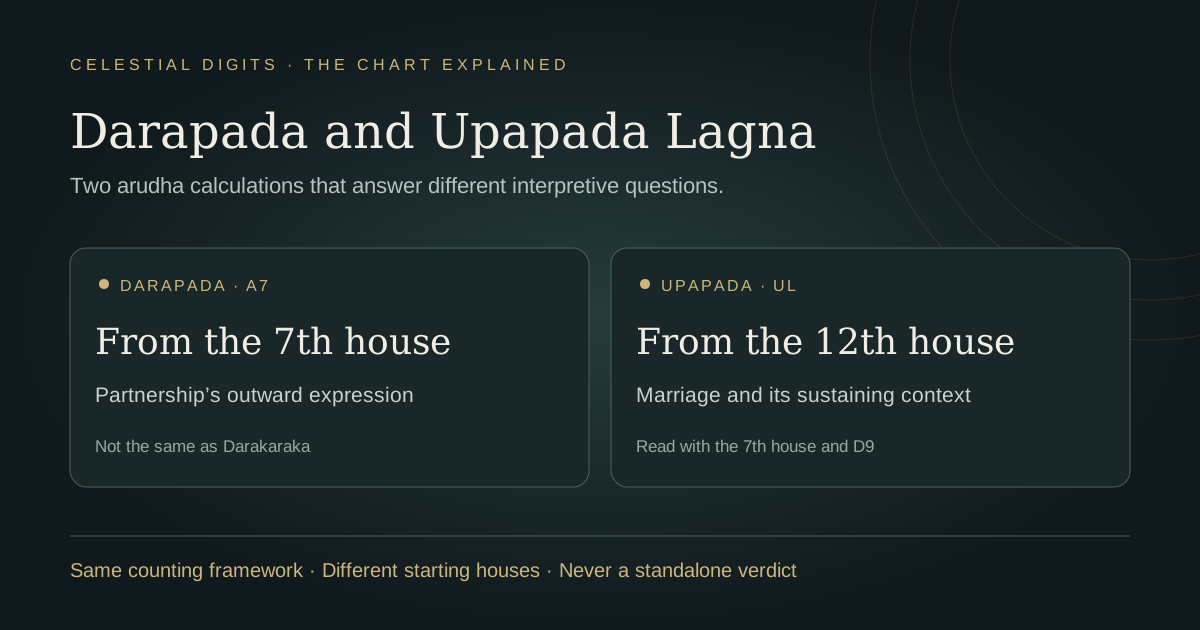
Darapada (A7) vs Upapada Lagna (UL): Relationship Indicators Explained
Understand Darapada, Upapada Lagna, the seventh house and Darakaraka with a worked arudha calculation and clear limits on relationship predictions.
Darakaraka in All 12 Houses: Spouse and Relationship Themes
Explore Darakaraka in houses 1–12 with detailed partnership questions, examples and limits, without treating house placement as control, divorce or spouse-location predictions.
Darakaraka in All 12 Signs: How Spouse Traits Change with the Sign
Read Darakaraka through Aries to Pisces, distinguishing the spouse planet from its sign, with detailed relationship themes, modifiers and an example synthesis.
A little more perspective.
Keep discussions respectful. No harassment, hate, sexual content or spam. Comments are reviewed before publication. Report concerns from a comment menu, or contact [email protected].
Checking your session…