
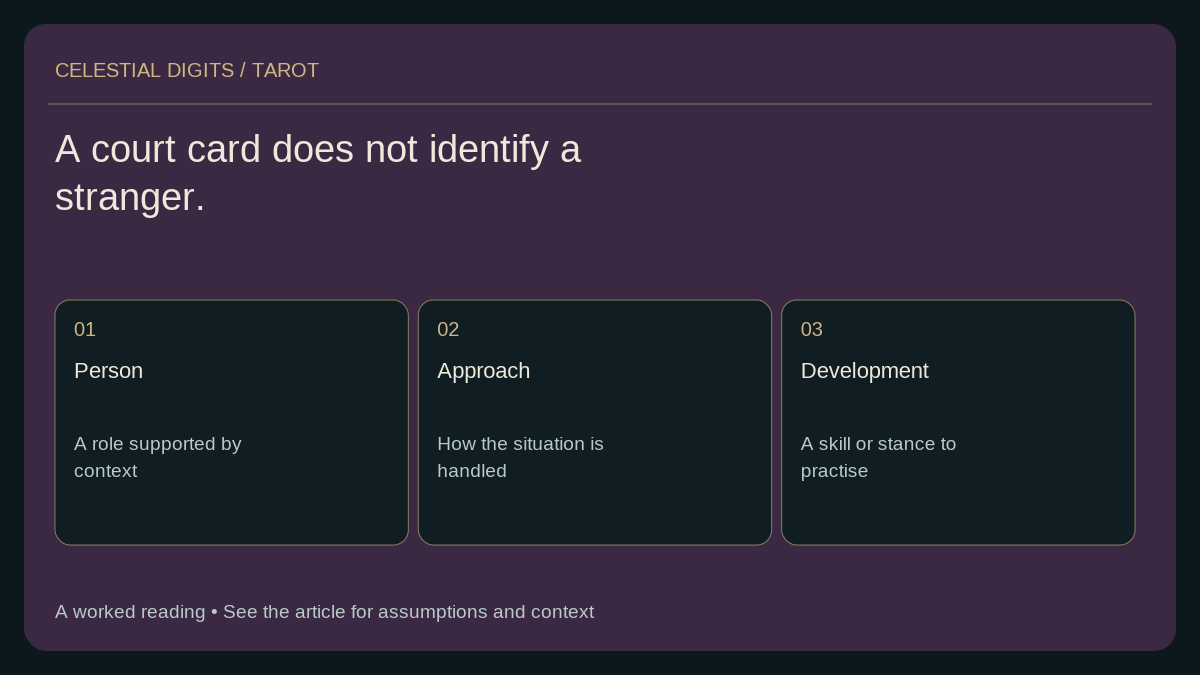
Tarot Court Cards: People, Roles or Parts of Yourself?
Read Page, Knight, Queen and King through a practical project example without assigning fixed genders, ages or hidden intentions.
A Queen appears in a spread and someone immediately asks, “Who is she?” A Knight appears and the reader predicts a younger man arriving. Those are possible historical reading habits, but they are not the only ways to approach court cards—and they can create unsupported assumptions about people.
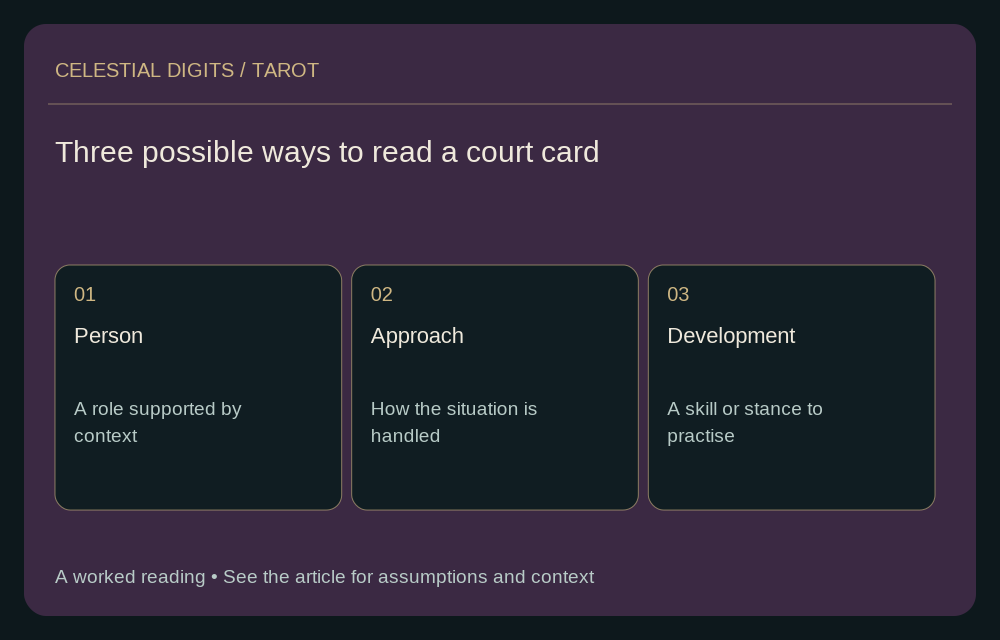
In Rider–Waite–Smith tarot, each suit contains a Page, Knight, Queen and King. The sixteen court cards can be explored as people, roles, approaches or qualities depending on the question and position.
Begin with suit and role#
A useful contemporary learning framework treats Pages as exploring, Knights as pursuing, Queens as cultivating and Kings as directing. This is a study aid, not a universal law or a replacement for the individual card image.
| Rank | Reflective starting question |
|---|---|
| Page | What is being learned or approached with curiosity? |
| Knight | How is effort being pursued, and at what pace? |
| Queen | What needs sustained attention and competent care? |
| King | What needs direction, responsibility or a clear standard? |
Then add the suit. The four-suit guide explains why Cups and Pentacles, for example, focus attention on different aspects of the same situation.
Work through the Queen of Pentacles#
Suppose a fictional organiser asks how to make a weekly community meal sustainable. The Queen of Pentacles appears in an advice position. The image's attention to a pentacle and cultivated surroundings can invite a discussion about practical care, resources and maintenance.
The reader could ask who orders supplies, how volunteers avoid exhaustion and whether the setting supports the people using it. That interpretation does not require identifying a wealthy woman who will arrive to solve the problem.
If the question had explicitly concerned the organiser's responsibilities, the card might describe a stance to develop. If it concerned an existing team, the reader might ask whether someone already performs that role. Context should establish the connection before a person is assigned.
Do not turn ranks into a hierarchy of human worth#
A Page is not an inferior person and a King is not automatically more emotionally mature. A project can need curiosity at one moment and firm direction at another. The useful stance depends on the task.
Nor does a Queen require a woman, or a King a man, in a contemporary reflective reading. Historical descriptions sometimes use appearance, gender and social rank in ways that should not be treated as reliable identification tools today.
What if several court cards appear?#
Consider whether the question involves multiple responsibilities, competing approaches or an actual group of people. Do not automatically invent a cast of rivals, admirers or secret enemies. A spread cannot establish what an absent person privately thinks.
For a team question, it can help to name the functions first: learner, organiser, spokesperson, reviewer. Then ask which functions are present or neglected in the real situation.
Keep the reading accountable#
Write why you chose the person, role or approach interpretation. Include one alternative and what information would distinguish them. That keeps the reading from becoming a confident story built entirely on an ambiguous face card.
Waite's Queen of Pentacles description supplies historical imagery and associations. The rank framework and community-meal example here are contemporary teaching choices. Practise them within our three-card beginner spread, where the position gives each card a clear purpose.
Related Posts
Major vs Minor Arcana: Big Themes and Everyday Situations
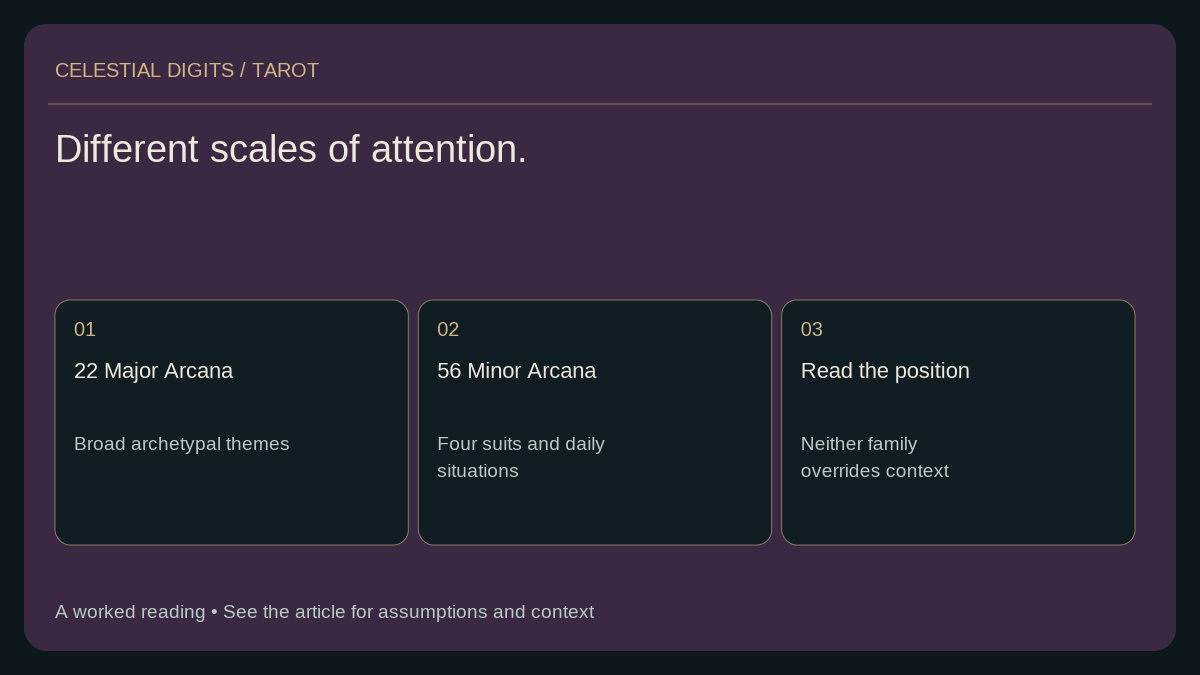
Understand the 22 Major and 56 Minor Arcana through two sample readings, without treating a Major card as an inevitable event.
Do You Need Reversed Tarot Cards? Two Consistent Reading Methods
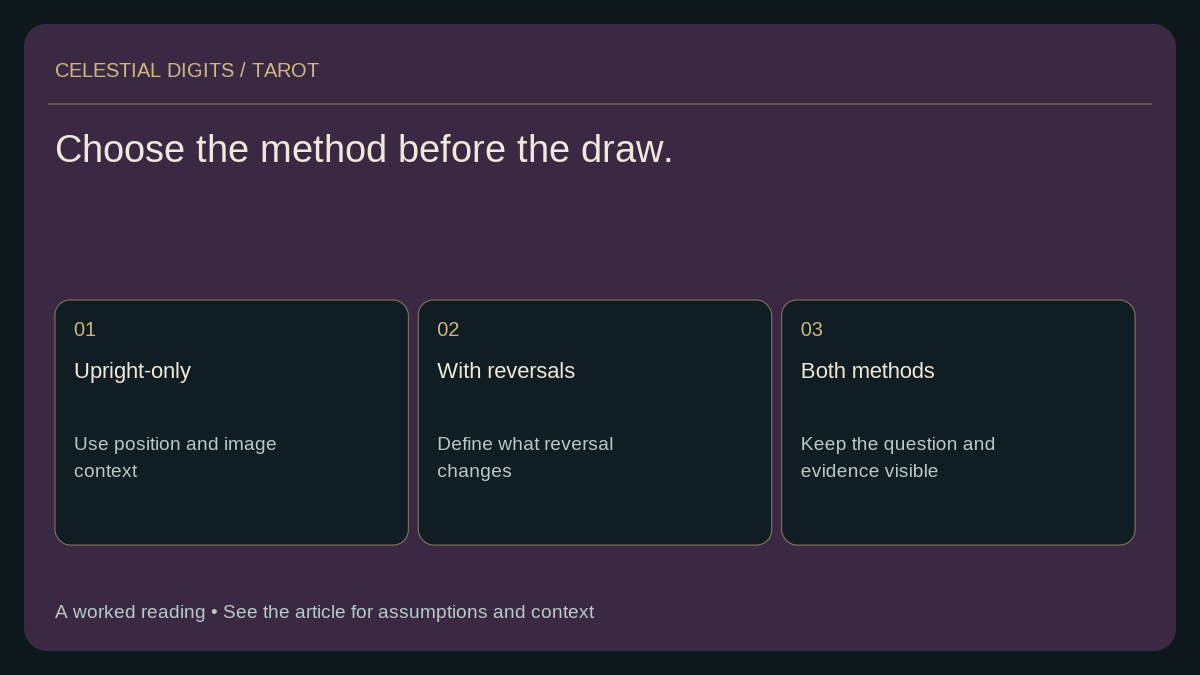
Compare an upright-only reading with an explicitly defined reversal method using a work-and-practice example.
How to Read Tarot: A Complete Three-Card Beginner Example
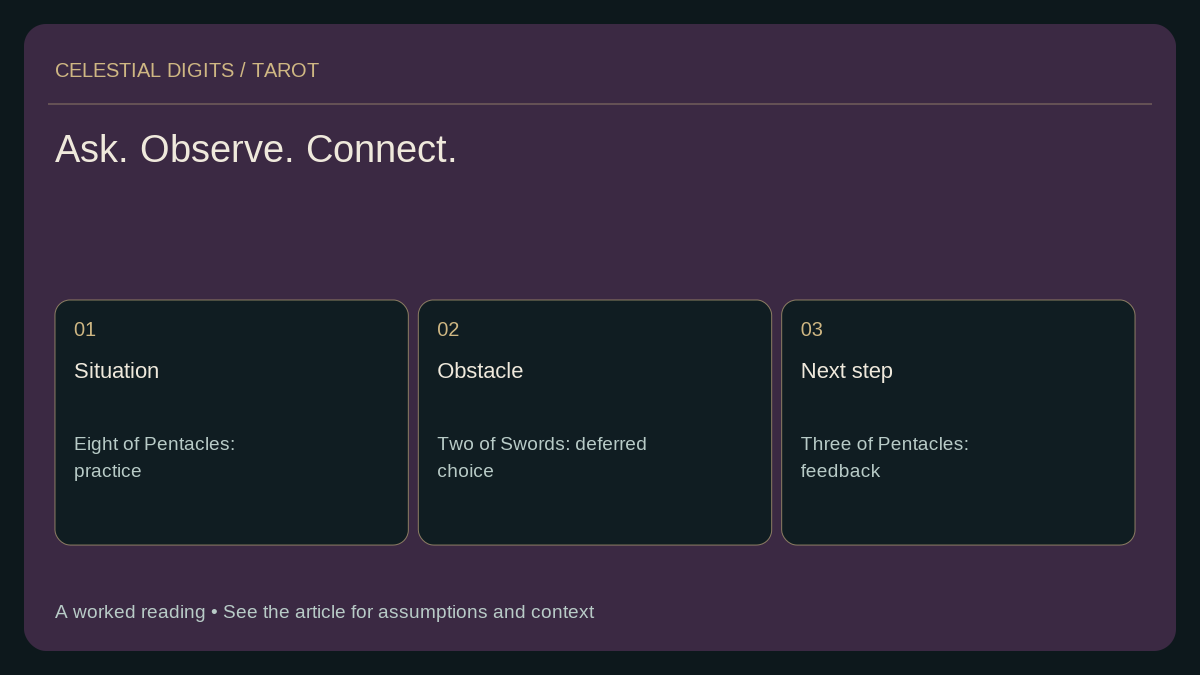
Follow a Rider–Waite–Smith three-card reading from a clear question to a practical next step, with an illustrated sample spread.
A little more perspective.
Keep discussions respectful. No harassment, hate, sexual content or spam. Comments are reviewed before publication. Report concerns from a comment menu, or contact [email protected].
Checking your session…