
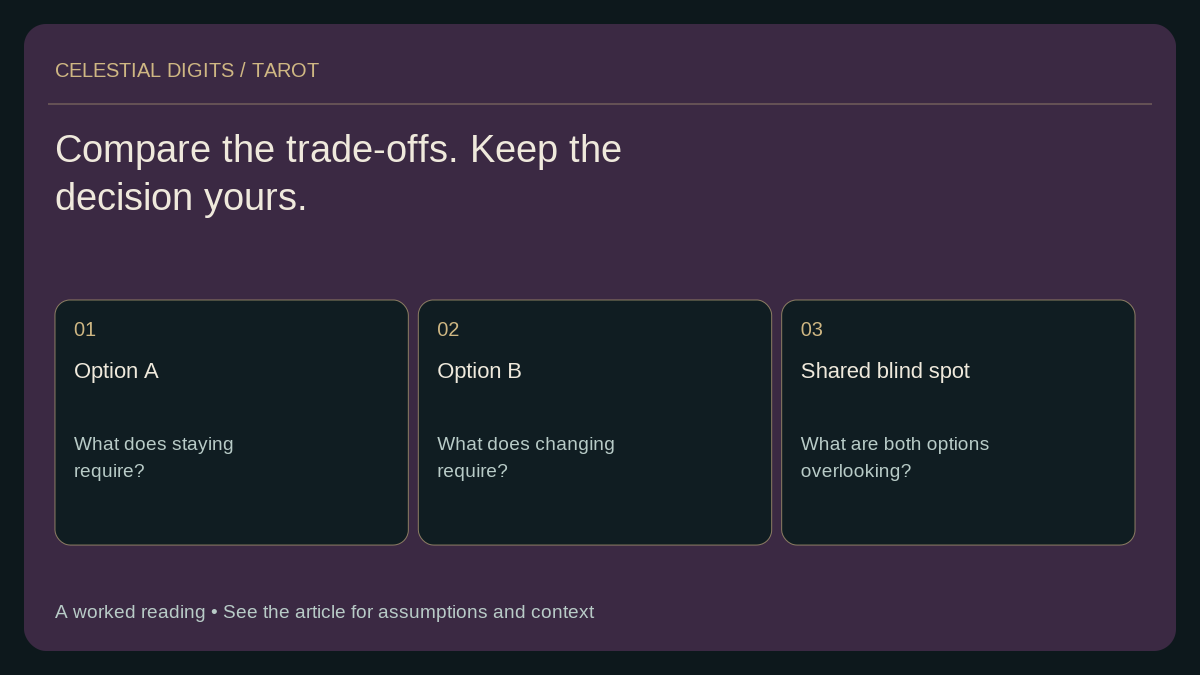
A Three-Card Tarot Spread for a Difficult Decision
Compare two options and a shared blind spot through an illustrated reflective spread, without treating the cards as a command.
A decision spread is most useful when it clarifies trade-offs. It becomes less useful when the reader treats one attractive card as permission to ignore practical concerns or asks repeatedly until the preferred option appears to win.
This three-card exercise compares two options and one shared blind spot. It is a reflective method using Rider–Waite–Smith symbolism, not a mechanism for determining which future is guaranteed.
Define options at the same level of detail#
Our fictional reader is deciding whether to continue a familiar evening course or switch to a new programme. Both have known schedules, but the second requires a longer journey. The question is: “What should I examine in each option before making this choice?”
Write the options before selecting cards. Avoid describing one as “stay stuck” and the other as “follow my dreams,” because the wording has already decided which will sound better.
Assign three positions#
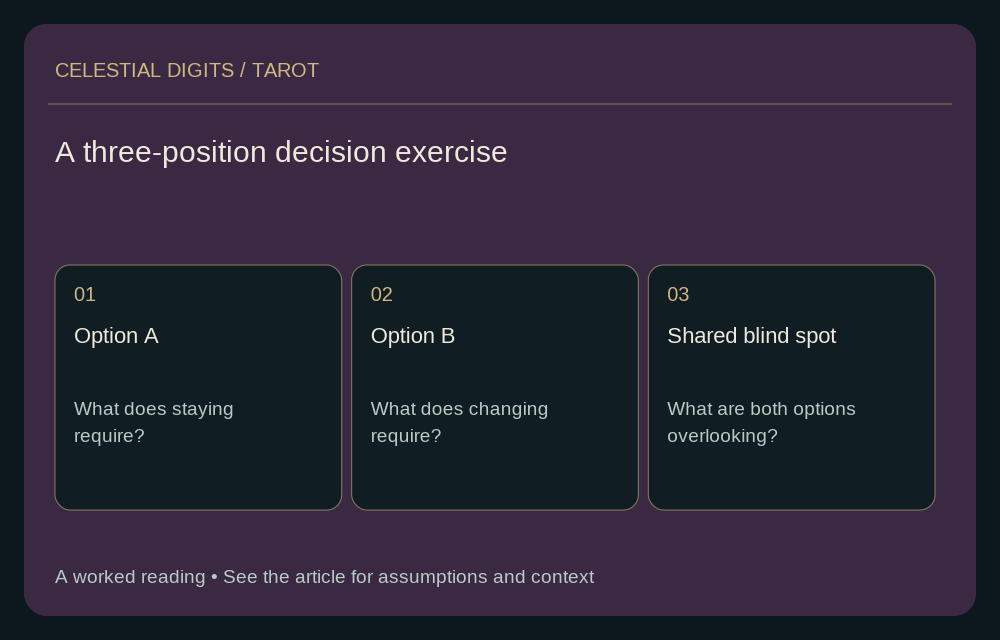
| Position | Meaning in this exercise | Selected teaching card |
|---|---|---|
| Option A | What continuing requires | Eight of Pentacles |
| Option B | What changing requires | Two of Wands |
| Shared blind spot | What both plans may overlook | Four of Swords |
The cards are deliberately chosen for the example. We are not claiming that a random draw produced them or that they describe a real student's future.
Read the requirements, not a verdict#
The Eight of Pentacles can invite examination of whether the familiar course still offers worthwhile practice. Repetition might consolidate skill, or it might no longer challenge the learner. The actual course content distinguishes those possibilities.
The Two of Wands can invite planning beyond the current setting. What does the new programme require in travel, preparation and coordination? Interest in a different option does not by itself establish that its promises are reliable.
The Four of Swords can raise a shared question about rest and available attention. Perhaps both options assume more evening energy than the learner currently has. That does not command withdrawal from education; it asks whether the schedule is realistic.
Add facts beside the interpretation#
For each programme, list teaching quality, requirements, travel time and the outcome sought. Then compare those facts with the questions raised by the spread. If the new programme does not teach the desired skill, an encouraging card cannot repair that mismatch.
The reading may reveal that a third option deserves consideration, such as postponing the switch or reducing another commitment. That possibility should emerge from the person's circumstances, not from inventing a hidden meaning whenever the first two choices feel uncomfortable.
Decide how you will review the choice#
Choose one uncertainty to resolve before committing. It might be speaking with the tutor, reviewing the syllabus or testing the journey at the relevant time. After the decision, record what you learned rather than treating every later difficulty as proof that the wrong card was chosen.
A good decision can still involve inconvenience. A disappointing result does not mean the reader ignored fate. The exercise is intended to improve attention and questioning, not transfer responsibility to the deck.
For historical card descriptions, see Waite's The Pictorial Key to the Tarot. Continue with how to frame a useful tarot question and reading two cards together before trying a larger spread.
Related Posts
The Celtic Cross Explained Through One Complete Example
Follow all ten Celtic Cross positions in a fictional creative-project reading, then combine the cards into a practical, conditional interpretation.
The Chariot vs Strength: Direction, Persistence and Resistance
Compare purposeful direction with patient self-regulation through a rehearsal example, without treating either card as a command to push harder.
Death vs The Tower: Endings, Disruption and What Comes Next
Compare two often-feared tarot cards through project examples, separating symbolic change from literal predictions of disaster.
A little more perspective.
Keep discussions respectful. No harassment, hate, sexual content or spam. Comments are reviewed before publication. Report concerns from a comment menu, or contact [email protected].
Checking your session…