
Tithi vs Nakshatra: Two Different Ways to Read the Moon
Calculate tithi from the Sun–Moon angle and nakshatra from lunar longitude, with worked examples, boundary checks and local-calendar distinctions.
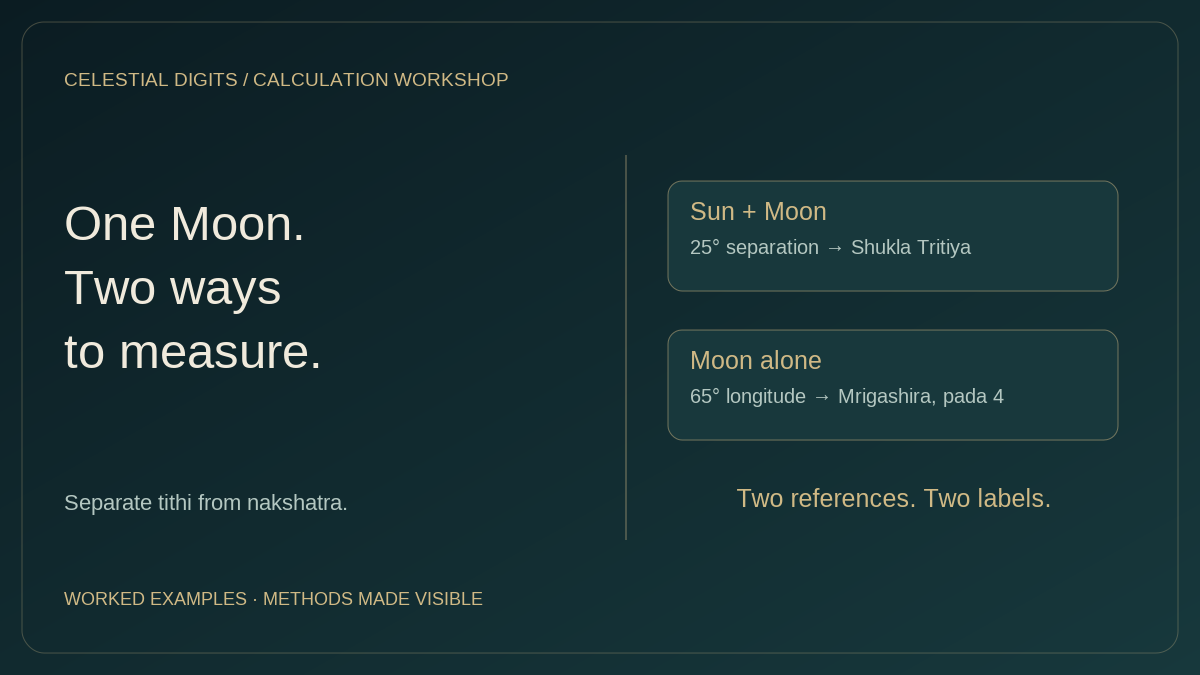
A panchang can say Shukla Tritiya and Mrigashira at the same time. These are not competing names for one thing. Tithi measures the Moon's angular progress relative to the Sun; nakshatra identifies a segment of the sidereal zodiac occupied by the Moon.
Knowing your Moon sign or nakshatra alone does not reveal your tithi. You also need the Sun's position at the same instant. The examples below separate the measurements so you can see exactly which input produces each label.
Two rulers, two questions#
| Measurement | Required positions | Segment size | What is counted? |
|---|---|---|---|
| Tithi | Sun and Moon in the same longitude system | 12° | The forward Moon–Sun angle around the full circle |
| Lunar nakshatra | Moon's sidereal longitude | 13°20′ | One of 27 equal zodiac divisions |
| Nakshatra pada | Moon's position inside its nakshatra | 3°20′ | One of four quarters |
The myPanchang calendar explanation describes tithi as the interval in which the Moon gains 12° relative to the Sun. Its calendar explanation also distinguishes astronomical ending times from the local calendar day. The arithmetic and examples here are our own illustrations, not extracted birth records.
Example one: calculate both labels#
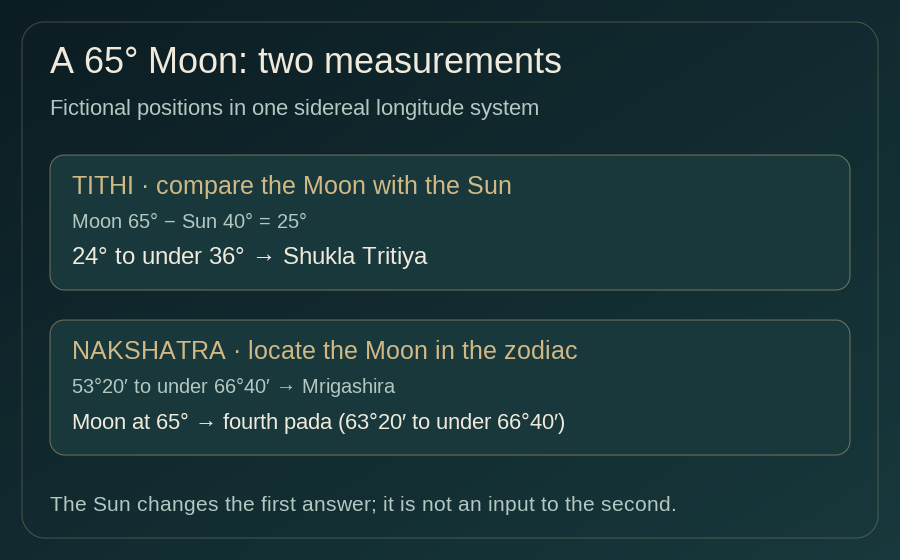
Assume sidereal Sun longitude 40° and sidereal Moon longitude 65°. These are invented positions for teaching the calculation, not a claim about today's sky.
Subtract the Sun from the Moon:
65° − 40° = 25°.
The first tithi occupies 0° to just before 12°; the second 12° to just before 24°; the third 24° to just before 36°. Our 25° angle is therefore the third tithi, Shukla Tritiya.
The general arithmetic is: divide the normalized angle by 12, take the whole-number part, then add one. Thus floor(25 ÷ 12) + 1 = 3. Here “floor” means discard the fractional remainder.
For nakshatra, do not subtract the Sun. Use the Moon's 65° longitude directly. Mrigashira extends from 53°20′ to 66°40′, so the Moon lies within it. Its fourth pada extends from 63°20′ to 66°40′. The result is Mrigashira, pada 4.
The Moon's sign is Gemini, because 65° is 5° beyond Gemini's 60° starting point. Gemini, Mrigashira pada 4 and Shukla Tritiya can all describe the same example without contradiction.
Same Moon position, a different tithi#
In a second independent teaching example, keep the Moon at 65° but place the Sun at 52°. The separation is now 13°, giving Shukla Dwitiya, the second tithi.
The Moon is still in Gemini and Mrigashira pada 4. Its nakshatra has not changed because its longitude has not changed. The Sun–Moon relationship has.
These are two hypothetical input sets, not a suggestion that the Sun can move twelve degrees instantly while the real Moon stands still. Holding one input fixed is a way to isolate the formula's dependence on the other input.
Handle the end of the zodiac correctly#
Suppose the Sun is at 350° and the Moon at 5°. Direct subtraction gives −345°. Add 360° to normalize the result into the range from 0° up to, but not including, 360°:
(5° − 350°) + 360° = 15°.
That is Shukla Dwitiya. The Moon itself is at 5° Aries, in Ashwini pada 2. Crossing the Aries boundary does not produce a negative tithi.
Use the forward angle, not always the shortest distance between the two positions. At an angle of 240°, folding the separation to 120° would confuse the waning and waxing portions of the cycle. Tithis 1–15 belong to the bright fortnight and 16–30 to the dark fortnight; traditional labels restart the count within each fortnight.
Why the calendar and a birth report may show different names#
At an elongation of 23°59′, the second tithi is still running. At exactly 24°, the third begins. A tithi is an angular interval, not a fixed 24-hour civil day, and its boundary need not occur at midnight.
A birth report asks what was running at a particular instant. A daily panchang may foreground the tithi present at local sunrise and also list its ending time. Festival observance can involve additional rules. Comparing only the headline labels can therefore compare different reference moments.
For geocentric calculations, converting the same instant from UTC to IST changes its clock display, not the underlying Sun–Moon angle. Local sunrise, however, depends on place. Keep the instant, location and calendar rule visible when investigating a disagreement.
Which settings matter for which calculation?#
Subtracting the same ayanamsha from both longitudes cancels it out of the Sun–Moon difference. Under otherwise identical position conventions, changing that common zodiac offset does not change tithi. It can change the Moon's sidereal longitude and therefore a nakshatra assignment near a boundary.
Do not mix a tropical Sun with a sidereal Moon. Nor should you compare a topocentric Moon from one report with a geocentric Moon from another without accounting for the different position convention.
For chart reading, retain these as distinct fields: Moon sign, Moon nakshatra and pada, tithi, and the timestamp being described. None is a substitute for the others, and none by itself establishes a person's temperament or future. Continue with nakshatra lord versus sign lord when the labels are clear but the planetary rulerships are not.
Related Posts
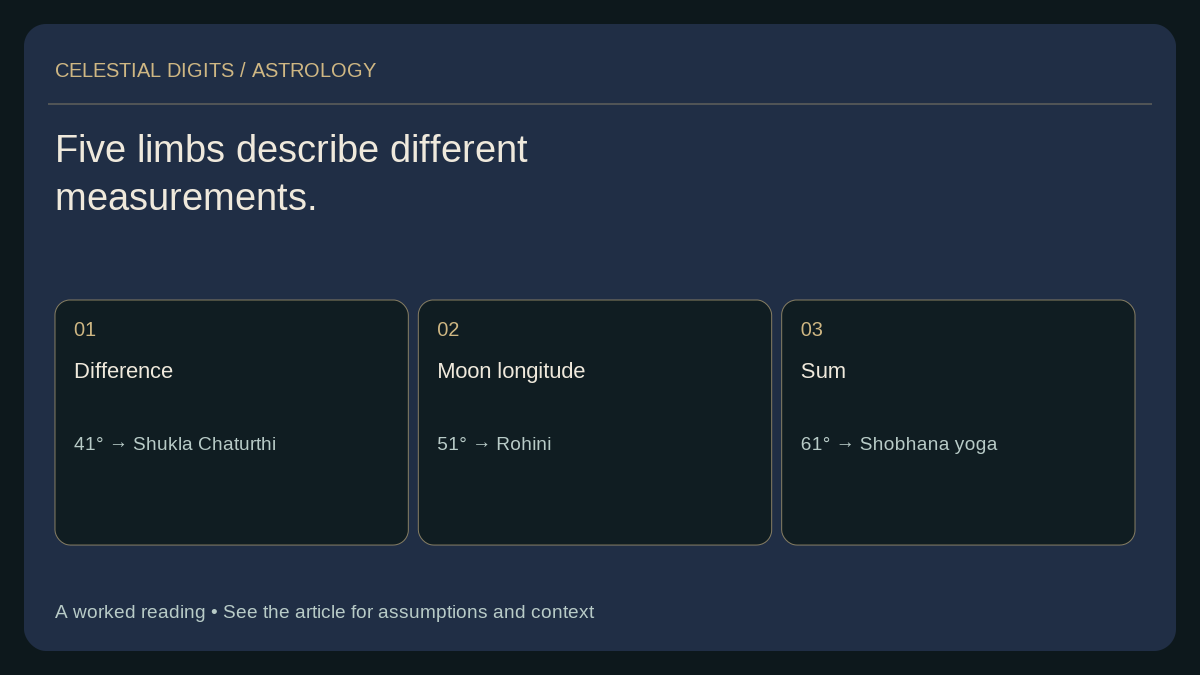
A Panchanga Reading: Tithi, Vara, Nakshatra, Yoga and Karana
Calculate all five Panchanga limbs from a clearly hypothetical example, and learn why a daily label is not an exact event-time calculation.
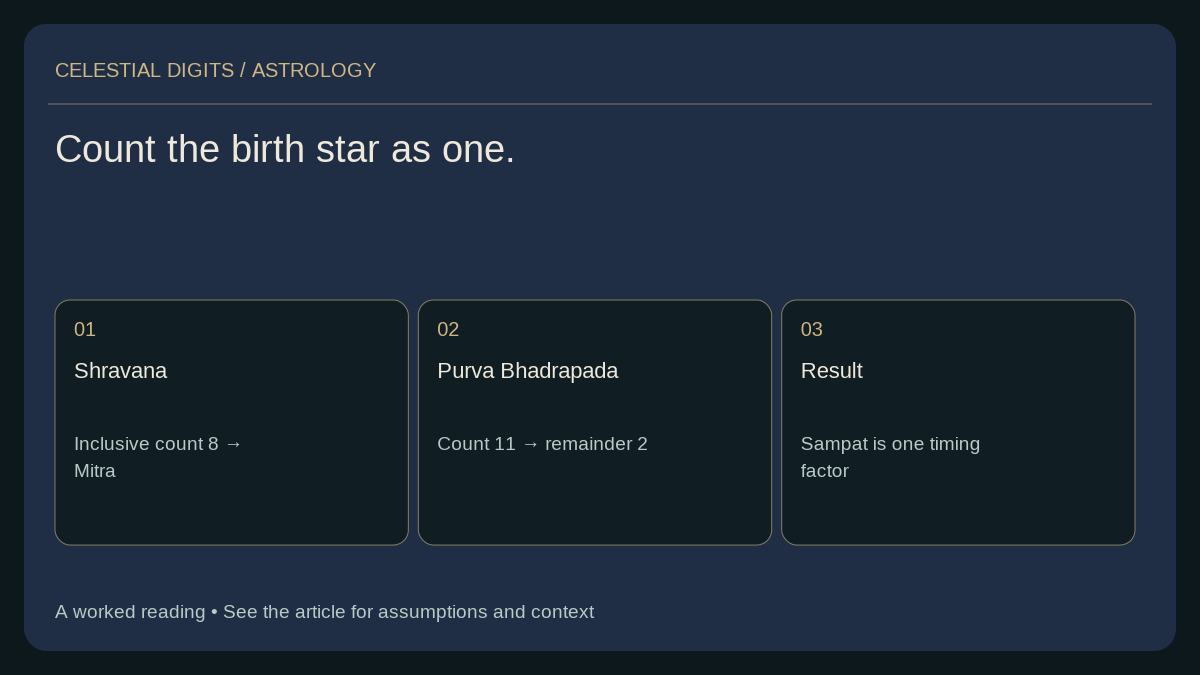
Tara Bala: Count from Your Birth Nakshatra with a Worked Example
Calculate Tara Bala with inclusive counting, a ninefold cycle and wraparound examples, while keeping it separate from a complete muhurta judgement.
Sookshma Dasha: Calculate the Fourth Level, with a Complete Timeline
Follow nine Sookshma periods inside Saturn–Mars–Mars, check exact boundaries, and understand why birth balances must not restart the sequence.
A little more perspective.
Keep discussions respectful. No harassment, hate, sexual content or spam. Comments are reviewed before publication. Report concerns from a comment menu, or contact [email protected].
Checking your session…