
Why Was My First Mahadasha So Short? Dasha Balance at Birth
Calculate the remaining mahadasha at birth from the Moon's nakshatra, and see why the first antardasha must not restart from the mahadasha lord.
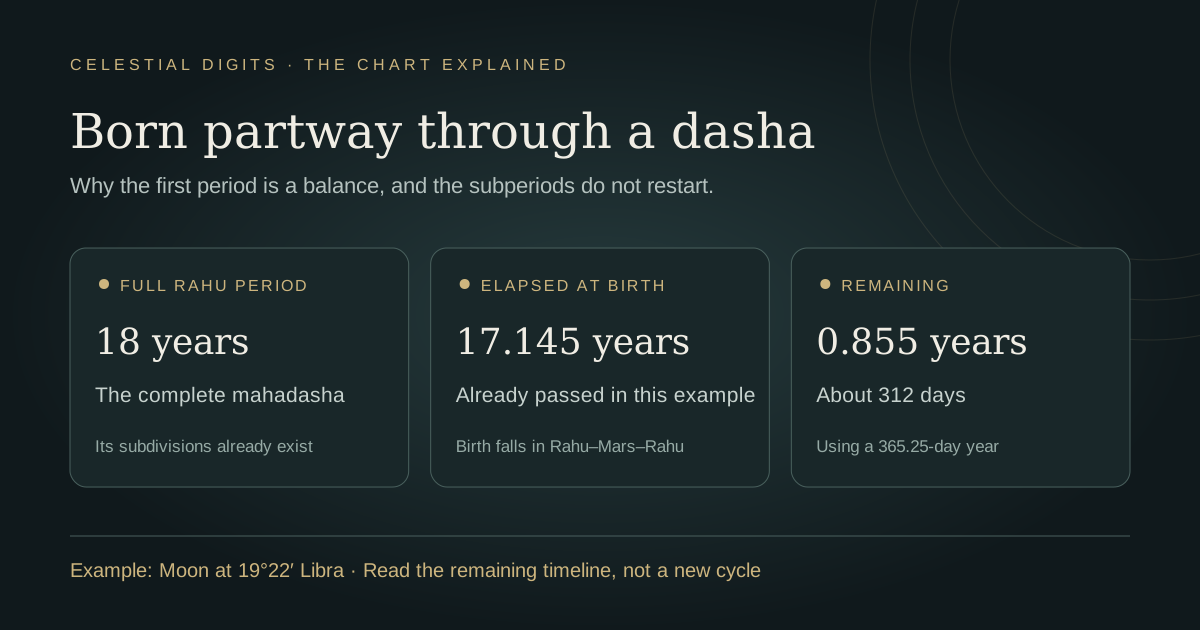
Rahu mahadasha lasts 18 years. Yet your chart may show less than one year of Rahu after your birth, followed by Jupiter. That is not automatically an error.
The first mahadasha is usually a remaining balance, not a fresh full period. In the standard Moon-based Vimshottari system, the Moon's progress through its birth nakshatra tells us how much of that period has already elapsed in the calculation.
There is a second detail that matters just as much: the antardashas inside that first partial period must retain their place in the full mahadasha. They should not all be squeezed into the short balance or restarted at birth.
The rule in plain language#
Each nakshatra covers 13°20′. The Moon's nakshatra lord supplies the starting mahadasha, whose full duration comes from the Vimshottari sequence.
| Lord | Full mahadasha years |
|---|---|
| Ketu | 7 |
| Venus | 20 |
| Sun | 6 |
| Moon | 10 |
| Mars | 7 |
| Rahu | 18 |
| Jupiter | 16 |
| Saturn | 19 |
| Mercury | 17 |
Together they total 120 years. The sequence cycles, so Mercury is followed by Ketu.
To calculate the birth balance:
Remaining years = full mahadasha years × remaining arc in the nakshatra ÷ 13°20′.
Use the Moon's distance from the start of its nakshatra, not its distance from the start of its sign. They often have different starting points.
Worked example: a Moon near the end of Swati#
Take a hypothetical Moon at exactly 19°22′ Libra. Swati runs from 6°40′ to 20°00′ Libra and its lord is Rahu.
Working in arcminutes avoids rounding the nakshatra width:
| Step | Calculation |
|---|---|
| Full Swati span | 13°20′ = 800 arcminutes |
| Remaining arc | 20°00′ − 19°22′ = 38 arcminutes |
| Remaining fraction | 38 ÷ 800 = 0.0475 |
| Rahu balance | 18 × 0.0475 = 0.855 years |
| Approximate days using 365.25 days per year | 0.855 × 365.25 = 312.3 days |
The calculation has already passed through 17.145 years of the full Rahu period at the birth instant. Only 0.855 years remains after birth.
These are exact teaching coordinates, not a recalculation of any reader's saved profile. A Moon a little further along Swati, such as a rounded position near 19°23′, would produce a smaller balance. Use the full stored longitude when comparing exact dates.
Which antardasha is running at birth?#
Within a full mahadasha, each antardasha has this duration:
Antardasha years = mahadasha lord's years × antardasha lord's years ÷ 120.
The first antardasha belongs to the mahadasha lord. For the full Rahu mahadasha, the order and cumulative positions are:
| Antardasha | Duration in years | Position within full Rahu mahadasha |
|---|---|---|
| Rahu | 2.70 | 0.00–2.70 |
| Jupiter | 2.40 | 2.70–5.10 |
| Saturn | 2.85 | 5.10–7.95 |
| Mercury | 2.55 | 7.95–10.50 |
| Ketu | 1.05 | 10.50–11.55 |
| Venus | 3.00 | 11.55–14.55 |
| Sun | 0.90 | 14.55–15.45 |
| Moon | 1.50 | 15.45–16.95 |
| Mars | 1.05 | 16.95–18.00 |
Our birth instant is at year 17.145, which falls inside Rahu–Mars. Therefore the remaining 0.855 years is already part of Rahu–Mars. The child does not start in Rahu–Rahu simply because Rahu is the first mahadasha visible in the report.
After Rahu finishes, Jupiter begins with its own full sequence, starting Jupiter–Jupiter.
What about pratyantardasha?#
The same principle applies one level deeper. Divide the full antardasha, starting with its own lord, and locate the birth instant inside that timeline.
In this example, Rahu–Mars began at year 16.95 of Rahu, so birth occurs 0.195 years into its 1.05-year duration. Its first two pratyantardashas are:
- Mars: 1.05 × 7 ÷ 120 = 0.06125 years.
- Rahu: 1.05 × 18 ÷ 120 = 0.1575 years, ending at 0.21875 years from the start of the antardasha.
Because 0.195 falls between 0.06125 and 0.21875, the birth combination is Rahu–Mars–Rahu. Only 0.02375 years of that pratyantardasha remains, approximately 8.67 days under the same year convention.
This is why calculating all nine subperiods afresh from the birth date can create a plausible-looking but incorrect table.
What should a correct display show?#
A report may show the full theoretical period, including its pre-birth portion, or show only the portion from birth onward. Either presentation can work if the labels make the choice clear.
In a timeline clipped to birth, the first visible row may begin on the birth date even though the underlying period began earlier. Its visible duration is the remaining duration. That clipping should not change the identities or original boundaries of the surviving subperiods.
The conceptual pre-birth start is a mathematical anchor for this timing system. It does not mean the software has observed a person's life before birth.
Why websites can disagree on the date#
Before comparing results, check the underlying Moon longitude, ayanamsa, birth timezone and year-length convention. A system using a 360-day dasha year will not produce the same calendar dates as one using 365.25 days.
Also check whether the displayed longitude has been rounded. Arcseconds can matter when converting a fractional nakshatra into many years. Date-only displays can conceal different time-of-day boundaries.
Those differences are separate from a logic error such as restarting every first antardasha at birth. Our guide to different kundlis across websites explains the broader comparison process.
Check your chart without guessing#
In your birth-chart report, note the Moon's exact position and nakshatra. Check the starting lord, remaining balance and first visible antardasha together. A short birth mahadasha is normal; a short balance containing a freshly restarted sequence of all nine antardashas deserves scrutiny.
For interpretation after the dates are established, read mahadasha and antardasha together. Correct arithmetic makes a traditional timing model internally consistent; it does not establish that its predictions are scientifically reliable.
Calculation note: all examples use the standard 120-year Vimshottari proportions. Calendar approximations use 365.25 days per year, matching the convention currently used for the main Vimshottari report in Celestial Digits. No personal birth data is required to reproduce the example.
Related Posts

Vimshottari Dasha for Beginners: How to Read Mahadasha and Antardasha Together
Learn how to read Vimshottari Mahadasha and Antardasha together using house activation, lordship, dignity, and timing logic rooted in Jyotish.
Ascendant Nakshatra vs Moon Nakshatra: Why Both Matter
Learn why your ascendant and Moon can have different nakshatras, how to find both, and which one sets your birth star and Vimshottari dasha.
KP Astrology: Sign Lord, Star Lord and Sub-Lord Explained
Understand KP's sign, star and sub-lords through an exact Aries example, a complete Ashwini sub table, and the difference between planets and cusps.
A little more perspective.
Keep discussions respectful. No harassment, hate, sexual content or spam. Comments are reviewed before publication. Report concerns from a comment menu, or contact [email protected].
Checking your session…