
Sookshma Dasha: Calculate the Fourth Level, with a Complete Timeline
Follow nine Sookshma periods inside Saturn–Mars–Mars, check exact boundaries, and understand why birth balances must not restart the sequence.
A chart reading Saturn–Mars–Mars–Rahu describes four nested periods. Rahu is the Sookshma lord inside Mars pratyantardasha, inside Mars antardasha, inside Saturn mahadasha. It does not replace the three larger periods.
Sookshma, also written Sukshma or Sukshmantar, is the fourth level of Vimshottari. This guide calculates all nine subdivisions of one parent interval, then checks a date against them. The calendar is fictional and explicitly anchored; these are not universal dates for everyone running Saturn mahadasha.
Start with the complete parent interval#
We continue the example in our Pratyantardasha calculation guide: a full Saturn–Mars antardasha begins on 1 January 2030 at 00:00 UTC, using 365.25 days per dasha year.
The arithmetic is:
- Saturn mahadasha: 19 years.
- Saturn–Mars antardasha: 19 × 7 ÷ 120 = 1.108333… years = 404.81875 days.
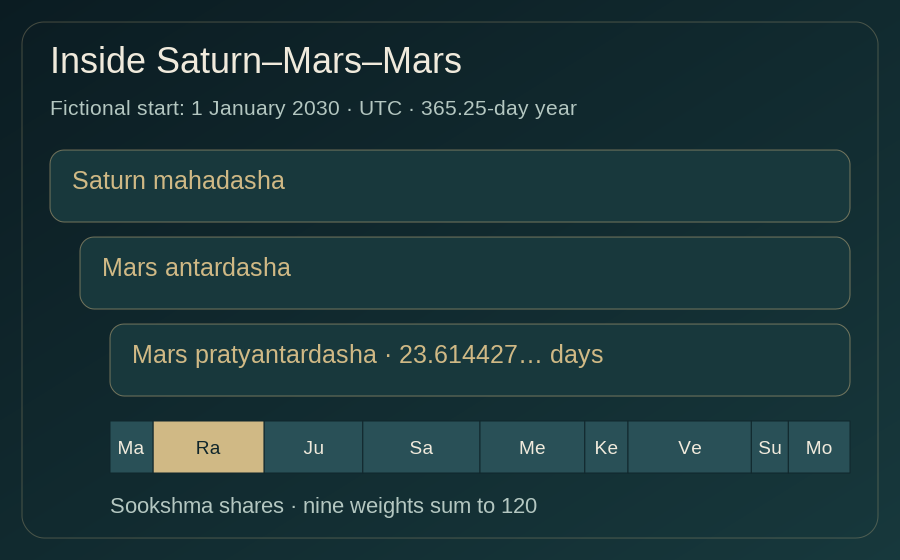
- Saturn–Mars–Mars pratyantardasha: 404.81875 × 7 ÷ 120 = 23.614427083333… days.
That final duration is the parent we now divide. Using the whole antardasha again would produce third-level periods, not Sookshma periods.
The proportional rule is recorded in Brihat Parashara Hora Shastra, chapter 62, verse 1. For each fourth-level lord:
Sookshma duration = full Pratyantardasha duration × lord's Vimshottari years ÷ 120.
Inside Mars pratyantardasha, begin with Mars, then follow Rahu, Jupiter, Saturn, Mercury, Ketu, Venus, Sun and Moon. Their weights are 7, 18, 16, 19, 17, 7, 20, 6 and 10. These add to 120, so the children fill their parent exactly.
A complete fourth-level schedule#
Rahu's duration, for example, is 23.614427083333… × 18 ÷ 120 = 3.5421640625 days. Venus gets a larger share because its weight is 20; Sun gets a smaller share because its weight is 6.
All dates below are in January 2030, UTC. Durations are rounded to six decimals and clock displays omit seconds. Compute boundaries from unrounded values, not from the displayed numbers.
| Sookshma lord | Days | Starts, UTC | Ends, UTC |
|---|---|---|---|
| Mars | 1.377508 | 01 Jan 00:00 | 02 Jan 09:03 |
| Rahu | 3.542164 | 02 Jan 09:03 | 05 Jan 22:04 |
| Jupiter | 3.148590 | 05 Jan 22:04 | 09 Jan 01:38 |
| Saturn | 3.738951 | 09 Jan 01:38 | 12 Jan 19:22 |
| Mercury | 3.345377 | 12 Jan 19:22 | 16 Jan 03:39 |
| Ketu | 1.377508 | 16 Jan 03:39 | 17 Jan 12:43 |
| Venus | 3.935738 | 17 Jan 12:43 | 21 Jan 11:10 |
| Sun | 1.180721 | 21 Jan 11:10 | 22 Jan 15:31 |
| Moon | 1.967869 | 22 Jan 15:31 | 24 Jan 14:44 |
The exact parent end is 24 January 2030, 14:44:46.5 UTC. The next pratyantardasha begins there; its Sookshma sequence begins with its own lord. Do not continue this Mars sequence beyond its parent.
Find the active period without a date-boundary mistake#
At 4 January 2030, 12:00 UTC, the fourth-level lord is Rahu. The complete label is therefore Saturn–Mars–Mars–Rahu.
Rahu begins at 2 January, 09:03:36.7125 UTC. At that exact instant, Mars Sookshma has ended. Use an interval that includes its start and excludes its end, so exactly one row is current.
In India, the same boundary displays as 2 January, 14:33:36.7125 IST. The clock changes; the active period does not. A date-only screenshot cannot resolve a disagreement occurring within that day. Compare timestamps with their time zones before comparing interpretations.
A partial period does not start over at birth#
Suppose a timeline is viewed from 4 January at noon in this teaching example. Rahu has already started. Show its remaining interval until 5 January at 22:04:19.6875 UTC, then Jupiter and the later rows.
Do not take the remaining parent duration and distribute it again among all nine lords. That would invent a new Mars start and move every subsequent boundary. The same principle applies when birth occurs partway through a period: reconstruct the complete sequence first, then display only the portion after birth.
This assumed timeline does not establish the dasha of a child actually born on that date. A real birth balance comes from the natal Moon's position. Read the first mahadasha and its birth balance for that calculation.
What to include when copying a chart for analysis#
Include the reference date, all four active lords, their start and end timestamps, the time zone, and the parent periods containing the Sookshma rows. A loose list beginning “Rahu, Jupiter, Saturn” loses the hierarchy.
In the Dasha section, expand the relevant mahadasha, antardasha and pratyantardasha. When copying an AI consultation prompt, check that the exported dates cover the question's actual time window. Ask the assistant to distinguish calculation facts from traditional interpretation.
More decimal places make a boundary easier to reproduce. They do not establish that a conversation, marriage or job offer will occur at that moment. Sookshma is a finer subdivision of an astrological framework, not evidence of minute-by-minute predictive accuracy.
Method note: The dates here were independently generated from the stated proportions and assumed starting instant. A different year convention or natal starting balance changes the calendar. No saved profile is used in this example.
Related Posts
Tithi vs Nakshatra: Two Different Ways to Read the Moon
Calculate tithi from the Sun–Moon angle and nakshatra from lunar longitude, with worked examples, boundary checks and local-calendar distinctions.
Foreign Travel, Work or Permanent Settlement? Read the Question First
Separate a foreign trip, overseas employment and a lasting change of home. Use a Virgo-ascendant worksheet to read houses, lordships and timing together.
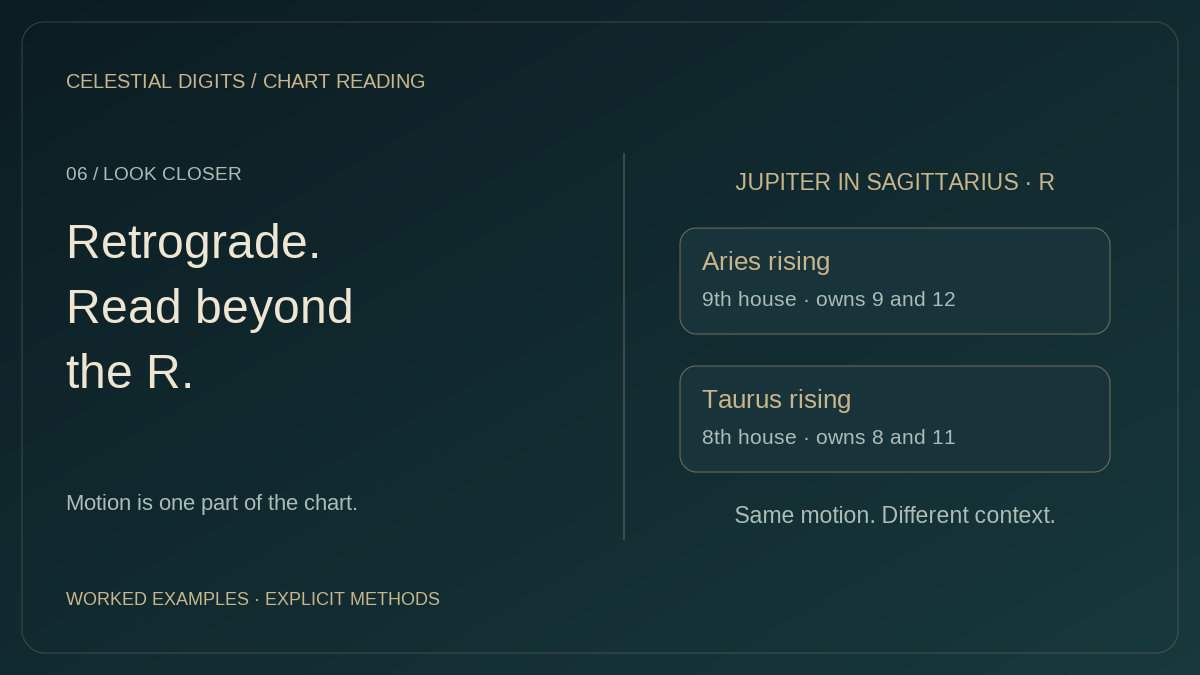
Retrograde Planets in Your Birth Chart: Stronger, Delayed or Misunderstood?
Read natal retrograde planets without blanket predictions. Separate motion, dignity, house lordship and timing with two worked chart examples.
A little more perspective.
Keep discussions respectful. No harassment, hate, sexual content or spam. Comments are reviewed before publication. Report concerns from a comment menu, or contact [email protected].
Checking your session…