
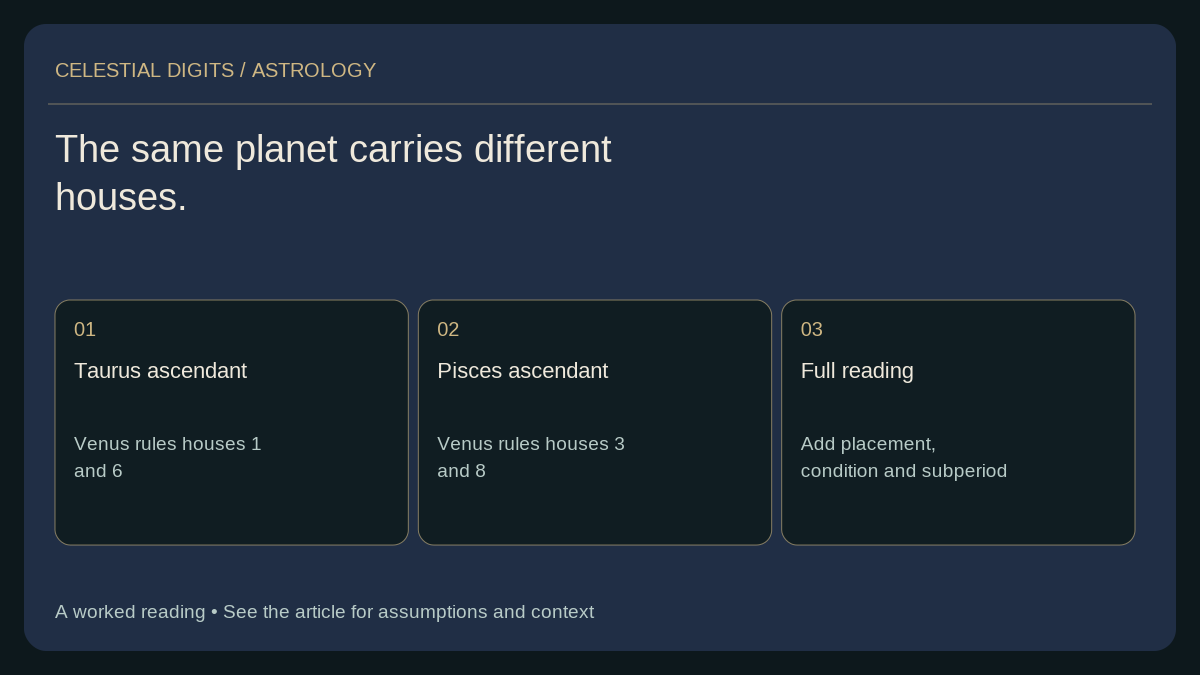
Why Two People in Venus Mahadasha Can Have Different Experiences
Compare Taurus and Pisces ascendants to see how Venus changes functional roles, even before adding placement, subperiods and real-life circumstances.
Venus mahadasha is often advertised as a period of love, beauty and comfort. Those are familiar Venus associations, but a twenty-year Vimshottari period cannot be described responsibly through a few natural significations alone.
Venus also owns particular houses in each chart, occupies a particular place and interacts with other planets. Two people sharing the same mahadasha name can therefore have very different interpretive contexts.
Compare ownership before telling a story#
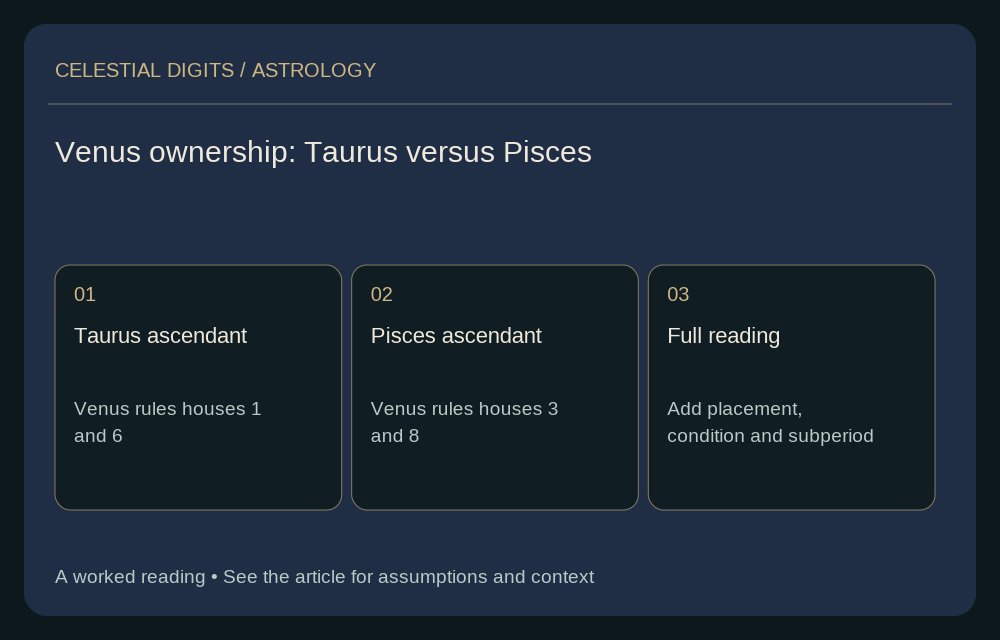
Take two fictional charts, one with Taurus ascendant and one with Pisces ascendant. Venus rules Taurus and Libra in both charts, but those signs occupy different houses.
| Ascendant | Taurus is house | Libra is house | Venus owns |
|---|---|---|---|
| Taurus | 1 | 6 | 1 and 6 |
| Pisces | 3 | 8 | 3 and 8 |
For Taurus, the period can involve identity alongside work, service or other sixth-house responsibilities. For Pisces, initiative, skills, shared resources or transitions may be relevant through the third and eighth. These are areas to examine, not guaranteed events.
Add placement to each chart#
Suppose Venus occupies Capricorn in both examples. It is in the ninth house for Taurus ascendant and the eleventh for Pisces ascendant. Even identical sign placement now connects to different houses from the ascendant.
The first reading might explore how education, principles or mentors relate to the person's responsibilities. The second might explore how networks and aspirations relate to effort or shared commitments. Neither interpretation is complete without Venus's condition and other chart factors.
Natural beneficence is not a universal verdict#
Calling Venus a natural benefic describes one classification within the tradition. It does not mean every Venus period is easy, and difficult house ownership does not make every experience harmful.
A planet can support some matters while making others demanding. Avoid converting a functional classification into a moral label for the person or a promise about the entire period.
Subperiods change the emphasis#
Within Venus mahadasha, the antardasha lord contributes its own ownership, placement and relationship with Venus. Two people may also be in different Venus subperiods at the same calendar date.
Even when both are in Venus–Saturn, their natal Saturn placements differ. Adding the label of a second planet does not remove the need to read the chart. Relevant divisional charts and transits can refine the inquiry, but they should support a coherent topic rather than generate an unlimited list of predictions.
Life stage and circumstances are essential#
A student, a caregiver and a retiree can encounter the same symbolic theme in very different forms. “Responsibility” might mean examinations, family care or managing a community role. Their available choices and real constraints must be respected.
Do not tell someone that an ordinary difficulty proves they are using Venus incorrectly. The period label is not a measure of worth or a guarantee of relationships, wealth or leisure.
Read natural versus functional benefics and Venus–Saturn relationship themes.
Traditional basis and limits#
Vimshottari periods and house ownership are described in Brihat Parashara Hora Shastra. The two-chart comparison is original. It demonstrates why personalised context matters, not that either fictional person must experience the suggested themes.
Related Posts
Marriage Astrology: A Study Guide to Partnership and Timing
Explore 56 marriage guides: Venus and Mars placements, seventh-house planets, combinations, Darakaraka, synastry and timing with worked examples.
Marriage Timing Through Mahadasha, Antardasha and Pratyantar
Read the full Vimshottari hierarchy, compare planetary roles across ascendants and work through sub-period durations without inventing a wedding date.
Navamsa in Marriage Timing: Cross-Checking the Dasha Lords
Follow the same dasha lords from D1 into D9, calculate two Navamsa examples and see why a conjunction or uncertain ascendant needs careful interpretation.
A little more perspective.
Keep discussions respectful. No harassment, hate, sexual content or spam. Comments are reviewed before publication. Report concerns from a comment menu, or contact [email protected].
Checking your session…