
Ascendant Nakshatra vs Moon Nakshatra: Why Both Matter
Learn why your ascendant and Moon can have different nakshatras, how to find both, and which one sets your birth star and Vimshottari dasha.
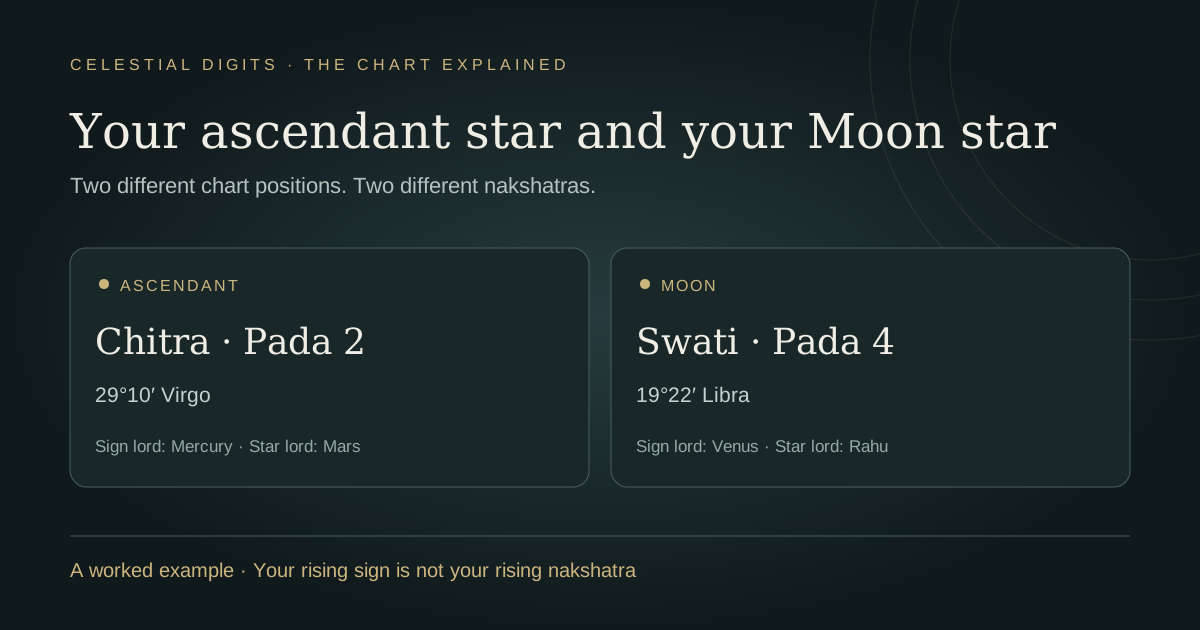
You open a chart and see Virgo ascendant, Chitra nakshatra, Libra Moon and Swati birth star. Which one is “your nakshatra”?
In everyday Jyotisha usage, birth nakshatra or janma nakshatra usually means the Moon's nakshatra. Ascendant nakshatra means the nakshatra occupied by the precise rising degree. They can be different because the Moon and the ascendant are different points in the chart.
Neither cancels the other. The useful first step is to identify what was measured before reading what it might mean.
What is being measured?#
The ascendant, also called lagna, is the point where the ecliptic meets the eastern horizon at the birth time and place. The Moon's position is the Moon's longitude in the zodiac at that moment.
Each longitude falls within a sign, a nakshatra and a pada. Those are nested labels for a location, not competing answers to one question.
| Feature | Ascendant nakshatra | Moon nakshatra |
|---|---|---|
| Calculated from | Rising degree at the local horizon | Moon's zodiacal longitude |
| Common name | Lagna nakshatra | Janma nakshatra or birth star |
| Traditional reading emphasis | Approach to life and outward engagement | Experience, response and mental patterns |
| Standard Moon-based Vimshottari starting lord | Not taken from this point | Taken from this nakshatra |
| Sensitivity to birth-time uncertainty | Often high | Usually slower to change, but important near boundaries |
The interpretive descriptions in the table are traditional shorthand. They are not a psychological diagnosis or a claim that every person with the placement behaves alike.
A worked example: Chitra rising and Swati Moon#
Consider these illustrative rounded sidereal positions:
| Detail | Ascendant | Moon |
|---|---|---|
| Position | 29°10′ Virgo | 19°22′ Libra |
| Sign lord | Mercury | Venus |
| Nakshatra | Chitra | Swati |
| Pada | 2 | 4 |
| Nakshatra lord | Mars | Rahu |
Chitra begins at 23°20′ Virgo. Its second pada runs from 26°40′ Virgo up to the beginning of Libra, so 29°10′ Virgo falls in pada 2.
Swati begins at 6°40′ Libra and ends at 20°00′ Libra. Its fourth pada runs from 16°40′ up to 20°00′ Libra, so the example Moon falls in pada 4.
The answer to “What is this person's birth star?” is therefore Swati. The answer to “What is the ascendant nakshatra?” is Chitra. The ascendant sign remains Virgo.
The starting Vimshottari mahadasha is Rahu because the Moon is in Swati. Mars ruling Chitra does not change that Moon-based calculation. As the Moon is near Swati's end, only a small part of Rahu's full period remains at birth. See the dasha-balance worked example.
Why the descriptions may sound different#
An astrologer might use Chitra's building and shaping symbolism to discuss how someone approaches a task, then Swati's movement and independence symbolism to discuss their need for space. Those are two interpretive lenses, not a demand that the person fit two fixed personality types.
Someone can present themselves methodically while internally needing freedom. Someone else with the same two nakshatras may express them differently because the rest of the chart, upbringing and circumstances differ.
The useful question is not “Which description should win?” It is “Which point is this description about, and does the interpretation fit the whole context?”
Avoid adding every sentence from two generic profiles together. If one article calls a nakshatra reserved and another calls it expressive, that alone is not evidence of an inner conflict or disorder.
Why a few minutes can matter more for the ascendant#
The rising degree moves as Earth rotates, but its rate through the zodiac is not uniform. Latitude, time and the part of the zodiac matter. “One sign every two hours” is only an average, not a reliable boundary test for an individual chart.
A birth time close to a pada or nakshatra boundary can therefore produce different ascendant labels after a small correction. The Moon moves more slowly, but it too can cross a boundary during an uncertain birth-time window.
If the time is approximate, calculate both ends of the plausible interval. Record which labels remain stable and which change. Do not quietly select the version whose personality description sounds nicer. Our five-minute birth-time comparison explains why this matters.
Which one should I read first?#
For understanding the layout of your natal chart, begin with the ascendant sign and its lord. For the conventional birth-star label and Moon-based Vimshottari timing, identify the Moon's nakshatra. Then examine the ascendant nakshatra as an additional layer.
For a topic such as work or marriage, neither nakshatra replaces the relevant houses, lords and timing checks. Nor does a birth-star compatibility score establish whether two people communicate well or share important values.
This reading order keeps the chart coherent without declaring one placement universally more important than every other factor.
Find both in Celestial Digits#
Open the birth-chart report, check the birth details, and read the Ascendant Nakshatra separately from the Moon's Birth Star. When copying chart data, preserve the full labels and the exact degrees.
If you are comparing websites, match the birth time, location, timezone and ayanamsa first. A sidereal chart and a tropical chart are not using the same zodiac reference. Read why kundlis differ across websites before treating a difference as a calculation error.
Common questions#
Can the ascendant and Moon share a nakshatra?#
Yes. They can occupy the same 13°20′ sector. They may still occupy different padas, and the Moon is still a planet while the ascendant is a horizon point.
Is an ascendant nakshatra the same as a rising sign?#
No. The sign covers 30 degrees; the nakshatra covers 13°20′. “Virgo rising” and “Chitra rising” describe different divisions of the same longitude.
Should I use my ascendant nakshatra to change my dasha?#
Not in the standard Moon-based Vimshottari method described here. Alternative methods should be explicitly named and kept separate.
Continue with sign lord vs nakshatra lord vs deity or explore the nakshatra library.
Related Posts
Rohini Nakshatra: Traits, Ascendant Behavior, and House Effects
Strictly Vedic guide to Rohini nakshatra covering its deity, ruler, ascendant behavior, and house-wise effects from Lagna.
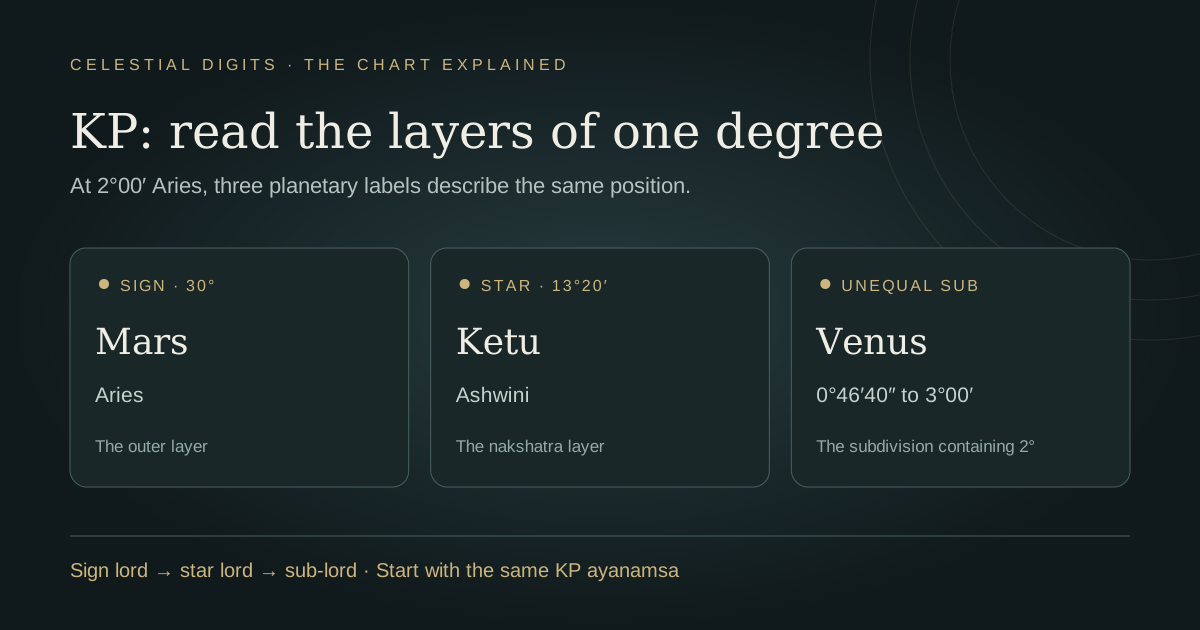
KP Astrology: Sign Lord, Star Lord and Sub-Lord Explained
Understand KP's sign, star and sub-lords through an exact Aries example, a complete Ashwini sub table, and the difference between planets and cusps.
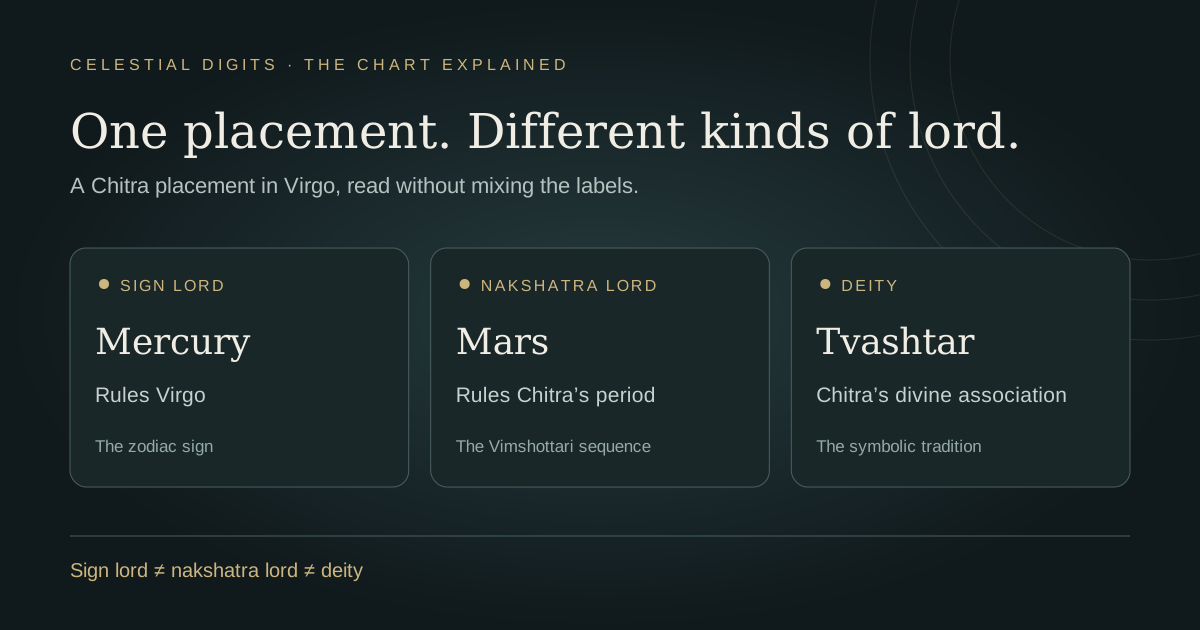
Nakshatra Lord vs Sign Lord vs Deity: Who Rules Your Chart?
Separate sign lord, nakshatra lord and deity with clear examples from Chitra, Revati and Krittika, plus a practical way to read your own chart.
A little more perspective.
Keep discussions respectful. No harassment, hate, sexual content or spam. Comments are reviewed before publication. Report concerns from a comment menu, or contact [email protected].
Checking your session…