
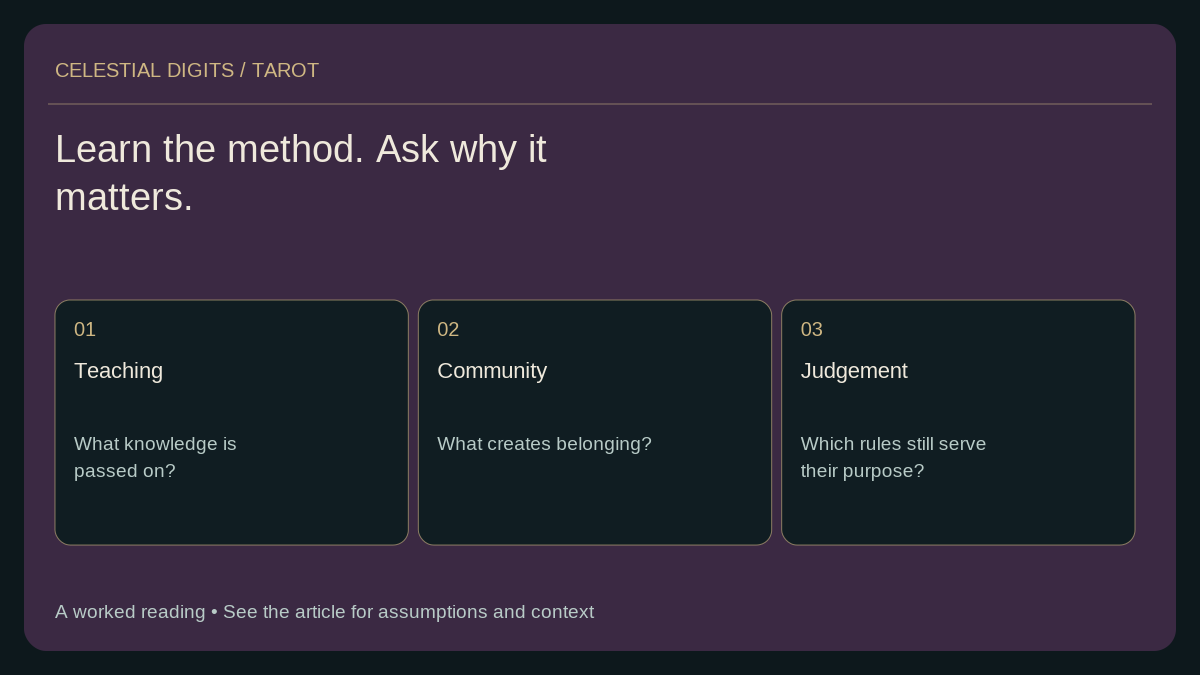
The Hierophant: Tradition, Teachers and Questioning the Rules
Read the Hierophant through a learning example that distinguishes useful instruction, belonging and rigid authority.
The Hierophant often appears in discussions of tradition, teaching and institutions. That does not make it a simple instruction to obey, nor does it always describe a restrictive authority. A tradition can preserve valuable knowledge while still needing thoughtful interpretation.
The useful question is what a particular framework makes possible, and what it asks people to accept without examination.
Look at the teaching relationship#
The Rider–Waite–Smith image shows an elevated religious figure, two attendants and crossed keys. The scene is organised around transmitted knowledge and recognised authority. Waite discusses the card in relation to institutional religious expression.
Contemporary readings often extend that image to schools, professional training, communities and shared practices. That extension should be named as interpretation rather than presented as the only historical meaning of the card.
A music-school example#
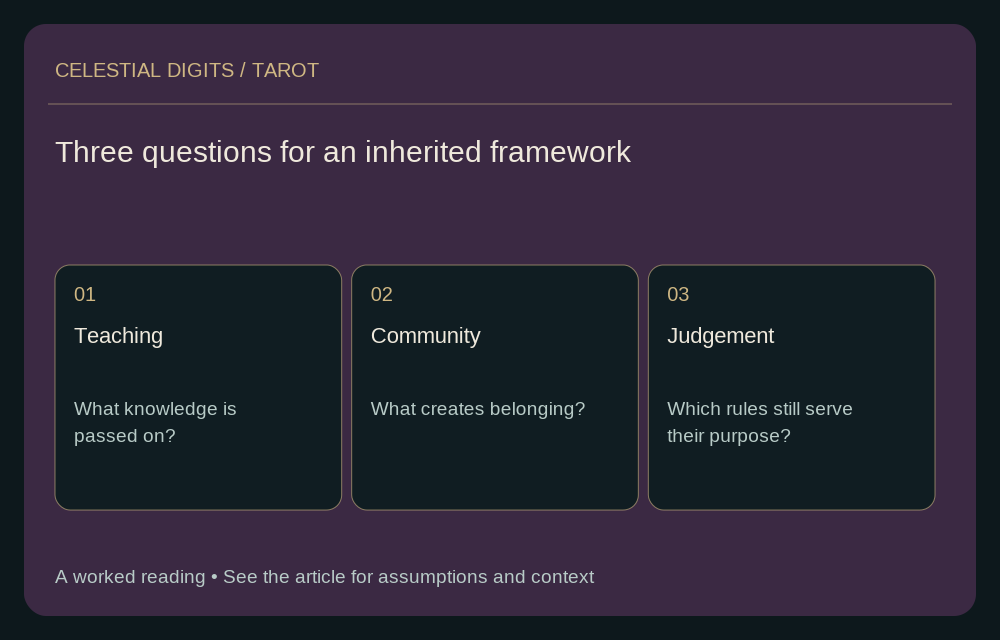
Imagine a beginner learning an instrument. In a constructed reading, the Hierophant appears in “What would support my learning?” It could prompt a discussion of a teacher, a structured course or regular practice within an established method.
This does not mean every teacher is suitable or every rule is beyond question. A useful instructor can explain why a technique matters, adjust guidance to the learner and welcome reasonable questions.
| Part of the framework | Useful question |
|---|---|
| Technique | What problem does this method solve? |
| Practice | How will progress be assessed? |
| Community | Can I participate without pretending to agree with everything? |
| Authority | Is expertise demonstrated and open to scrutiny? |
When the card describes a challenge#
Perhaps the learner is copying an exercise without understanding it, or feels unable to ask for clarification. The challenge may be passive compliance rather than the existence of a tradition itself.
Alternatively, someone may reject every basic exercise as restrictive before learning what it teaches. In that case, the card can prompt patience with foundations. These are opposite possibilities, so the reader must ask about the situation rather than choosing a story from the image alone.
Belonging can be helpful and complicated#
Shared rituals and language can create continuity. They can also make disagreement feel like exclusion. A reflective reading should leave room for both experiences.
The card cannot establish that an organisation is trustworthy, that a leader has special authority over your life, or that leaving a group would be spiritually wrong. Those claims require scrutiny of actual conduct and circumstances, not a tarot symbol.
Turn the reading into a better question#
Instead of “Should I obey this teacher?”, ask “What can I learn here, what do I need clarified, and what boundaries matter to me?” For the music student, that might mean asking for a demonstration, agreeing a realistic practice schedule and reviewing whether the teaching style is useful.
The aim is informed participation. Learning from a tradition and thinking independently do not have to cancel each other out.
Compare related cards#
The High Priestess can prompt attention to what remains unspoken or privately understood. The Hierophant brings attention to what is formally taught and shared. The Emperor adds questions about organisation and authority. These are distinctions to explore, not rigid boundaries between meanings.
Source and adaptation#
Waite's Hierophant chapter is the historical reference. The music-school example and questions are our contemporary reflective adaptation. Tarot does not verify an institution's claims or replace independent judgement.
Related Posts
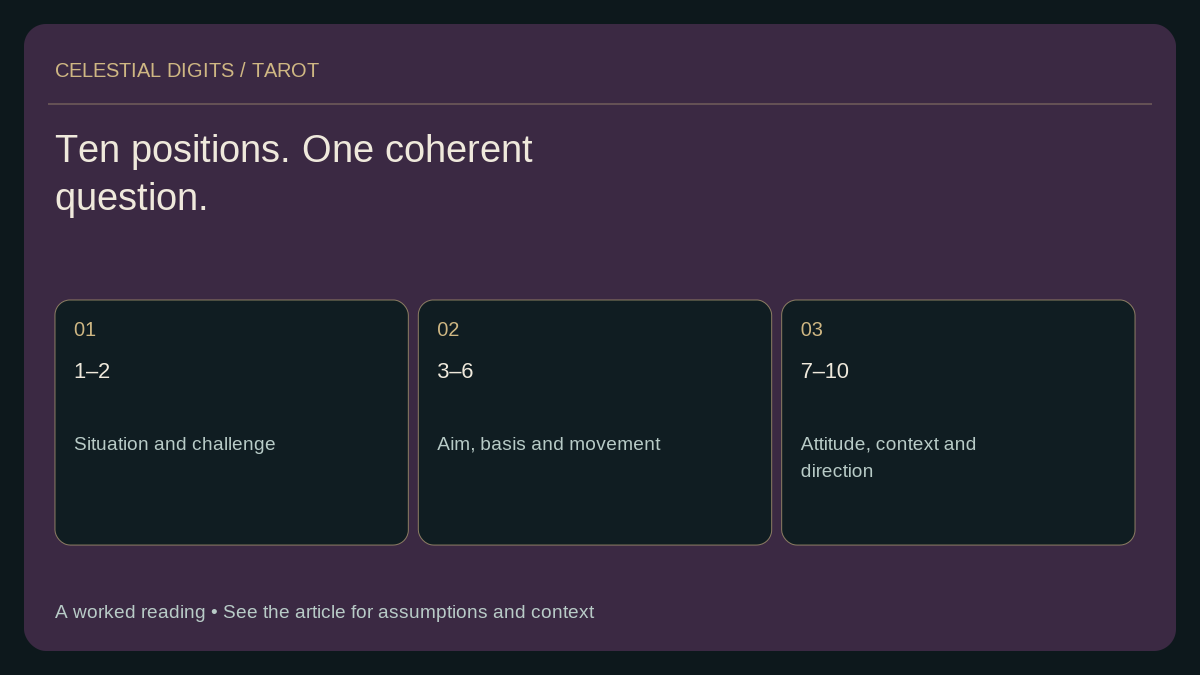
The Celtic Cross Explained Through One Complete Example
Follow all ten Celtic Cross positions in a fictional creative-project reading, then combine the cards into a practical, conditional interpretation.

The Chariot vs Strength: Direction, Persistence and Resistance
Compare purposeful direction with patient self-regulation through a rehearsal example, without treating either card as a command to push harder.
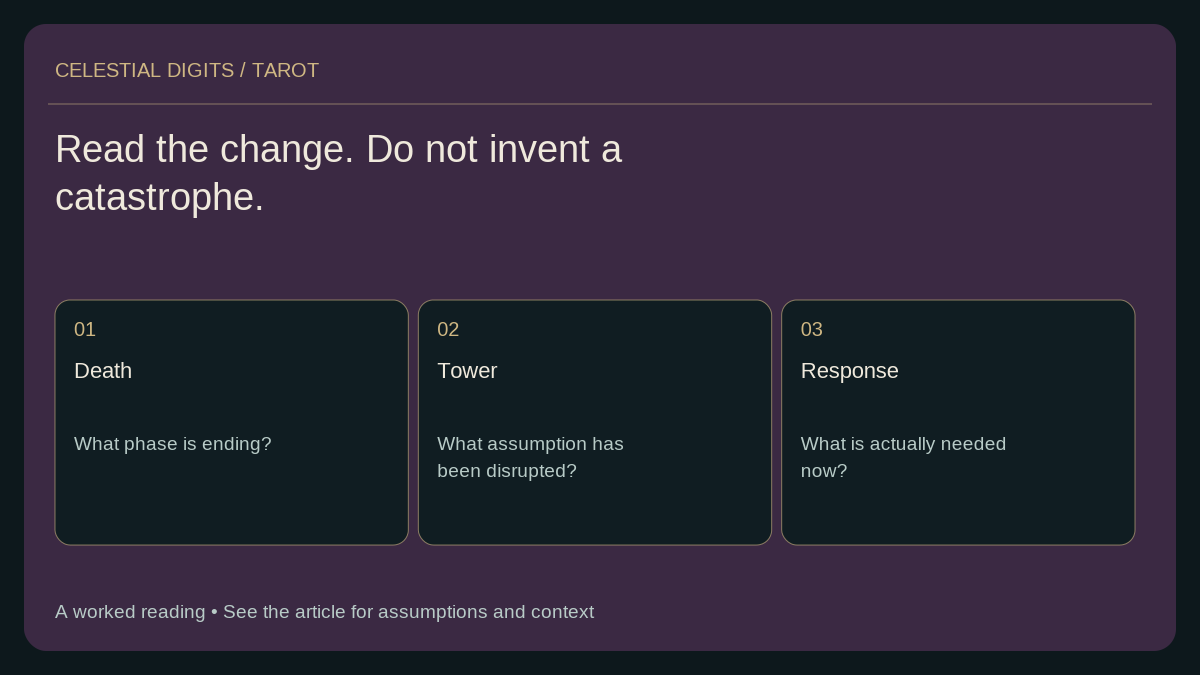
Death vs The Tower: Endings, Disruption and What Comes Next
Compare two often-feared tarot cards through project examples, separating symbolic change from literal predictions of disaster.
A little more perspective.
Keep discussions respectful. No harassment, hate, sexual content or spam. Comments are reviewed before publication. Report concerns from a comment menu, or contact [email protected].
Checking your session…