
The Magician and The High Priestess: Acting vs Listening First
Use a worked project example to compare visible action with attentive observation, without treating intuition as proof or activity as progress.
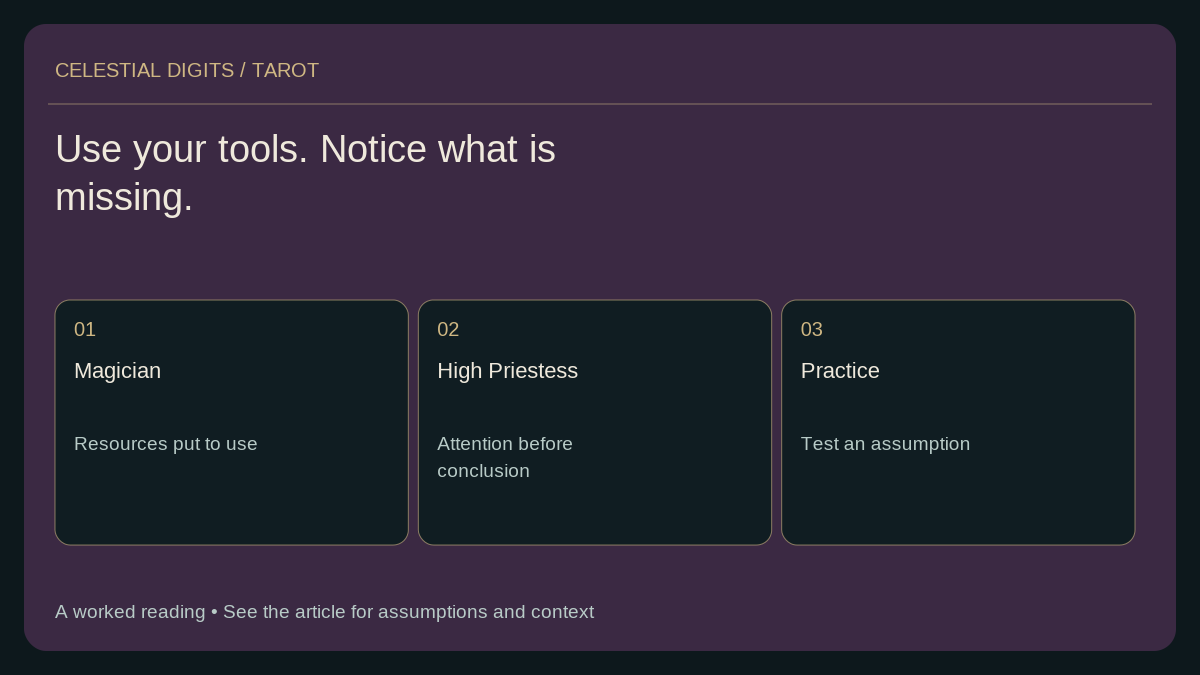
The Magician and the High Priestess can look like opposites: one visibly acts, while the other sits in stillness. In a useful reading, they describe complementary questions. What can I do with the resources available? What do I need to understand before deciding what to do?
Neither action nor waiting is automatically wiser. The situation and the card's position determine the question worth asking.
Start with the visual evidence#
The Rider–Waite–Smith Magician stands before a table bearing the suit emblems, with one hand raised and the other directed downwards. The image readily supports a discussion of attention, available tools and bringing an intention into practice.
The High Priestess sits between contrasting pillars with a partly concealed scroll and a veil behind her. The image introduces thresholds, partial disclosure and knowledge that is not immediately available. It does not prove that a reader can discover another person's secrets.
A workshop example#
Imagine Arun wants to run a weekend drawing workshop. In a deliberately constructed two-card exercise, the Magician represents “What can I use now?” and the High Priestess represents “What needs closer attention?”
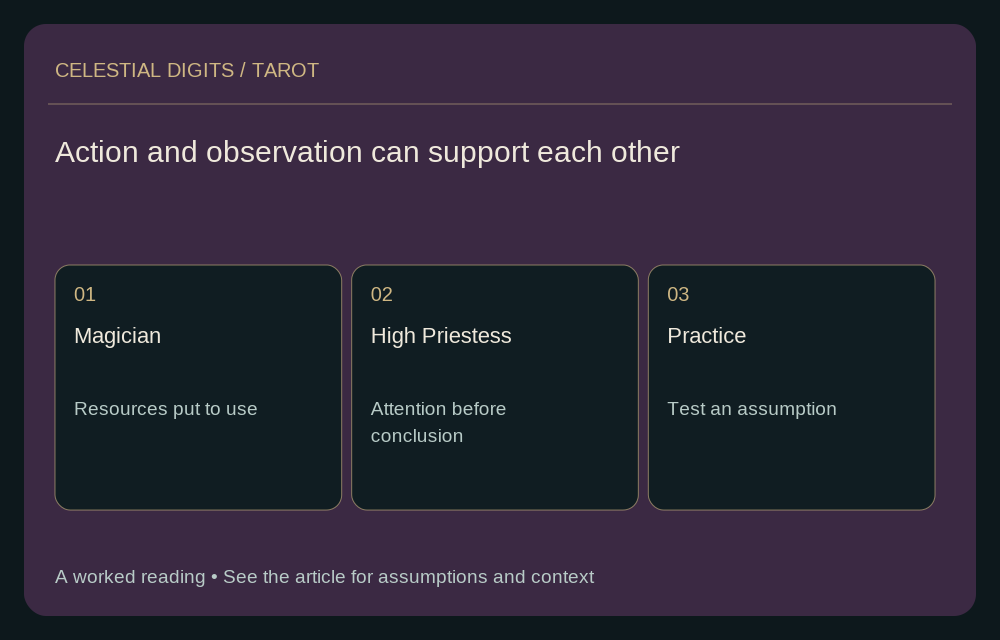
The Magician points towards existing materials, teaching experience and a possible venue. A useful next step is to prepare a short sample lesson. The High Priestess asks what is still unknown: who the workshop is for, what participants expect and whether the proposed format suits them.
The combined reading is not “Manifest the workshop and trust everything.” It is “Use what you have to test an idea, while listening carefully to the people it is intended to serve.”
Compare the two failure modes#
| Emphasis | Useful expression | Possible imbalance to investigate |
|---|---|---|
| Action and tools | Make a small working prototype | Perform confidence without checking assumptions |
| Observation and reserve | Gather relevant information | Delay indefinitely while waiting for certainty |
These are possibilities, not diagnoses. Someone may have a good reason to wait: unavailable space, limited time or missing information. Another person may already have enough information and need a modest first attempt.
Intuition is not the same as evidence#
An impression can be worth noticing without being treated as established fact. If Arun feels participants may prefer a shorter session, he can ask them. If he suspects a collaborator is withholding something, the card does not confirm deception; a direct, respectful conversation is more appropriate.
This distinction is especially important when reading about relationships. The High Priestess should not become a licence to claim knowledge of someone else's private thoughts.
Reverse the positions#
Put the High Priestess in “What helps?” and the Magician in “What challenges?” The reading may now explore whether Arun is speaking before listening or making the presentation more elaborate than the underlying lesson. Swap them again and the emphasis changes.
The meaning comes from the relationship between image, position and question. It is not a fixed instruction stored inside the card.
One useful action after the reading#
Create a two-column note: “Known and usable” and “Unknown and relevant.” Choose a small action using the first column that helps answer one question in the second. For Arun, a short trial session could do both.
Read how to ask useful tarot questions and combining two cards.
Historical reference#
Waite describes the Magician and the High Priestess in his account of the deck's symbolism. The workshop, comparisons and practical exercise are our contemporary interpretation, not claims that tarot can verify hidden facts.
Related Posts
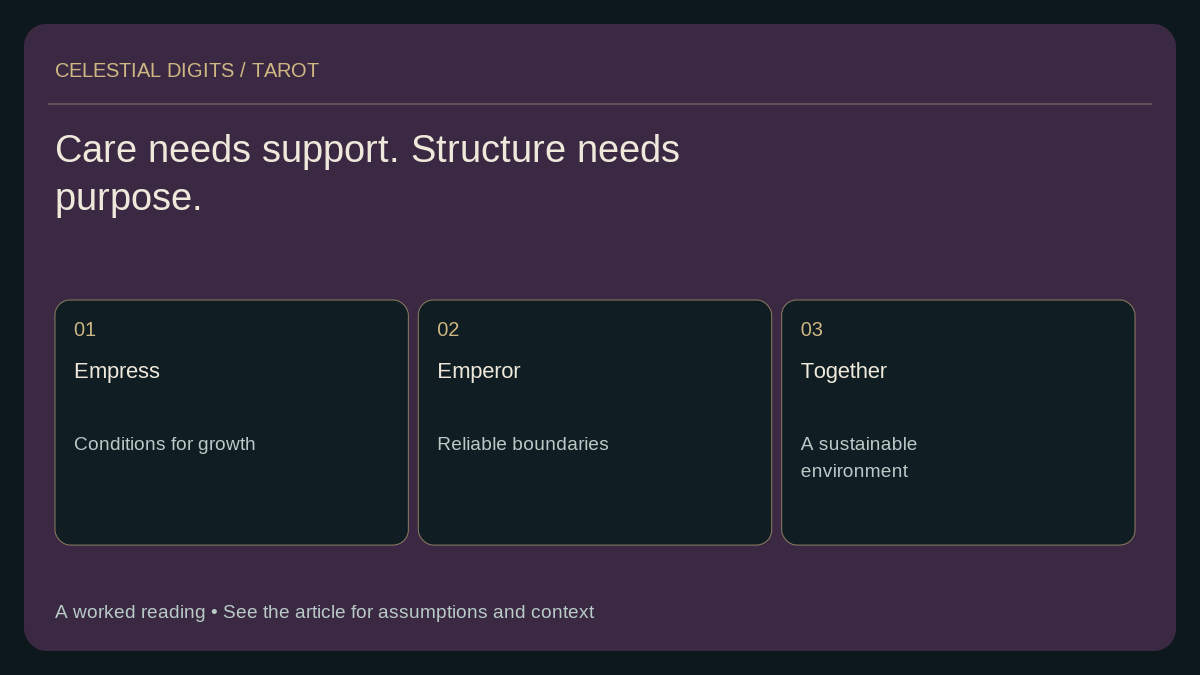
The Empress and The Emperor: Care, Structure and Their Imbalances
Compare nurture and structure through a community-garden example, with questions for reading both cards beyond gender stereotypes.
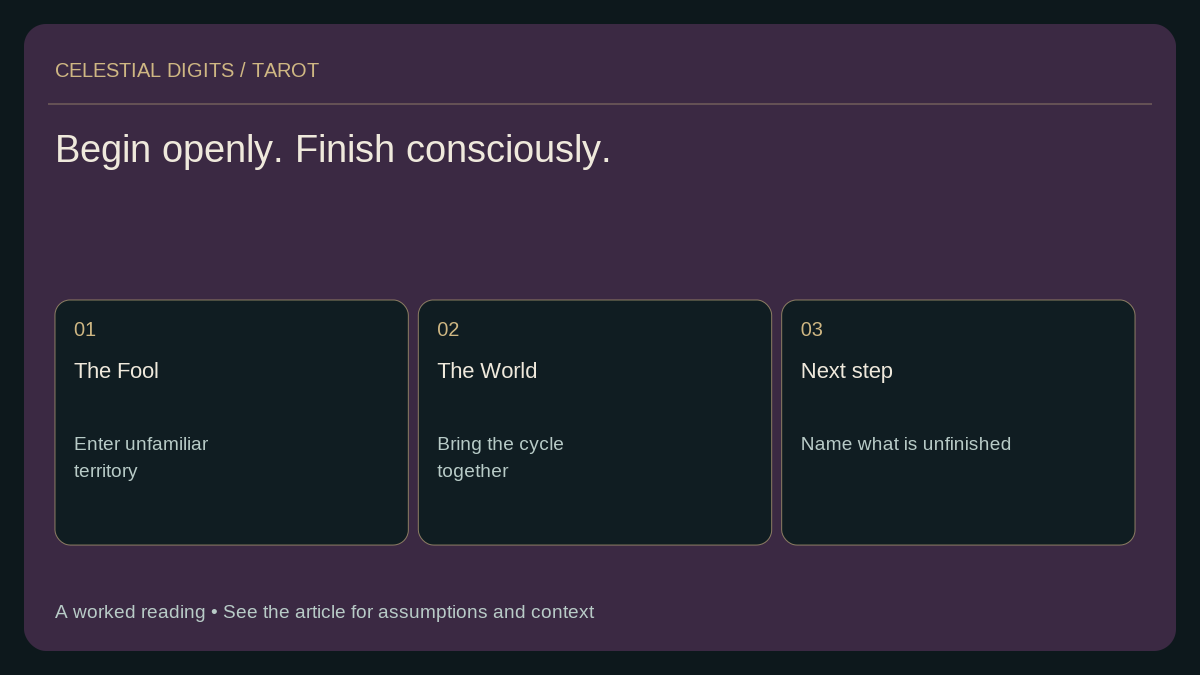
The Fool and The World: Beginning a Journey vs Completing One
Compare two Major Arcana cards through a practical project example, and learn why openness and completion ask different questions.
Judgement: Reviewing the Past Before a New Commitment
Read the Judgement card through a practical review exercise: evidence, responsibility and a chosen next commitment rather than doom or a verdict.
A little more perspective.
Keep discussions respectful. No harassment, hate, sexual content or spam. Comments are reviewed before publication. Report concerns from a comment menu, or contact [email protected].
Checking your session…