
The Hanged Man: When Pausing Is Different from Giving Up
Use a stalled creative-project example to distinguish a purposeful pause, a new perspective and indefinite postponement.
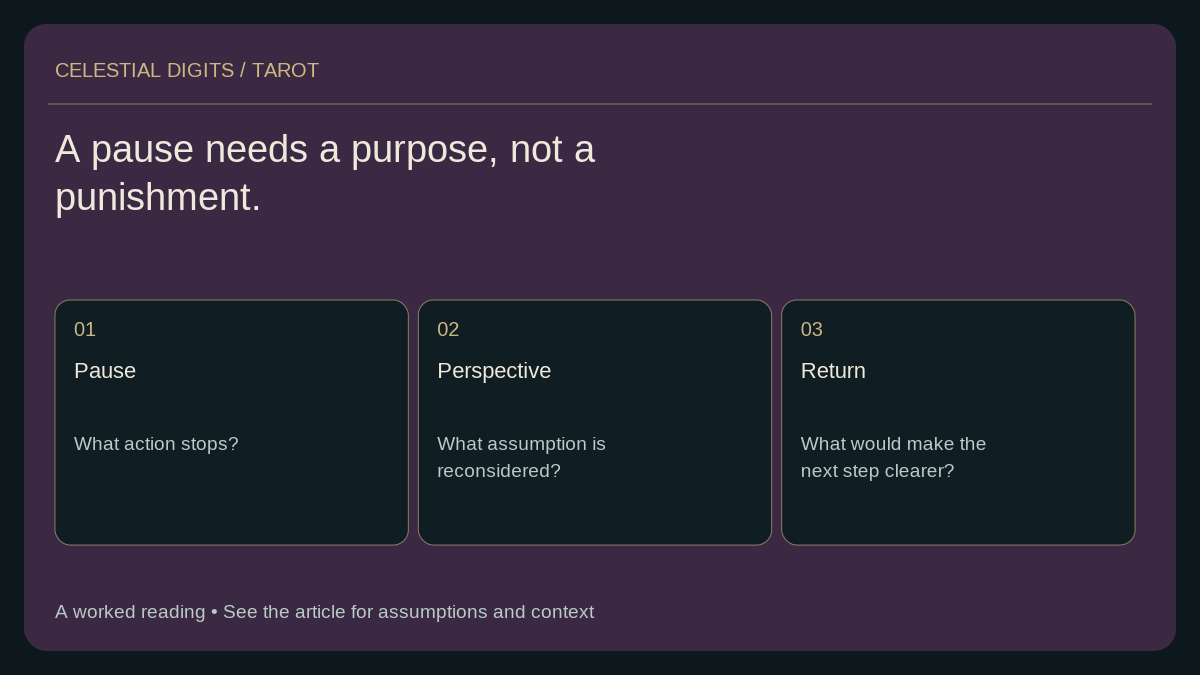
The Hanged Man is often read as waiting, surrender or a change of perspective. Those words can be useful, but they can also become vague instructions to remain stuck. A purposeful pause differs from giving up because it has a question, a boundary or a reason to return.
The card should not be used to romanticise suffering or tell someone that they must accept an unhealthy situation.
Look at the suspended figure#
In Rider–Waite–Smith imagery, the figure hangs by one foot, with a calm expression and a halo. Waite emphasises suspension rather than a simple scene of punishment. Contemporary reflective readings often use the unusual viewpoint to discuss seeing a situation differently.
That does not mean every delay is meaningful or that waiting will automatically reveal an answer. The reading needs the context of the actual question.
A stalled design example#
Imagine a designer keeps revising a poster without resolving its cluttered layout. In a constructed reading, the Hanged Man appears in “What approach is no longer helping?”
The useful pause may be to stop adjusting colours and reconsider the assumption that every piece of information must appear at the same size. Looking at the poster from the audience's perspective could reveal that the main message has no clear priority.
| Unfocused waiting | Purposeful pause |
|---|---|
| Stop because the task feels difficult | Stop a specific unhelpful action |
| Hope clarity arrives by itself | Ask a defined question |
| Avoid setting a return point | Choose a review condition |
The difference is not moral worth. It is whether the pause helps the person understand what to do next.
What surrender can mean here#
In this example, surrender means releasing the insistence that the current approach must work. It does not mean abandoning all agency, tolerating mistreatment or accepting a reader's authority over the decision.
The designer might remove an element, ask for feedback or start a simpler draft. The change of perspective produces a testable action rather than a mysterious command to wait.
When the card appears as a challenge#
The question may be whether the person is postponing a decision without gathering new information. Alternatively, they may be refusing to pause despite repeated evidence that the method is failing. These are opposite possibilities, so ask rather than assume.
A card cannot establish which explanation is true. The person's observations and constraints matter more than a memorised keyword.
A short exercise#
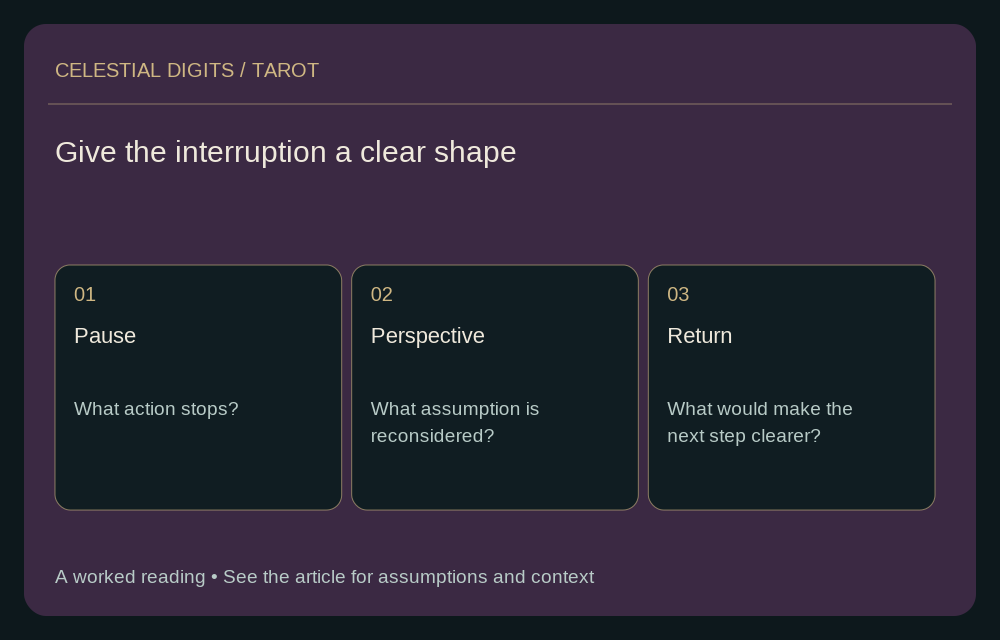
Complete three sentences: “I will stop doing…”, “I need to reconsider…”, and “I will review this when…”. Keep the review condition realistic and within your influence where possible.
If the pause has no useful purpose, a small next step may be better. If important information is genuinely unavailable, acknowledge that uncertainty instead of inventing an answer.
Continue with the Hermit and Four of Swords and the three-card decision spread.
Historical reference#
Waite's Pictorial Key to the Tarot supplies the historical image and account. The design scenario and pause exercise are our contemporary teaching interpretation, not a claim that the card controls the timing of events.
Related Posts
The Celtic Cross Explained Through One Complete Example
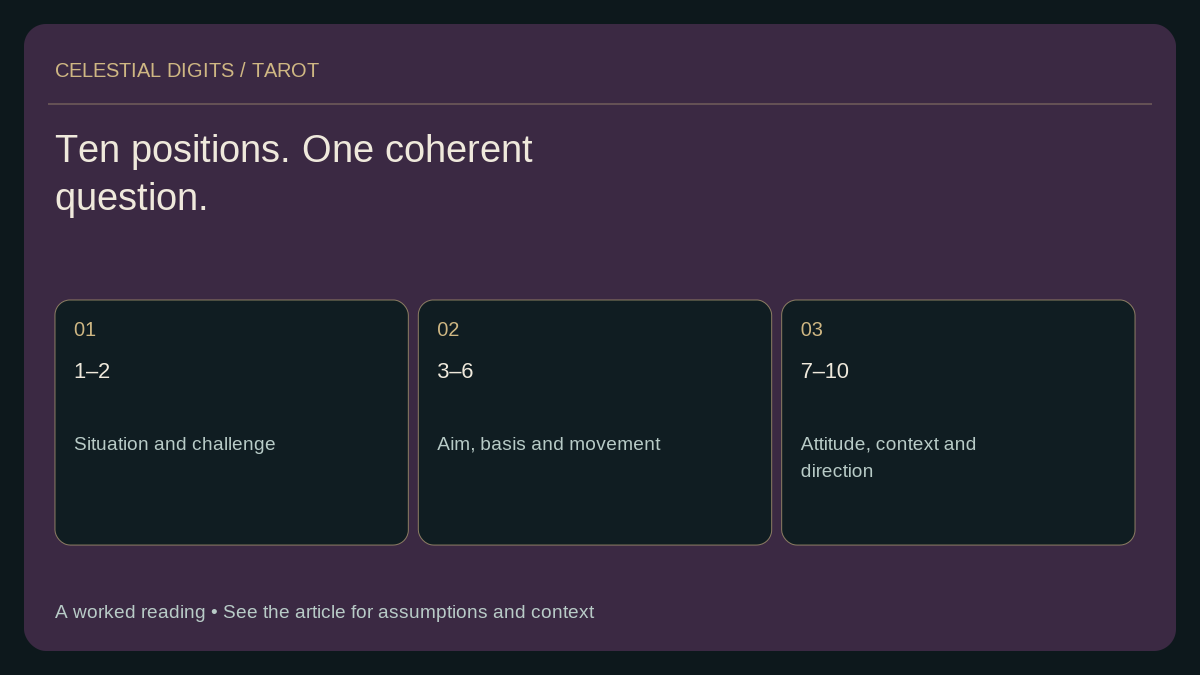
Follow all ten Celtic Cross positions in a fictional creative-project reading, then combine the cards into a practical, conditional interpretation.
The Chariot vs Strength: Direction, Persistence and Resistance
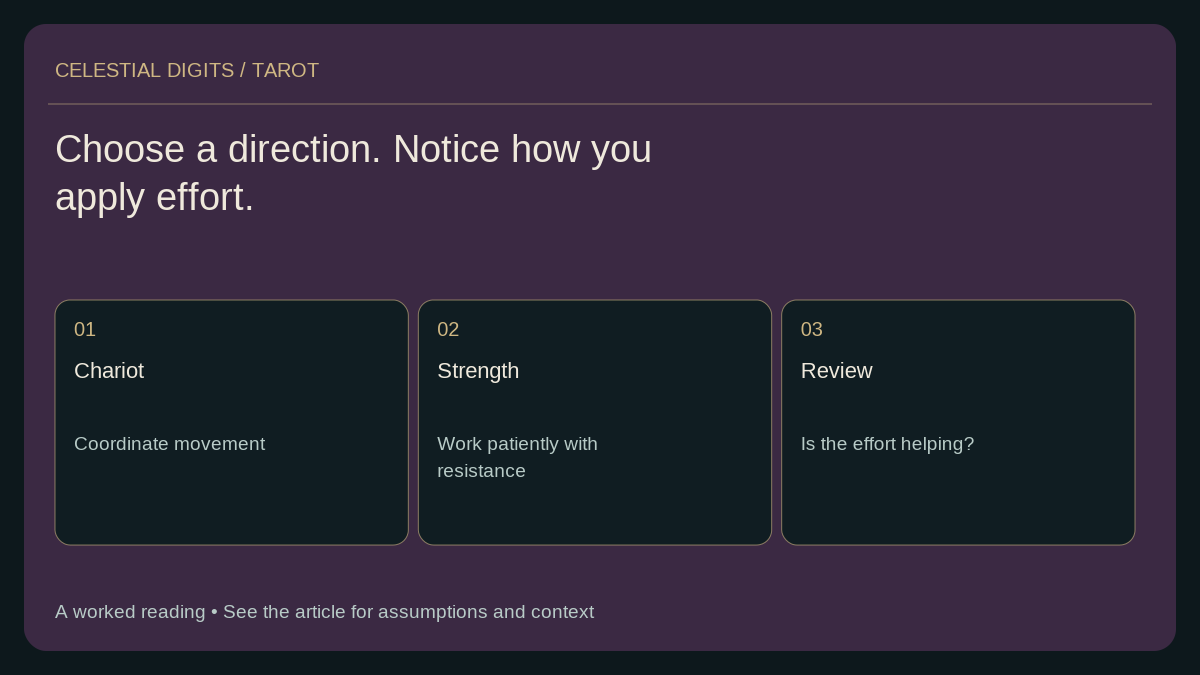
Compare purposeful direction with patient self-regulation through a rehearsal example, without treating either card as a command to push harder.
Death vs The Tower: Endings, Disruption and What Comes Next
Compare two often-feared tarot cards through project examples, separating symbolic change from literal predictions of disaster.
A little more perspective.
Keep discussions respectful. No harassment, hate, sexual content or spam. Comments are reviewed before publication. Report concerns from a comment menu, or contact [email protected].
Checking your session…